【本章提要:社会的基本划分是有权和无权;从组织角度可描述为“权组织+被组织”;权力的强制性主要不是出于强力,而是出于组织的程序性沟通。】
Chapter synopsis: The basic division of society is between have power and powerlessness. From an organizational perspective, this can be described as “the power organization + the been organized”. The coercion of power is not primarily from force, but from the procedural communication of the organization.
我们熟悉的社会一直是以权力划分的二元结构——一元是权力,另一元是无权:统治—被统治、管理—被管理、官—百姓、当局—公众、国家—人民……历史上各种社会的性质不同,这种二元都一样。古代是朝廷和百姓,现代换成代表和被代表者,公仆和人民……本质区别仍是有权和无权。其他的划分——阶级、阶层、等级、集团、族群、强势弱势等,都不如有权无权的划分清楚明了。各种主义和学说无论怎样分歧,也都把权力视为自在的“利维坦”(Leviathan),既要靠它管理民众,又要对其进行驯服,防范它压迫民众。以民主制约权力,出发点也是把权力当作对象进行“监督”、“选举”或“罢免”。在人们观念中,这种分离似乎与生俱来,不假思索。
The familiar structure of our society has consistently been divided into a dualistic structure of power—one with power, the other without: ruler and ruled, manager and managed, official and citizen, authority and public, state and people, etc. The nature of various societies throughout history may differ, but this dualism remains the same. In ancient times, it was the court and the common people; in modern times, it transforms into representatives and the represented, public servants and the populace... The essential difference is still power and powerlessness. Other divisions, like class, caste, rank, groups, ethnicity, strong and weak, etc., are not as straightforward as the division of power and powerlessness. Regardless of the divergence in ideologies and theories, power is universally perceived as a naturally existing "Leviathan." It is both relied upon to govern the people, but also tames it and prevents it from oppressing them. Even in democratic systems designed to constraint power, the indention remains treating power as an object for "supervision," "election," or "removal." In people’s consciousness, this separation seems to be innate and unthinking.
权力自古便是争夺目标,抢到手就成为高踞社会之上的主人。然而权力到底是什么?它不是具体物质,没有实体,却无一不被人时刻感受,无形但有效。有人认为权力是职位。的确,官员一退位,荣耀就烟消云散,原本前呼后拥者立刻投向新官。然而垂帘的慈禧和退休的邓小平都无职位,却是大权在握。
Power has been a goal since ancient times, and if you grab it, you become the master of the society. But what is power? It is not a concrete substance, there is no entity, but it is invariably felt by people all the time, intangible but effective. Some people think that power is the position. Indeed, once the official abdicated, the glory will disappear, and those who once surrounded them immediately shift allegiance to the new authority.However, figures like the influential Dowager Empress Cixi and retired leader Deng Xiaoping held no official positions, yet they still control significant power.
有人说权力源于强力,但是强力不是权力。持枪罪犯迫使受害者服从,不能说实施了权力。权力的强制性无疑包含强力,更多强制却不需要使用强力。如扣工资不是强力,却是强制。日常人们服从权力,主要是服从非强力的强制,甚至不显露强制,服从权力被人当作只能如此的“天经地义”。在这种“天经地义”中,更能看到权力的本质。
It has been said that power derives from force, but force is not power. Armed criminals compelling victims to obey cannot be considered an exercise of power. The coercion of power undoubtedly involves force, but more coercion does not require the force. For example, deducting wages is not force, but coercion. The main thing is to obey the non-forceful coercion, or even not to show coercion, to obey the power as "a matter of course". In this kind of “a matter of course” situation, we can see the essence of power more clearly.
权力存在于组织。无论是国家组织、社会组织,或公司组织、村庄组织,有组织就有管理和被管理,就存在有权无权,以及无需强力也得服从的“天经地义”。强盗与受害者没有组织关系,因而没有权力关系。
Power exists in organization. Whether it is a State organization, a societal organization, a company organization or a village organization, when there is an organization, there is governing and being governed, there is power and powerlessness, and "a matter of course" that must be obeyed without the force. The robber has no organizational relationship with his victim, and therefore no power relationship.
国家之间各为独立组织,权力体系也相互独立。一个国家被另一个国家占领,相当于强盗与受害者的关系,同权力无关。如果占领国在被占国建立了政权,便有了权力关系。若抵抗者不承认,占领政权对其就仍然只是强力。
Countries are independent organizations and have independent systems of power. The occupation of one country by another is equivalent to the relationship between the robber and victim, and has nothing to do with power. If the occupying country establishes a regime in the occupied country, there is a power relationship. If the resisters do not recognize it, the occupying power remains only a force for them.
“天经地义”源于组织成员的同意。这种同意首先是因为人的生存与发展需要组织。权力维系组织运转,是权力的第一要义。如果权力只有对人的管束压迫,人便会脱离组织,权力对其也就不复存在。人们容忍压迫,说明组织带来的好处大于压迫的坏处。
"The matter of course" stems from the agreement of the members of an organization. This agreement initially arises from the human organizing needs for survival and development. The primary purpose of power is to sustain the functioning of the organization which is the foremost imperative of power. If power is only about constraining and oppressing people, they would detach themselves from the organization, and power over them would cease to exist. The fact that people tolerate oppression means that the benefits brought about by the organization outweigh the drawbacks of oppression.
当然,人若没有选择离去的自由(如奴隶),就更多是因为强力的强制了。
Certainly, when individuals lack the freedom to choose to leave (as in the case of slavery), their compliance is often more a result of coercive force.
组织理论一般把组织分为他组织和自组织。经典定义是:组织在形成过程中没有外界的特定干预的为自组织,否则是他组织。
Organization theory generally divides organizations into hetero-organization and self-organization. The classic definition is: an organization is considered self-organization if it forms without specific external intervention, otherwise, it is hetero-organization.
人是社会动物,会自发形成组织。自发组织的初始往往是自组织—没有外来指令,参与者直接沟通协商,没有压迫和强制,是人们出于自身利益需要的自愿结合。利益受损,人就会离开。因此自组织状态下人们彼此平等,相互认同。
Humans are social animals and have a natural tendency to spontaneously form organizations. The initial formation of a spontaneously organized group is often self-organization,there are no external directives, participants communicate and negotiate directly, and there is no oppression or coercion. It is a voluntary association driven by individuals' self-interest and needs. If interests are harmed, people may choose to leave. Therefore, in a state of self-organization, individuals perceive each other as equals and mutually recognize one another.
以自组织和他组织分类会遇到如下问题:一是最初的他组织是如何产生的?例如是在人类学家描述的从血缘族群发展到国家组织,自组织在哪个环节变成了他组织?最初的外界干预是什么?他组织又怎么会在后来登上统治地位?二是自组织发展到一定规模需分出子组织(次级组织)。子组织往往由母组织推动和调控,运转也受母组织干预,因此子组织符合他组织的定义。那么由这种子组织组成的母组织还算自组织吗?这后一个问题已经包含了对前一个问题的一种回答——他组织可以由自组织演变形成。
To classify by self-organization and hetero-organization would encounter the following problems: First, how did the initial hetero-organization emerge? For example, in the anthropological description of the development from kinship groups to state organizations, at which link did self-organization become hetero-organization? What was the initial external intervention? And how did hetero-organization later ascend to the dominant position? Second, self-organization develops to a certain scale and needs to divide into sub-organizations (secondary organizations). Sub-organizations are often driven and regulated by the parent organization, and their operation is also interfered by the parent organization, so sub-organizations meet the definition of hetero-organization. Then, is the parent organization composed of such sub-organizations still a self-organization? This latter question already contains a kind of answer to the former question—hetero-organization can evolve from the self-organization.
他组织的概念对本文要做的分析并不实用,因为很难相信今日还存在没有外界干预的组织。即便是边远地区的村民自发合作,也受到国家法令、政府政策乃至村干部的干预。在这层意义上便几乎没有不属于他组织的组织,以其分析会失之笼统。
The concept of other-organization is not very useful for the analysis that this article wants to do, because it is hard to believe that there are still organizations that are not interfered by external forces today. Even the spontaneous cooperation of villagers in remote areas is subject to the intervention of state laws, government policies, and even village cadres. In this sense, there are hardly any organizations that do not belong to other-organization, and the analysis based on it would be too general.
本文提出一个“权组织”概念——实施权力的组织。典型的权组织是由官员和官僚组成的政府。企业、学校、机构也各有其实施权力的系统。各种权组织之间不一定直接从属(除非整个社会被全能型专制权力控制),但最终在国家权力的框架内,各种权组织共同构成二元社会的权力元。
Here introduces the concept of a "power organization", an organization that implements power. A typical power organization is a government composed of officials and bureaucrats. Businesses, schools, and institutions also each have their own systems for implementing power. The various power organizations are not necessarily directly subordinate to each other (unless the society as a whole is controlled by an all-powerful authoritarian power), they ultimately operate within the framework of national power, collectively constituting the power element of the dualistic society.
任何他组织的内部都有权组织,可以把他组织分解为“权组织”和“被组织”。“被组织”指的是由“权组织”对无权者进行组织,看似组织起来的无权者在本质上仍是无组织(一离开权组织即会显现为无组织)。把他组织分解为权组织和被组织,有助于体现组织内部的二元关系。
Any other-organization has an internal power organization, which can decompose the other-organization into a “power organization” and a “been organized”. The “been organized” refers to the organization of the powerless by the “power organization”. The seemingly organized powerless are still unorganized in essence (they will appear as unorganized as soon as they leave the power organization). Decomposing the other-organization into a power organization and a been organized helps to reflect the dualistic relationship within the organization.
他组织定义所说的“组织受外界干预”可以这样看——发出干预的是外界的“权组织”,接受和贯彻外界干预的是组织内部的“权组织”。当组织受外界“权组织”干预时,即是该组织的权组织接受“被组织”,再由该组织的“权组织”对组织内部完成“被组织”。
The definition of other-organization says that “the organization is interfered by external forces”. This can be seen as follows: the external force that intervenes is the “power organization” outside, and the one that accepts and implements the external intervention is the “power organization” inside the organization. When the organization is interfered by the external “power organization”, it means that the power organization of the organization accepts the “been organized”, and then the “power organization” of the organization completes the “been organized” for the internal part of the organization.
由此看自组织也会更明确——只要是自组织,就没有权组织,也不是被组织。一旦自组织内出现权组织,自上而下进行被组织,自组织就不再是自组织。按此标准,当前社会规模稍大的正式组织都不可能是自组织。
This makes self-organization more clear—as long as it is self-organization, there is no power organization, nor is it been organized. Once a power organization appears within the self-organization, and carries out the been organized from top to bottom, the self-organization is no longer self-organization. According to this criterion, formal organizations with a slightly larger scale in the current society are unlikely to be self-organizations.
“权组织+被组织”是二元社会的基本关系,社会从整体到局部皆如此。权组织是自上而下的倒树结构,结构的每个节点皆对上接受指令,对下发布指令,将无组织的无权者组织起来。
“Power organization + been organized” is the basic relationship of a dualistic society, which is the case from the whole to the part. Power organization is a top-down inverted tree structure, where each node accepts instructions from above and issues instructions to below, organizing the unorganized powerless.
权组织内部也是被组织,自上而下,形成逐层扩大的金字塔。上级是其下级的组织者,下级被上级所组织,再去组织更下级,而无权者的被组织由权组织的基层官员具体实现。基层以上的权组织层级,除了制定决策,主要是为了管理权组织自身,使其成为贯彻权力意志、让无权元实现被组织的有效机器。而权组织的层级主要是出于权力自身沟通的需要。
The power organization is also been organized internally, from top to bottom, forming a pyramid that expands layer by layer. The superior is the organizer of its subordinate, the subordinate is organized by the superior, and then organizes the lower level. The been organized of the powerless is specifically implemented by the grassroots officials of the power organization. The power organization level above the grassroots, besides making decisions, is mainly for managing the power organization itself, making it an effective machine to implement the will of power and let the powerless achieve the been organized. And the level of the power organization is mainly for the communication needs of the power itself.
权力分立的社会并非由一个权力金字塔自上而下统治,并列的权组织相互竞争制衡,但社会总体仍然是“权组织+被组织”的结构。
A society with separation of powers is not ruled by a single power pyramid from top to bottom, but by parallel power organizations that compete and balance each other. However, the overall structure of the society is still “power organization + been organized”.
权力存在于组织,沟通是组织的基本特征和基本活动,是组织的基础,因此也是权力的基础。本文只从这个角度讨论沟通。
Power exists in organization, and communicating is an essential feature and a fundamental activity of organization, the basis of organization and therefore of power. This article discusses communication only from this perspective.
沟通在自然界和人类社会都是无所不在、时刻发生的。当一个群体形成了常规的程序化沟通,便有了组织的性质。
Communication is ubiquitous and occurs all the time in both nature and human society. When a group develops routine programmed communication, it takes on the nature of an organization.
如果群体中人们各自分头沟通,从排列组合看,任何一人可能与其他人(包括其他人的不同组合)发生的关系数(且不说具体内容),等于2的n-1次方减1(2n-1-1),即每增加一人,群体可发生的人际关系数约增加一倍。9人是255;20人是524,287,为 9人的2,048倍;50人约为56万亿(5.6294995e+14),为20人的一亿倍以上……因此群体达到一定规模,各自分头沟通便无法做到,必须以固定、集中、合并的程序化沟通进行简化,群体才能共同行动和相互协作。沟通包括信息、反馈、管道三个方面,所谓的程序化沟通主要体现于管道的安排与固化上。用各种沟通管道搭建成将群体纳入其中各司其职的结构,即为组织。
If people in a group communicate separately, from the perspective of permutation and combination, the number of relationships (not to mention the specific content) that any one person may have with others (including different combinations of others) is equal to 2n-1-1, that is, for every additional person, the number of interpersonal relationships that the group can have increases by about twice. For 9 people, it's 255; for 20 people, it is 524,287, which is 2,048 times that of 9 people; for 50 people, it is about 56 trillion (5.6294995e+14), which is more than 100 million times that of 20 people…. Therefore, when the group reaches a certain size, it is impossible to communicate separately, and it must be simplified by fixed, centralized, and merged programmatic communication, so that the group can act and cooperate together. Communication includes three aspects: information, feedback, and channel. The so-called programmatic communication is mainly reflected in the arrangement and solidification of the channel. The structure that incorporates the group into it and assigns each its own role with various communication channels is the organization.
权力体现于对这种管道的掌控,通过开放某些管道,堵塞另一些管道而控制沟通,既能统一决定群体的共同行动,又能分别决定群体成员的不同处境。这种沟通结构即为权组织。由权组织沟通无权者,便是无权者的被组织。
Power is manifested in the control of these channels, by opening some channels and blocking others to control communication, which can both unify the decision of the group’s collective action and determine the different situations of the group members. This communication structure is the power organization. The communication of the powerless by the power organization is the been organized of the powerless.
权力到底是什么?本文不去梳理已有的诸多理论,只从沟通角度认识权力。
What is power? This article will not go through the many theories that exist, but will only recognize power from a communication perspective.
设想一公司有某个被多数同事厌恶的小人,某天钻营得逞被董事会任命为总经理,尽管他一点也没变,人们立刻就得服从他。变化源于哪里?表面是总经理的职位,但职位的作用要放在沟通背景上理解。总经理是公司沟通结构上的枢纽,不管由谁担任,公司的各条信息沟通管道都交汇其上,这是由组织结构确立和保证的。
Imagine a company has a villain who is hated by most of his colleagues. One day, he succeeds in his scheming and is appointed as the general manager by the board of directors. Even though he hasn’t changed at all, people have to obey him immediately. Where does the change come from? On the surface, it is the position of the general manager, but the role of the position has to be understood in the context of communication. The general manager is the hub of the communication structure of the company. No matter who holds it, all the information communication channels of the company converge on it. This is established and guaranteed by the organizational structure.
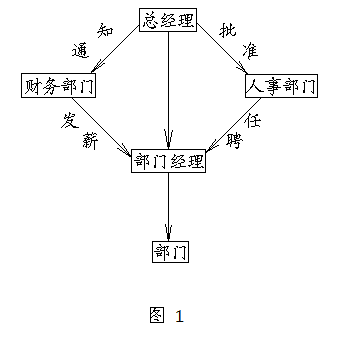
以聘任一个部门经理为例,假设流程如图1:
As an example, suppose the process of hiring a department manager is as in Figure 1:
正常程序是:人事部门按总经理的要求选择对象,总经理批准后正式聘任;财务部门从总经理处得到给受聘者发薪的指令;财务部门并不知道公司需要什么样的人,也不必知道。哪怕总经理结党营私安插了一个马屁精,财务部门见到指令也得照发工资。而人事部门虽然清楚公司所需的人才,没有总经理同意,再合适的人也无法聘用,因为财务部门不按人事部门指令发工资。假设人事部门通过直接沟通说服了财务部门,超越总经理聘任了更称职的部门经理。受聘者上任的部门是否接受其领导?公司其他部门又是否与其配合?一步程序的破坏如同电路“短路”,会造成诸多错乱。
The normal procedure is: The human resources department selects candidates according to the requirements of the general manager, and formally hires them after the approval of the general manager; the finance department receives the instruction from the general manager to pay the salary to the hired person; the finance department does not know what kind of person the company needs, nor does it need to know. Even if the general manager nepotistically appoints a sycophant, the finance department has to pay the salary according to the instruction. Although the human resources department knows clearly what kind of talent the company needs, without the consent of the general manager, no matter how suitable the person is, they cannot be hired, because the finance department does not pay the salary according to the instruction of the human resources department. Suppose the human resources department convinces the finance department through direct communication, and hires a more competent department manager beyond the general manager. Will the department where the hired person takes office accept his or her leadership? And will the other departments of the company cooperate with him or her? The destruction of one step of the procedure is like an electrical “short circuit”, which will cause many disorders.
退到底,就算公司各方在私下沟通后都接受了人事部门聘的部门经理,与其配合,等于全体员工共同废黜了总经理,那样即使公司内部可以运转,与公司外部的沟通也会有问题。本需通过总经理之法人地位对外衔接的组织关系、经济合同、银行贷款、供货进货等……既得不到法律认可,也得不到客户信任。
In the end, even if all parties of the company accept the department manager hired by the human resources department and cooperate with him or her after private communication, it is equivalent to all employees jointly dismissing the general manager. In that case, even if the company can operate internally, there will be problems with the communication with the outside world. The organizational relationships, economic contracts, bank loans, supply and purchase, etc. that need to be connected with the outside world through the legal status of the general manager… will not only fail to obtain legal recognition, but also fail to gain customer trust.
至此,各部门仍不得不服从总经理——从这个例子可以看到权力与沟通的关系,以及权力的“天经地义”之所在。
At this point, all departments still have to obey the general manager - from this example, we can see the relationship between power and communication, and the source of the “matter of course” of power.