【本章提要:追求个人意志的满足是人的基本性质,正义则是所有社会成员对这种追求的平等节制——即不扭曲他人的个人意志。只有自组织状态下个人意志的向量求和能实现这种平等的节制。】
Chapter synopsis: The pursuit of the satisfaction of the individual will is the basic nature of the human being, and justice is the equal restraint of all members of society on this pursuit, that is, without distorting the individual will of others. Only the vector summation of individual will in a self-organization state can achieve this kind of equal restraint or constraint.
历史上的当权者尽管以君权神授、奉天承运为自己确立合法性,压制挑战,仍然避免不了权力争夺。对于神授说,血统最重要,让外人最少有挑战的资格。然而血缘内照样争权。同一血统,神到底把权力授予谁就变得没那么确定。这时另一种标准——正义与否就被当做合法性根据。血缘之外的人更是只能以正义为名才可取而代之。正义用天和神是解释不清的,因为谁都可以如此自我加冕。既然权力体现为统治,而统治对象是人民,正义与否就只能归结到权力给人民带来幸福还是痛苦。
The power holders in history, despite establishing their legitimacy with the divine right and the mandate of heaven, and suppressing challenges, still could not avoid the struggle for power. For the divine right theory, bloodline is the most important, making outsiders have the least qualification to challenge. However, there is still power struggle within the bloodline. With the same bloodline, it is not so certain who God grants power to. At this time, another standard, "justice or no", is used as the basis of legitimacy. People outside the bloodline can only replace it in the name of justice. Justice cannot be explained by heaven and God, because anyone can crown themselves like this. Since power is manifested as rule, and the object of rule is the people, the justice depends only on whether power brings happiness or misery to the people.
这除了是逻辑,也是功利。当权力争斗势均力敌,最终胜负往往就在民众的选择。因为从沟通角度,能否沟通顺利取决于被沟通对象的配合,进而决定权力的有效性。在只有一个权力体系统治时,民众没有其他选择,看上去似乎顺从,但只要出现选择,民众作用便会立时凸显。权力除了其所把持的沟通,其实一无所有,资源和兵源都只能利用沟通取之于民。当民众有了选择,自然会向得民心的一方倾斜,使其沟通得到扩展,由弱变强,失民心一方则反之。孟子对此种功利得失算得清楚 ——“得道者多助,失道者寡助。寡助之至,亲戚畔之。多助之至,天下顺之。以天下之所顺,攻亲戚之所畔,故君子有不战,战必胜矣。”正是这种民众定胜负的力量,使权力争夺者总是打出为民争权的旗号,反过来当权者也要表明自己爱民。权力对“民可载舟亦可覆舟”的利用与担忧,演化成民为上的正义观。
This is not only logic, but also utilitarianism. When the power struggle reach a stalemate, the final victory or defeat often lies in the choice of the people. Because from the perspective of communication, whether communication can proceed smoothly depends on the cooperation of the object of communication, and then determines the effectiveness of power. When there is only one power system, the people have no other choice and seem to be obedient, but as soon as there is a choice, the role of the people will immediately become prominent. Power has nothing but the communication it holds, and resources and troops can only be obtained from the people by using communication. When the people have a choice, they will naturally lean towards the side that gains their favor, expand their communication, and become stronger from weak. Conversely, the side that loses public support experiences the opposite. Mencius was clear about this utilitarian calculus, stating, "Those who gain the Way have many helpers; those who lose the Way have few helpers. When one has few helpers, even close relatives turn against him. When one has many helpers, all under heaven follow him. Hence, the ruler who has the support of all under heaven attacks those who go against their close relatives. Therefore, a nobleman may have a reason not to fight, but when he fights, he will surely win." It is this power of the people to determine victory and defeat that prompts power contenders to always claim to fight for the people, and conversely, those in power to emphasize their love for the people. The utilization and concern of power over "the people being able to carry the boat but also capsize it" evolve into a sense of justice where the people are prioritized.
几乎每个社会都存在民为上的正义观,然而 “民”的概念在中国比较抽象,更接近伦理。西方出于个人主义, “民”被视为个人的集合,正义观从个人出发,发展出引领西方政治理论数百年的契约论。契约论去掉统治者的天道和神授光环,将其降格为契约执行人。霍布斯指出君主的任务是保护人民的生命安全;洛克进一步提出权力须经人民同意,以不可剥夺的个人权利为政府权力划定边界。卢梭更是提出人民主权为最高权力。在契约论中,个人是主体,是形成国家的基础,国家只是用于实现个人权利。对契约论的批评认为其虽是有说服力的价值观和解释方法,却无法具体操作——大规模人民无论如何不可能真的相互签订和执行契约,因此契约论只能作为一种虚构的比喻。人民是一个类似政治神学的空泛概念,离不开代表者,极权主义便可以趁机以人民代表的名义登堂入室。马基雅维利和霍布斯的理论被极权主义利用还容易理解,因为他们的着眼点就是期盼透过强大政府的管控,避免一切人对一切人的战争。而“公意”变成极权主义的口实却非卢梭本意。作为彻底且激进的民主先驱,卢梭被极权统治者供奉于庙堂,正是因为缺少操作方法,越漂亮的理论越可被极权者当作华丽外衣。
Almost every society holds a sense of justice where the people are prioritized. However, the concept of "the people" in China is relatively abstract and closer to ethics. In the West, influenced by individualism, "the people" are seen as a collection of individuals, and the sense of justice originates from individuals, leading to the development of contract theory that has guided Western political thought for centuries. Contract theory removes the divine and bestowed aura from rulers, reducing them to executors of contracts. Hobbes pointed out that the task of the monarch is to protect the life and safety of the people; Locke further proposed that power must be consented to by the people, outlining the boundaries of government power with inviolable individual rights. Rousseau, in particular, introduced the concept of popular sovereignty as the highest power. In contract theory, the individual is the subject and the foundation of the formation of the state, and the state is only used to realize individual rights. The criticism of the contract theory believes that although it is a persuasive value and explanation method, it cannot be operated concretely, that's large-scale mutual agreements and execution of contracts among people are simply not feasible. Thus, contract theory is considered a fictitious metaphor. The term "the people" is a vague concept similar to political theology and cannot be realized without representatives. Totalitarianism can then exploit the notion of representing the people to establish control. It is easy to understand that the theories of Machiavelli and Hobbes are used by totalitarianism, because their focus is to hope to avoid the war of all against all through the control of a powerful government. However, the transformation of "public opinion" into a pretext for totalitarianism is contrary to Rousseau's original intent. As a thorough and radical pioneer of democracy, Rousseau is deified by totalitarian rulers precisely because of the lack of practical methods. The more elegant the theory, the more it can be used as a splendid coat by authoritarian leaders.
卢梭、洛克都谈到人民可以推翻违反契约的统治者或祸害人民的政府(这种人民权利被写进后来的美国独立宣言),以此作为保证契约的根本手段。但同样卡在操作上。当统治者一口咬定自己代表人民时,那个宏大壮丽的人民在哪呢?如何听到他们的声音以及确认他们对政府的不满呢?更别说人民如何才能把推翻政府的权利从伦理层面转到具体实现。因此,必须找到实实在在的正义,而非仅有契约的抽象意念,才能让极权主义从其窃取的外衣下现形。
Rousseau and Locke both talked about the people’s right to overthrow the ruler or government that violates the contract or harms the people (this kind of people’s right was written into the later American Declaration of Independence), as a fundamental means to guarantee the contract. But they also got stuck in the operation. When the ruler insists that he represents the people, where is the magnificent people? How to hear their voice and confirm their dissatisfaction with the government? Not to mention how the people can turn the right to overthrow the government from the theoretical level to the concrete realization. Therefore, we must find real justice, not just the abstract idea of contract, in order to expose totalitarianism from the coat it stole.
其实只需从契约再往前追溯一步,便能在沟通的坚实地面让正义扎根。沟通和契约没有矛盾,但二者有顺序的先后。沟通在前,是形成契约的前提和基础,无契约可以有沟通,但是无沟通一定不会有契约。说契约而不说沟通是本末倒置,注定是无法操作的意象。霍布斯描述的社会契约和卢梭描述的公意都如空中楼阁,看着美妙,却不知如何形成,以及在现实中存身何处,因而成为极权者任意编造的玩物。从沟通入手却不同。沟通是不能被代表的,因为沟通是实实在在的存在,人人对其一目了然。契约的制定需要沟通,契约实现的前提也是沟通。若真能充分沟通,人民自然会成为实体,而没有相应的沟通,人民只能是空洞概念,自称的“人民代表”更不可能真实。仅此一点,便可戳穿那些想方设法限制民众沟通的专制者,暴露出其是人民公敌的面目。
In fact, just taking one step back from the concept of contracts allows justice to be firmly rooted in communication. Communication and contracts are not contradictory, but they follow a certain order. Communication comes first, which is the prerequisite and foundation for forming contracts. While communication can exist without contracts, the reverse is not true. To talk about contracts without mentioning communication is to invert the natural order, and it is doomed to be unworkable imagery. The societal contract described by Hobbes and the public will described by Rousseau are like castles in the air, which look wonderful, but do not know how to form, and where to exist in reality, thus becoming the plaything of the totalitarian fabrication. Starting from communication is different. Communication cannot be represented, because communication is a real existence, and everyone can see it clearly. The formulation of the contract requires communication, and the realization of the contract also requires communication. If we can communicate fully, the people will naturally become entities, and without corresponding communication, the people can only be empty concepts, and the so called “people’s representatives” are even more impossible to be true. Just this point, we can expose those who try to restrict the communication of the people, and reveal their face as the public enemy of the people.
如罗尔斯(John Rawls)所说“正义是社会制度的首要德行”, 契约是为了实现正义。没有正义,人类不会有和平,社会也不会有安宁。正义是一切思想首要解决的题目。而从沟通入手,让契约从理念变成现实,才能让正义切实立足,实现契约理论家的理想。
As John Rawls said, “Justice is the first virtue of social institutions”, and contract is for the realization of justice. Without justice, there will be no peace for mankind, and no tranquility for society. Justice is the first problem to be solved by all thoughts. And by starting from communication, making the contract from an idea into a reality, we can make justice stand on a solid ground and realize the ideal of contract theorists.
明确了从沟通入手,还需继续向前追溯,找到沟通的正义基础是什么,以及达成正义的沟通应从哪里起步?在沟通起点就找到正义,才能通过沟通过程达成正义。
To clarify, starting with communication is a good approach, but it is necessary to continue tracing back to what is the justice basis of communication, and where should the communication that achieves justice start from? Finding justice at the starting point of communication is essential to achieve justice through the communication process.
这节题目犯了“宏大叙事”之忌,却不能不谈,因为寻求正义需要针对人的本性。社会正义是满足社会成员的共同本性,平等是这种满足的前提。这又涉及什么是平等,以及如何衡量平等的实现。由权力推行平等会丧失自由,只能通过民主实现平等。而自由和民主又与人的本性分不开,因此无论如何需要回答人的本性是什么,以及如何满足的问题。
The title of this section is a taboo on "grand narratives", but it cannot be avoided, because seeking justice requires addressing human nature. Societal justice is to satisfy the common nature of social members, and equality is the prerequisite for this satisfaction. This also involves what is equality, and how to measure the achievement of equality. Imposing equality by power will lose freedom, and equality can only be achieved through democracy. And freedom and democracy are inseparable from human nature, so we need to answer what human nature is and how to satisfy it anyway.
诸多关于自然法的讨论于此都有论述。对于本文,只需一个凭常识可理解的结论就够——人的基本性质即是不断追求自身更好的生活。
Many discussions of natural law have been discussed here. For the purposes of this article. For this article, only a common-sense conclusion is enough, that is, the fundamental nature of human beings is to constantly pursue a better life for themselves.
这虽是一句白话,其中每个词都要界定。首先什么是“更好”?不同人对好坏的判断别如天壤,但肯定没人把饥饿、寒冷或生病视为更好。在基本生存温饱尚未满足时,每一点客观条件的改善——食物增多、住房改善、安全加强——都是非常明确的更好,且有量的确定。即使人已温饱,在以物质满足为基本价值的社会,更好的含义也相当明确——国民生产总值、劳动生产率、人均收入、福利指标、就业率……“增长”就是“更好”。衡量个人的更好则是工资额、消费额、住房面积、寿命、存款数等。在物质的世界,“更好”始终从物质角度衡量。
This is a plain sentence, but every word needs to be defined. First of all, what is “better”? Different people have different judgments of good and bad, but no one would regard hunger, cold or illness as better. When the basic survival needs are not met, every improvement of the objective conditions, like more food, better housing, stronger security, are very clear better, and have quantitative determination. Even if people are well-fed, in a society that takes material satisfaction as the basic value, the meaning of better is also quite clear, like gross national product, labor productivity, per capita income, welfare indicators, employment rate… “Growth” is “better”. The measure of personal better is wage, consumption, housing area, life span, savings, etc. In the material world, “better” is always measured from the material perspective.
但是人有精神世界,随着温饱满足,精神愈来愈变得广阔和有主导性。一旦进入精神世界,“更好”就失去共性,判断也变得模糊。人和人的追求各不相同。有些观点力图把这些千差万别归结到经济基础与后天实践一类客观差异,然而精神是文化发展的造物,远不是仅仅反映客观的镜子。在人的基本性质中,“生活”一词所指内容也会发生质的变化。当人的精神属性超过物质属性时,“更好”就不能单纯用物质衡量,“意义”成为更重要的来源。
But people have a spiritual world, and with the satisfaction of basic material needs, like food and clothing, the spirit needs becomes more and more expansive and dominant. Once in the spiritual world, "better" loses its commonality and judgment becomes blurred. People have different pursuits. Some views try to attribute these differences to objective differences such as economic foundation and acquired practice, but spirit is the product of cultural development, and it is far from being a mirror that merely reflects the objective. In the basic nature of human beings, the content of the word “life” also undergoes qualitative changes. When human’s spiritual attributes surpass material attributes, “better” cannot be measured by material alone, and “meaning” becomes a more important source.
这时会出现一个矛盾,当人以意义为生活目标时,会表现出超越自我的舍己和为他,人的基本性质中的“自身”二字似乎就站不住脚了。献身者、苦行者、自找苦吃的冒险家们孜孜以求的献身、苦行和险境难道是“更好”吗?那些为他人牺牲的人是为“自身”吗?虽然那种人只是少数,但哪怕只有一个人与“不断追求自身更好生活”的性质违背,就可以证伪人的基本性质。
This is a contradiction, when people take meaning as their life goal, they will show self-transcendence and self-sacrifice for others, and the word “self” in the basic nature of human beings seems to be untenable. Are the dedication, asceticism and danger that the devotees, ascetics and adventurous people seek tirelessly “better”? Are those who sacrifice for others for “themselves”? Although such people are only a minority, even if only one person contradicts the nature of “constantly pursuing a better life for themselves”, it can falsify the basic nature of human beings.
对这个疑问,边沁(Jeremy Bentham)的“自利选择原理”和马斯洛(Abraham Harold Maslow)的“需求层次理论”都可解释。但是用本文使用的概念——“个人意志”解释会更符合本文的逻辑。这里避开哲学层面的讨论和定义,只在常识意义上使用意志概念——广义上,意志是人依照拥有的条件自觉地确定目标、支配行动、实现愿望的精神驱动过程。意志由判断、目标、决定(选择)组成。意志的活动过程往往先是由判断感受到不满,继而树立追求的目标,做出决定,通过行动达到目标以得到满足。采用“个人意志”的概念,可以给人的基本性质中的“更好”找到更普适的定义——“更好”即是个人意志得到满足。
For this question, Jeremy Bentham’s “principle of self-interest choice” and Abraham Harold Maslow’s “hierarchy of needs theory” both can explain. But using the concept of “individual will” used in this article will be more consistent with the logic of this article. Here I avoid the discussion and definition of the philosophical level, and only use the concept of will in the common sense sense. In a broad sense, the will is the spiritual driving process of people consciously determining goals, controlling actions, and realizing desires according to the conditions they have. Will consists of judgment, goal, decision (choice). The activity process of will is often first to feel dissatisfied by judgment, then to set up the goal of pursuit, make a decision, and achieve the goal through action to get satisfaction. Using the concept of “individual will”, we can find a more universal definition of “better” in the basic nature of human beings, i.e. “better” is the satisfaction of individual will.
不同个人意志追求的“更好”可以不同,但那“更好”会使他们的个人意志获得满足却人人相同。因而与其说人是在追求“更好”,不如直接说成是在追求个人意志的满足。当人们追求从艺术创作到总统职位或美满家庭那些各不相同的目标时,最终要得到的其实是彼此相同的精神满足。因此,“更好”的本质不在具体目标的实现,而是个人意志得到满足。
Different individual wills may pursue different “better”, but the “better” that makes their individual wills satisfied is the same for everyone. Therefore, instead of saying that people are pursuing “better”, it is better to say that they are pursuing the satisfaction of individual will. When people pursue different goals from artistic creation to presidential position or happy family, what they ultimately want is actually the same spiritual satisfaction. Therefore, the essence of “better” is not in the realization of specific goals, but in the satisfaction of individual will.
这不仅适用于人的精神追求,也适用于人的物质追求。一个人的饥饿尽管是生理感觉,却传递到他的意志中,使生理要求同步成为意志要求。吃饱即是个人意志满足,“更好”即得到实现。而当人企望拥有高级时装或豪车游艇时,更是出自意志而非生理。
This applies not only to human’s spiritual pursuit, but also to human’s material pursuit. A person’s hunger, although it is a physiological feeling, is transmitted to his will, making the physiological demand synchronized with the will demand. Being full is the satisfaction of individual will, and “better” is achieved. And when people aspire to have high-end fashion or luxury cars and yachts, it is more from will than physiology.
引进个人意志的概念,可以把人当作能动的精神体对待,而非当作只有本能反应的生物。人的基本性质——“人不断追求自身更好的生活”,由此可描述为——“人不断追求个人意志的满足”。后面这个定义是本文所有逻辑的起点。
By introducing the concept of individual will, we can treat human beings as active spiritual beings, rather than as creatures that only have instinctive reactions. The basic nature of human beings, “people constantly pursue a better life for themselves”, can thus be described as “people constantly pursue the satisfaction of individual will”. The latter definition is the starting point of all the logic in this book.
人的基本性质中的“自身”一词已经包含在“不断追求个人意志的满足”中,因为“个人意志”只能属于“自身”,因此人不断追求的“更好”只能是为自身“更好”。虽然对个人意志而言,“更好”并不局限于物欲满足,有时甚至要付出牺牲。但哪怕是舍己为他,从个人意志的角度来说,也是在追求其个人的满足(信仰或原则)。人同时有肉体生活和精神生活,两种生活都有对“更好”的追求,有时相同,有时可能不同。当理想、信仰或道德伦理一类的精神追求成为个人意志的主导部分,即成为人判断自身生存状况和树立目标的主要依据时,人对肉体“更好”的追求就会下降到从属地位。如果肉体的“更好”与精神的“更好”发生冲突,尽管他们不会把肉体痛苦或牺牲生命当作享受,但若为肉体背叛理想,放弃精神追求,却会是更大的痛苦。以个人意志的满足权衡,就可能宁愿接受肉体折磨甚至死亡,也不愿放弃精神的“更好”,去陷入心灵的苦闷与沉沦。这也就是边沁所说的:什么是快乐、什么是痛苦,每个人自己最清楚。“更好”的具体内容可以截然不同,献身、牺牲、痛苦都能在一定文化根基上成为“更好”,但“为自身更好”是人人相同的,且不会改变。因为“更好”的具体内容只是人的基本性质所施加的对象,“为自身更好”则是人的基本性质本身。
The word “self” in the fundamental nature of human beings is already included in the “constant pursuit of the satisfaction of individual will”, because “individual will” can only belong to “self”, so the “better” that people constantly pursue can only be for the “better” of themselves. Although for individual will, “better” is not limited to material satisfaction, sometimes even requires sacrifice. But even if it is selfless for others, from the perspective of individual will, it is also pursuing its personal satisfaction (faith or principle). People have both physical and spiritual lives, and both have the pursuit of “better”, sometimes the same, sometimes different. When spiritual pursuits such as ideals, beliefs or moral ethics become the dominant part of individual will, that is, the main basis for people to judge their own living conditions and set goals, people’s pursuit of physical “better” will decline to a subordinate position. If the physical “better” conflicts with the spiritual “better”, although they will not regard physical pain or sacrifice of life as enjoyment, but if they betray their ideals for the body, give up their spiritual pursuits, it will be a greater pain. Weighing by the satisfaction of individual will, they may prefer to accept physical torture or even death, rather than give up the spiritual “better”, and fall into the misery and degeneration of the soul. This is what Bentham said: what is happiness, what is pain, everyone knows best. The specific content of “better” can be completely different, dedication, sacrifice, pain can become “better” on a certain cultural basis, but “for the better of oneself” is the same for everyone, and will not change. Because the specific content of “better” is only the object of the fundamental nature of human beings, “for the better of oneself” is the fundamental nature of human beings itself.
有了个人意志的概念,人的基本性质中的“不断”一词也就不难解释。意志是活动和变化的过程,如果不树立新的目标,过程便会失去延伸的可能。这就是人总是不满、求变、喜新厌旧的原因所在。“更好”只有在尚未实现时才是“更好”,一俟变成现实,即使“好”也没有了“更”。“更”总是在前面,因此追求“更好”便只能“不断”。这可以看出人的基本性质存在一个悖反——追求满足却又永远得不到最终满足。正是在这种悖反中,人的基本性质产生出永恒张力,把追求变为无止境的过程,成为推动社会不断发展的动力。
With the concept of individual will, the word “constantly” in the fundamental nature of human beings is not difficult to explain. Will is a process of activity and change, and if no new goals are set, the process will lose the possibility of extension. This is why people are always dissatisfied, seek change, and like new and dislike old. “Better” is only “better” when it has not been realized, and once it becomes a reality, even if it is “good”, there is no “better”. “Better” is always in front, so the pursuit of “better” can only be “constant”. This shows that there is a paradox in the fundamental nature of human beings, i.e. pursuing satisfaction but never getting the ultimate satisfaction. It is in this paradox that the fundamental nature of human beings produces eternal tension, turning pursuit into an endless process, and becoming the driving force for the continuous development of society.
动物有满足,人没有满足。曾经二者大同小异,都没有房子,不穿衣服。但是今天猪仍然是猪,吃饱了就睡,而人建立了联合国,登上了月球。不断的不满导致不断的进步,使得人类越饱暖越奔忙,越富有越贪婪,越探索越无知,越加速发展越恐惧落后。可以说,今天人类拥有的一切,归根结底都出自人的基本性质,包括剥削、专制、欺诈、相互残杀等丑恶事物,也是人的基本性质所驱动。
Animals have satisfaction, humans do not. Once they were similar, they had no houses, no clothes. But today pigs are still pigs, they sleep when they are full, while humans have established the United Nations, landed on the moon. Constant dissatisfaction leads to constant progress, making humans more busy as they are more warm and full, more greedy as they are more rich, more ignorant as they explore more, more fearful of falling behind as they accelerate development. It can be said that everything that humans have today, ultimately comes from their fundamental nature, including exploitation, tyranny, deception, mutual killing and other ugly things, which are also driven by their fundamental nature.
在现实中,个人意志并未显示为完整一体,而是分别针对不同的具体事项,存在着不同的具体意志,可称“个别意志”;一个人总是同时并存许多个别意志,其个人意志是由所有个别意志合成的。那种合成不是简单的迭加,而是一种向量求和。
In reality, individual will does not appear as a complete whole, but rather exists as various different specific wills for different specific matters, which can be called “particular wills”; a person always has many particular wills simultaneously, and his individual will is composed of all particular wills. That composition is not a simple addition, but a vector sum.
与只有大小的数量不一样,向量有大小又有方向。向量求和除了对大小求和,同时也对方向求和。例如某人反感警察对其进行违章罚款的个别意志,与其抱怨交通秩序混乱的个别意志,二者向量求和的结果不会是选边站,而会因为有了对方向的求和形成兼顾。虽然仍是追求自身的更好,却会得到更高视角,从就事论事的层次提升到追求较全面的“更好”。
Unlike scalars that only have magnitude, vectors have both magnitude and direction. Vector summation involves not only adding magnitudes but also combining directions. For instance, an individual may have a particular will expressing displeasure towards being fined by the police for a traffic violation, and another expressing frustration with disorderly traffic. The result of vector summation of these two particular wills is not a matter of choosing sides but rather a synthesis that considers both directions. Although they are still pursuing their own betterment, they will gain a higher perspective, from the level of dealing with things as they are to the level of pursuing a more comprehensive “better”.
每个人对个别意志的向量求和是可以在其头脑中自发完成的,虽然那过程不一定被其意识,也不一定显现。现实中很多情况下,当事人针对不同事项的态度显得矛盾甚至分裂,既不能清楚表达自己到底要什么,更不知道应该舍什么,完全看不出存在着向量求和。一般而言,多数人只知道自己所针对具体事项的个别意志,不知道自己的完整个人意志。但是却不等于完整的个人意志不存在。人在说不清楚自己到底要什么的时候,往往是因为无法决定舍什么,或者说因为什么都不想舍。然而人总是会知道在每件事上自己不要的是什么,那就足以进行个别意志的向量求和了。只要当其面对现实必须做出选择时,到底要什么和宁愿舍什么便会在其不要什么的迫使下变得明确起来,完成向量求和。其实那种向量求和的结果(即完整的个人意志)在此之前已经存在,只是没有变成当事者清楚的自我意识而已。
The vectorial summation of everyone's particular wills can be accomplished spontaneously in their mind, even though this process may not necessarily be conscious or evident. In many real-life situations, individuals may exhibit contradictory or fragmented attitudes toward different matters, struggling to clearly express what they truly want or what they are willing to sacrifice. The vector summation may not visible at all. Generally, most people are aware of their particular wills regarding specific matters but may not be conscious of their complete individual will. But it does not mean that the complete individual will does not exist. When people can’t clearly say what they really want, it is often because they can’t decide what to give up, or in other word they don’t want to give up anything. Yet, individuals usually know what they don't want in each situation, which is sufficient for the vector summation of particular wills. When faced with the necessity of making choices in reality, what one truly wants and is willing to sacrifice becomes clearer under the pressure of what one does not want, completing the vector summation. In reality, the result of that vector summation, i.e., the complete individual will, already exists; it just hasn't become clear self-awareness for the individual involved.
完整个人意志既然是个别意志的向量和,一定比参与求和的个别意志中性、均衡,更乐于看到多赢,因此更为理性。还因为现实事项林林总总,旧去新来,时刻变化,多变量造成的复杂性决定了当事人不可能完全预测与控制。与“无知之幕”相类似——当没人能确定自己在所有事上都会占优势,便会导致“最大化最小值规则” (maxi-mini rule,即让处在最不利地位者最大化在该地位可能得到的利益) 的向善趋向。当然有相反情况。那种自信可以在所有事项都占优势的人(往往因为把持权力、财富或暴力),其处处霸凌或算计他人的个别意志通过向量求和,形成的个人意志从整体上也是恶的,即通常形容的“坏人”(其人性善往往只体现于诸如对自己孩子的那类个别意志上)。但因为把持权力、财富或暴力的人只能是少数,社会进步的方向最终还是由多数人的向善决定。这是后话。
Since the complete individual will is a vector sum of particular wills, it must be more neutral and balanced than the particular wills involved in the summation, more willing to see a win-win situation, and therefore more rational. Additionally, the complexity arising from the myriad of real-life situations, the constant influx of new variables, and ever-changing circumstances renders it impossible for individuals to predict and control everything. Similar to the 'veil of ignorance' concept—when nobody can be certain they will have an advantage in all situations—it leads to a benevolent inclination toward the 'maxi-mini rule' (maximizing the benefits for those in the least advantageous position). Of course, the opposite scenario exists as well. Individuals who are confident in having an advantage in every situation (often due to holding power, wealth, or violence) can have a individual will formed by the vector summation of their bullying or calculating particular wills, resulting in an overall malevolent disposition, commonly described as a 'antagonistic villain' (their inherent goodness often only evident in particular wills, such as those involving their own children). However, since those who hold power, wealth, or violence are typically a minority, the direction of societal progress is ultimately determined by the benevolence of the majority. This is a topic for another discussion.
明白个人意志是个别意志的向量和,就会得出一个重要结论——个人意志是不可被分割的。因为针对具体事项的个别意志在与其他个别意志进行向量求和后,会被修正、相抵、甚至舍弃,所以单独抽出某人的某个个别意志,宣称就是其个人意志,必然是不准确或偏激的。如果再扩展到以众人皆有这种个别意志,因而宣称是民众的意志,偏离就会更大。即使人们针对具体问题的确表达了那种个别意志,却不是完整的个人意志。例如单独针对私人汽车,多数人当然愿意自己的车更大更好,反对燃油提价和增加税费,但不能认为那就是民众对私人汽车的整体态度,因为人们同样希望有好的空气,安宁的环境,以及留给后代未遭毁坏的生态。将人们的所有个别意志向量求和后,结果一定会对私人汽车的发展有所节制,做出不同的选择。
Understanding that the individual will is a vector sum of particular wills leads to an important conclusion—the individual will is indivisible. Because the particular will for specific matters will be corrected, offset, or even discarded after vector summation with other particular wills, it is inevitably inaccurate or biased to isolate one’s a particular will and claim it as their individual will. If extended to the notion that everyone possesses such particular wills and, therefore, claiming it as the will of the people, the deviation would be even greater. Even if people do express that kind of particular will for specific issues, it is not the complete individual will. For example, when it comes to private cars, most people certainly want their cars to be bigger and better, oppose fuel price increases and tax increases, but it cannot be assumed that this is the public’s overall attitude towards private cars, because people also hope to have good air, a peaceful environment, and an ecology that has not been destroyed for future generations. After summing up all particular wills, the result would inevitably impose constraints on the development of private cars and make different choices.
因此,看待个人意志必须是在向量求和后的完整形态下,不能被向量求和前的个别意志所迷惑。尤其要防范那种对众人特定个别意志的抽取,再在民主的旗号下进行迭加,当做合法性。善意解释,那是因为迄今的民主方法只能数量求和,只有抽取针对相同问题的个别意志,才能简化为可统计的数量;从坏的方面考虑,那种为我所用的抽取很多情况下其实是对民主的故意扭曲和操纵。
Therefore, the consideration of individual will must be based on its complete form after vector summation, without being misled by particular wills before the summation. It is especially important to guard against the extraction of specific particular wills from the general public and then, under the banner of democracy, presenting them as legitimate. An optimistic interpretation suggests that this is because current democratic methods often only allow for quantitative summation, and extracting particular wills related to the same issue is a simplification for statistical purposes. From a less optimistic perspective, such extraction is, in many cases, a deliberate distortion and manipulation of democracy for their gains.
人是社会性的,个人意志中的大部分内容是针对人与人的关系。强调人的基本性质是追求个人意志的满足,目的不在重复人性恶的老调,而是把人的为己当作天然属性。没有这属性,社会便无规律可循,找不到构建依据。包括什么是正义也会变得茫然。因为人若是为他而不为己,其所为的他人也是为他而不为己,那种为他便是人家不需要的。而为己若是被视为恶,为他者去为为己者,就成了善对恶的付出,意义何在便成了问题。而从满足个人意志的角度,却可以同时容纳为己和为他,避免寻求正义的困惑——恶不在为己,只在损人,不损人的为己不是恶,若能在为己同时有益他人,就是善。
Humans are social beings, and much of individual will pertains to social relationships between people. Emphasizing that the fundamental nature of humans is the pursuit of satisfaction in individual will is not to repeat the cliché of human nature being inherently evil, but rather to consider self-interest as a natural attribute. Without this attribute, society would have no rules to follow and could not find a basis for construction. Even what is justice would become confused. If individuals act for others and not for themselves, and those acting for others are doing so for someone else and not for themselves, the act of doing something for others becomes redundant. And if self-interest is seen as evil, for others to go for those who are for themselves, it becomes a virtuous for evil, and the meaning becomes a problem. However, from the perspective of satisfying individual will, it can accommodate both self-interest and others, avoiding the confusion of seeking justice—evil is not in self-interest, only in harming others, self-interest that does not harm others is not evil, and if it benefits others simultaneously, it is the virtuous.
这就涉及到个人意志的平等和边界。对于同一个人,其个人意志针对不同事项的向量既有方向不同,也有大小之分——主次、轻重、缓急……是可以不同的。但是在人与人之间,财富权势有大小,个人意志却无大小。每个人的意志都是完整的世界,是唯一的,基本的,不可替代的,都要追求个人意志的满足。在这一点上每个个人意志都是一样,没有任何区别。这种平等可被视为天赋人权。
This brings us to the equality and boundaries of individual will. For the same person, the vectors of their particular wills regarding different matters not only have different directions but also differences in magnitude—priorities, significance, urgency, etc., can vary. However, among individuals, while wealth and power may differ in size, individual will does not have a size. Each person's will is a complete world, unique, fundamental, irreplaceable, and everyone seeks satisfaction in their individual will. In this aspect, every individual will is the same, without any distinction. This kind of equality can be seen as an inherent human right.
当人组成社会时,共处的个人意志需按照这种平等保持彼此边界,既不构成对其他个人意志的侵犯,也不遭受其他个人意志的侵犯。边界即是一种节制。所谓的平等从抽象进入现实,只有在构成相互关系时体现,个人意志的边界也只有在与他人共处中才能找到。
When individuals come together to form a society, their coexisting individual wills should maintain boundaries in accordance with this equality—neither constituting an infringement on others' individual wills, nor nor suffering an infringement from other individual wills. Boundaries serve as a form of regulation or constraint. The so-called equality, from abstract to reality, is only manifested when forming mutual relationships, and the boundaries of individual wills can only be found in coexistence with others.
自由不是不受限制,人不能飞,不能不吃,不能穿墙而过,都是限制。最重要的节制是人与人之间形成边界。意志没有边界会趋向发散无序,不断分裂,从而找不到自己。而在人与人的共处中选择所要与所舍,形成彼此的边界,知道节制在哪里,才会由节制的界定形成明确的个人意志,找到自己。
Freedom is not without restrictions. People can’t fly, go without eating, or pass through walls, all of which are restrictions. The most important restraint is the boundary formed between people. If the will has no boundaries, it will tend to diverge and become disordered, constantly splitting, and thus unable to find sense of self. But in the coexistence of people, choosing what to want and what to give up, forming each other’s boundaries, knowing where the restraint is, will form a clear individual will defined by restraint, and find sense of oneself.
自由一定有边界也需要节制,但节制应该对所有人相同,不能一些人节制,一些人放纵。在这个意义上,平等就是人人有同样的节制。节制与控制不同。控制是自上而下的,有主宰,靠强制,控制者与被控制者之间自然无平等。节制是出于自我,非他者施加和强迫的自制。问题在于人们是否会自觉地节制?节制到什么程度?按照什么标准?如果有人不节制又该怎么办?平等的节制虽出于自我,却非靠自觉,而要靠机制的约束。至于机制是什么,如何建立,怎样执行,正是本文要解决的。
Freedom must have boundaries and needs restraint, but restraint should be the same for everyone, not some people are restrained, some people are indulgent. In this sense, equality is that everyone has the same restraint. Restraint is different from control. Control is top-down, has a master, relies on coercion, and there is naturally no equality between the controller and the controlled. Restraint is self-imposed, not imposed or forced by others. The question is whether people will consciously restrain themselves? To what extent is restraint? According to what standard? What if someone doesn’t restrain? Although equal restraint comes from the self, it does not rely on self-consciousness, but on the constraints of the mechanism. As for what the mechanism is, how to establish it, and how to implement it, that is what this article wants to solve.
所有社会成员平等的节制,前提一定是公平正义。如果不是人人平等的节制,就一定是一部分人控制另一部分人,被控制者就不会、也没有理由节制。
The equal restraint of all members of society must be based on fairness and justice. If it is not equal restraint for everyone, it must be a part of people controlling another part of people, and those who are controlled will not, and have no reason to, restrain themselves.
对平等最多的质疑,是它和自由的不相容。要对人与人的千差万别实现平等如何可能?以往从起点、机会或结果等方面解决不了真正的平等,甚至造成权力压迫,在于入手点就是错的。而若抛开千差万别,只从满足人的基本性质——即个人意志满足上寻求平等,便清楚和简单得多。
The most common criticism of equality is its incompatibility with freedom. How is it possible to achieve equality among people who are so different? Past attempts to solve equality from the perspectives of starting point, opportunity, or outcome have not been able to achieve true equality and have even resulted in oppression of power, because the starting point is wrong. However, if we disregard the differences and seek equality only from the satisfaction of people’s fundamental nature, that is, the satisfaction of individual will, it becomes much clearer and simpler.
既然自由不是无限制。只要是被人认可并接受的限制,就不会认为是不自由。个人意志的满足也是如此,没人认为为所欲为才是满足(哪怕皇帝也知道无法摘下太阳当灯用)。既然不能没有节制,人们可以共同接受和认可的节制就是不去扭曲他人的意志——己所不欲勿施于人。如果每个人都有这种节制,就同时保护了自己的意志不受他人意志扭曲。当人们的个人意志都不受他人意志扭曲,便是既实现了平等,又实现了自由。
Indeed, freedom is not without restrictions. As long as the restrictions are recognized and accepted by people, they will not be considered as unfree. The satisfaction of individual will is the same, nobody thinks that doing whatever they wants is satisfaction (even the emperor knows that it is impossible to pick off the sun to use as a lamp). Since there must be restraint, the restraint that people can jointly accept and recognize is not to distort the will of others—do not do to others what you even don't want. If everyone has this kind of restraint, it simultaneously protects their own will from being distorted by the will of others. When people’s individual will is not distorted by the will of others, both equality and freedom are achieved.
全民平等只是在这个意义上——平等的节制。其他方面则既不要求平等,也不可能平等,因为不同的个人意志所追求的满足千差万别,本不该也无法用相同的尺度去衡量。那么平等的节制怎样才能建立呢?
Universal equality is only achieved in this sense—equal restraint. In other aspects, it neither demands nor can achieve equality because the satisfaction pursued by different individual wills varies greatly, and it should not and cannot be measured by the same standard. So, how can the equal restraint be established?
只要置身共同体就有对个人意志的节制,也需要划分与其他成员的边界。当共同体内每个成员都接受与其他成员的边界,认可边界是公平的,愿意遵守,就是平等的节制。
As long as one is part of a community, there is restraint of individual wills, and boundaries with other members need to be defined. When each member of the community accepts the boundaries with others, recognizes them as fair, and is willing to abide by them, it constitutes equal regulation.
在节制个人意志上寻求平等,必须保证共同体是可以充分直接沟通的范围,亦可称“经验范围”;需要经验范围内的所有个人意志共同参与。平等不是外在的规定,而是出自个人意志的自我判断。人的基本性质使得共同体每个成员总是既要扩张自身意志,又要抵制其他成员意志的扩张。人与人的边界就是在这种扩张和抵制扩张下形成的。只有在人与人能够充分直接沟通时,才能让每人都认识到己所不欲勿施于人的公平边界在什么位置。
In seeking equality in the restraint of individual will, it is necessary to ensure that the community is a range that can communicate sufficiently and directly, also known as the “empirical range”; it requires the joint participation of all individual wills within the empirical range. Equality is not an external regulation, but a self-judgment from individual will. The fundamental nature of human beings makes every member of the community always want to expand their own will and resist the expansion of other members’ wills. The boundary between people is formed under this expansion and resistance to expansion. Only when people can communicate sufficiently and directly can everyone recognize where the fair boundary of “do not do to others what you do not want” is.
这种边界不是恒定的,需时刻调整。因为共同体是活的,针对多种变化和选项的公平边界也需是活的才能保持公平。个人意志在此过程既是目的又是手段。做为目的,个人意志知道什么是自己所求的满足;作为手段,唯有共同体内所有个人意志的相互沟通和随时调整能掌握这种动态。
This boundary is not constant and needs to be adjusted at all times. Because the community is alive, the fair boundary for various changes and options also needs to be alive in order to maintain fairness. Individual will in this process is both the purpose and the means. As a purpose, individual will knows what is the satisfaction it seeks; as a means, only the mutual communication and timely adjustment of all individual wills within the community can grasp this dynamic.
仅靠每个成员的自觉建立这种平等节制当然过于理想化,也不能靠外来的控制,而是经验范围内产生一种自生自发的制约:如果有成员试图超越与其他成员之间的平等节制,侵犯或扭曲他人意志,其他成员便会对其采取分头抵制或联合杯葛、直至将其逐出共同体的惩罚(充分直接沟通的协商会使采取的措施和分寸恰到好处)。人加入共同体是因为可以从中得到利益或满足。没人能孤立地存在,当其遭遇的反制对其自身的不利大于其从越界得到的好处时,理性便会使其回到合适位置。
Establishing this kind of equal restraint solely based on the consciousness of each member is of course too idealistic, and cannot rely on external control, but a self-generated constraint within the empirical range: if a member tries to go beyond the equal restraint with other members, infringe or distort the will of others, other members will take separate resistance or joint boycott, until the punishment of expelling it from the community (the negotiation of sufficiently direct communication will make the measures and proportions just right). People join the community because they can benefit or satisfy from it. No one can exist in isolation, when the countermeasures they encounter are more detrimental to themselves than the benefits they get from crossing the boundary, rationality will bring them back to the proper position.
契约论让每人交出权利,委托给主权者,以避免纷争。其实应该相反,不是交出权利,而是所有人始终牢牢把握自己的权利,通过充分沟通以在人人追求个人意志满足的互动中构建平等的节制,才能真正消除纷争。
The social contract theory suggests that everyone gives up their rights and entrusts them to the sovereign to avoid disputes. In fact, it should be the opposite. Instead of giving up rights, everyone should always firmly grasp their own rights. Through sufficient communication, equal restraint can be established in the interaction where everyone pursues the satisfaction of individual will, which can truly eliminate disputes.
至此只说到经验范围内实现平等的节制可以通过自然状态下的己所不欲勿施于人达成。但是对社会而言,更需要解决的是在大范围乃至全社会实现平等的节制。具体用什么方法,将在有关递进自组织的章节谈。
So far, we have only discussed that equal restraint within the empirical range can be achieved through the natural state of “do not do to others what you do not want”. However, for society, what needs to be solved more is to achieve equal restraint in a large-scale or even the whole society. As for what specific methods to use, it will be discussed in the chapter on recursive self-organization.
表面上,个人意志的平等可以体现在数量相等上,如表决的一人一票。但是世间本无一模一样的个人意志,每人对事物都有不同看法,理论上可能指向 360°球面的任何方向,而非只有表决的 yes/no 两个方向。因此,始终需要将个人意志与向量属性捆绑在一起,把不同个人之间通过充分直接沟通寻求平等的合作与节制视为向量求和的过程,达成的结果便是不同个人意志的向量和。
On the surface, the equality of individual will can be reflected in numerical equality, such as one person, one vote in voting. However, there is no exactly the same individual will in the world, everyone has a unique perspective on things, theoretically it can point to any direction of the 360° sphere, not just the yes/no two directions of voting. Therefore, it is always necessary to bind individual will with vector attributes, and regard the process of seeking equal cooperation and restraint through full direct communication between different individuals as the process of vector summation, and the result achieved is the vector sum of different individual wills.
三百年前牛顿提出的平行四边形法则仍能最直观地说明个人意志的向量求和。下图的箭头线段表示向量,长度代表大小,箭头表示方向。从天赋人权的角度,个人意志的大小是一样的,只是方向不同。先以两人的个人意志向量求和为例,两条长度相同、方向不同的线段,其向量和为二者所构成的平行四边形的对角线——对角线的长度为向量和的大小,箭头所指为向量和的方向。
Three hundred years ago, Newton proposed the Law of Parallelograms, which can still most intuitively illustrate the vector summation of individual wills. The arrow segments in the following diagram represent vectors, with their lengths representing magnitudes, and the arrows indicating directions. From the perspective of inherent human rights, the magnitudes of individual wills are the same, only differing in direction. Taking the vector sum of the will vectors of two individuals as an example, when two segments of equal length but different directions are considered, their vector sum is represented by the diagonal of the parallelogram formed by the two segments. The length of the diagonal corresponds to the magnitude of the vector sum, and the direction of the arrow indicates the direction of the vector sum.
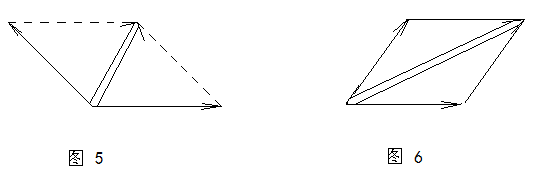
向量和当然也是向量。两向量的夹角(即分歧)越大(图5),向量和越小;夹角越小(图6),向量和越大。
The vector sum is, of course, also a vector. The larger the angle (or divergence) between two vectors (as shown in Figure 5), the smaller the vector sum; conversely, the smaller the angle (as shown in Figure 6), the larger the vector sum.
向量求和的价值在于二者不管分歧多大,哪怕是179°,也构成平行四边形,尽管能得到向量和非常小(图7是比例不准确的示意);而二者不管分歧多小,哪怕只有1°,同样构成平行四边形,且向量和就在1°的中间(图8)——只要是按平行四边形法则求出的向量和,永远是在两个向量的中间位置,即通常所说的折中。
The value of vector summation lies in the fact that regardless of how large the divergence is, even if it is 179°, it still forms a parallelogram (Figure 7, with an inaccurately proportioned illustration), although the resulting vector sum is very small. On the other hand, regardless of how small the divergence is, even if it's just 1°, it still forms a parallelogram, and the vector sum lies in the middle of the 1° angle (Figure 8). As long as the vector sum is calculated according to the Law of Parallelograms, it will always be positioned in the middle of the two vectors, commonly referred to as a compromise.


平行四边形只是比喻。但是在“无知之幕”下,双方考虑互换位置的可能,不以损害对方而以奉行“最大化最小值规则”的方式追求满足,被双方共同当作最好结果达成的求和,因此的确会像精确的对角线那样恰好公平,既是双方的合作所在,又是平等的节制所在。
The parallelogram is just a metaphor. However, under the "veil of ignorance," where both parties consider the possibility of swapping positions and pursue satisfaction by practicing to the "maximin rule" without causing harm to each other, the result achieved through mutual agreement is indeed considered the best outcome. In this context, it is akin to a precise diagonal that perfectly embodies fairness. It is both the realm of cooperation between the parties and the embodiment of equal restraint.
进一步考虑多个向量的相互求和,只需按照同样方式扩展:让两个向量求出的和(亦为向量)与第三个向量构成平行四边形,对角线便是三个向量的和,再与第四个向量构成平行四边形,对角线是四个向量的和……直至求出所有向量的和。
Further consideration of the mutual summation of multiple vectors simply requires extending the process in the same manner: let the sum obtained by two vectors (also a vector) form a parallelogram with the third vector, and the diagonal will be the sum of the three vectors. Then, form a parallelogram with this sum and the fourth vector, and the diagonal will be the sum of the four vectors, and so on, until the sum of all the vectors is obtained.
现实当然不会如此机械,一个群体总是在交叉地相互沟通与求和。而多个向量同时求和,前提是所有参与者都能充分直接沟通,既能准确地表达自身个人意志,又能准确地了解其他参与求和的个人意志,才能在互动中不断趋近平行四边形对角线。
Certainly, reality is not as mechanically structured. A community is always engaged in cross-interactions, communication, and summation. When multiple vectors are simultaneously summed, the prerequisite is that all participants can engage in sufficient direct communication. They should be able to accurately express their individual will and understand the other individual wills involved in the summation. Only then can they progressively approach the diagonal of the parallelogram in their interactions.
正义存在于在人与人的关系中,不是居高临下的道德信条,是对所有人形成“平等的节制”。在群体关系中,能够持久让个人意志满足的不是自己占了他人便宜(那会造成他人不满而不利自身),而是大家都不占便宜,每人得到不多也不少的份额,做出不多也不少的让步。只有个人意志的向量求和才能找到并动态跟随这种精确位置,并被所有参与求和者认可(或是在群体的制约关系中不得不认可)。因此可以说,对于共同体而言,正义即是共同体内所有个人意志的向量之和。对整个社会而言,正义即是所有社会成员个人意志的向量之和。
Justice exists in the relationships between individuals, not as an imposing moral creed but as a form of "equal restraint" that applies to everyone. In community dynamics, the sustainable satisfaction of individual wills doesn't come from taking advantage of others (which would lead to dissatisfaction and harm oneself), but rather from ensuring that no one takes advantage, and everyone receive a fair share, making reasonable concessions. Only through the summation of individual will vectors can this precise position be identified and dynamically followed, gaining recognition from all participants (or being compelled to do so within the constraints of the community). Therefore, We could say that for a community, justice is the sum of all individual will vectors within the community. On a societal scale, justice is the sum of all individual will vectors within the entire society.
从“无知之幕”回到现实,向量之和不一定让群体内每个成员都满意。一是在没有形成“向量文化”前,总是会有人力图占便宜,比别人得到更多;二是向量求和将矫正历史的不公,消除以往通过损人而固化的利己,被减少了多占利益的人会因此不满,可能造成僵局或冲突,使公平界限和平等节制无法达成。
Returning from the "veil of ignorance" to reality, the summation of vectors doesn't necessarily ensure satisfaction for every member within a group. Firstly, before a "vector culture" is established, there will always be individuals attempting to take advantage, seeking to gain more than others. Secondly, the summation of vectors aims to correct historical injustices, eliminating selfish gains that were previously solidified through harm to others. Those who experience a reduction in disproportionate benefits may be dissatisfied, leading to potential deadlock or conflicts, making it challenging to achieve fair boundaries and equal restraint.
解决方法是开放自由流动,不接受向量和的成员可以离开共同体,用脚投票,或自己另组、或参加对其更合适的共同体。这类似美国乡镇自治的理念。同时要看到生活是复杂的,即使能自由选择,人也面临诸多羁绊,需权衡取舍,绝非一走了之那么简单。在开放自由流动的情况下虽不满仍留下,说明权衡结果是留下比离开对自己更有利,因此是其相对的满意。在不可能随心所欲的世界中,满意只能是相对的,因此只要是在自由状况下做出的选择,就是个人意志的满足。
The solution lies in open and free movement, where members who are dissatisfied with the vector sum can choose to leave the community—voting with their feet—or form or join a community that better aligns with their preferences. This concept is akin to the idea of local autonomy in the United States. It's important to recognize that life is complex, and even with the freedom to choose, individuals face numerous constraints and must weigh various considerations. Leaving is not always a simple option. If individuals choose to stay despite dissatisfaction in a situation of open and free movement, it indicates that, upon balancing the pros and cons, staying is more advantageous for them than leaving. Therefore, their relative satisfaction lies in this choice. In a world where one cannot have everything they desire, satisfaction is inherently relative. As long as the choice is made in a condition of freedom, it represents the satisfaction of individual will.
同时,如果某些成员离去会对共同体整体利益造成较大损失(如带走资本),共同体内其他成员是能够认识到的,从而在向量求和过程中做出权衡,对历史不公的矫正保持在不使那些成员离开的幅度。经验范围内充分直接沟通的互动总是可以恰到好处地找到维系共同体最佳利益的平衡点,同时却不会停止矫正不公,继续以渐进的节奏走向公平正义。
Simultaneously, if the departure of certain members would result in significant losses for the overall interests of the community (such as taking away capital), other members within the community can recognize this. Therefore, they can make trade-offs during the vector summation process, ensuring that the correction of historical injustices is maintained without causing those members to leave. Through sufficiently and direct communication within the empirical range, interactions can aptly find the balance point that sustains the community's best interests. This process doesn't halt the correction of injustices but rather continues to progress toward fairness and justice with an incremental pace.