【本章提要:社会意志是所有社会成员个人意志的向量和。社会的基本性质是追求社会意志的满足。但迄今尚无社会意志实现向量求和的结构,只有权力意志主导的数量求和结构。社会意志因此总是被权力意志扭曲。】
Chapter synopsis: The societal will is the vector sum of the individual wills of all social members. The basic nature of society is the pursuit of the satisfaction of the will of society. However, so far, there is no structure for the societal will to achieve vector summation, only a quantitative summation structure dominated by the will of power. The will of society is thus always distorted by the will of power.
社会被划分为各种阶段、类型、模式与形态……细想是什么呢?归根结底是所有社会成员具体活动的集合。思想,研究,战争,生产,经商,民族形成,国家建立,朝代更迭……基本元素都是具体个人所做的具体事和发生的具体关系。一个奴隶当着奴隶主的面好好干活,奴隶主一转身就怠工,再偷吃一个马铃薯;另一个奴隶不光不偷懒,还向奴隶主举报第一个奴隶怠工,将其偷吃一个马铃薯说成五个;第三个奴隶暗地里做起义准备,宁愿牺牲生命。他们对社会发展都起作用。奴隶起义可能被历史书写;无言的怠工对奴隶制解体可能作用更大;巴结者虽卑琐,却使奴隶主认识到施恩比施暴更有效,影响权力决策乃至制度调整……滴水成大海,亿万局部的微小动力,最终汇成总体状况。
Society is divided into various stages, types, patterns, and forms... but what is it fundamentally? It boils down to the collective activities of all members in society. Thoughts, research, wars, production, trade, the formation of nations, the establishment of states, dynastic changes... the basic elements are all specific actions undertaken by individuals and the concrete relationships that occur. One slave may work diligently in front of the master, while another slacks off as soon as the master turns away, even stealing a potato; yet another slave not only avoids laziness but also reports the first slave for slacking off, exaggerating the potato theft from one to five. A third slave secretly prepares for rebellion, willing to sacrifice their life. They all contribute to societal development. A slave uprising might be recorded in history books; silent sabotage could have a more significant impact on the dissolution of slavery; the sycophant, though lowly, makes the master realize that kindness is more effective than cruelty, influencing decision-making and even systemic adjustments... Drop by drop, countless small actions from millions of individuals eventually converge to shape the overall situation.
社会的所有个人行动汇成社会发展,策动每人行动的个人意志之向量和就是社会意志。
All the individual actions of society converge into the development of society, and the vector sum of individual wills driving everyone's actions represents the societal will.
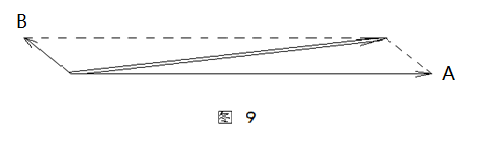
前面的论证对社会意志皆适用,区别只在人群规模的大小。迄今没有对社会意志进行向量求和的结构,但并不等于社会意志不存在。如同不去数一个篮子里的n个鸡蛋,篮子里的鸡蛋数也是n一样;十万只蚂蚁各按自己的方向搬运一个物体,即使难以计算十万个微小分力的合力,合力也照样形成并最终决定物体的运动状态。社会意志就是这样一个最终的向量和。与其比较接近的概念是所谓的“民心”。当社会多数个人意志在某方面趋向一致,如图9的A,与之分歧的意志较小(B),社会意志(对角线)的方向与大小近似地等于 A。A 也就是一般而言的“民心”。
The preceding arguments apply to societal will, with the only difference being the scale of the population. So far, there is no a structured method for vector summation of societal will, but that does not mean that societal will does not exist. Just as if you don’t count the N eggs in a basket, the number of eggs in the basket is also N; a hundred thousand ants each move an object in their own direction, even if it is difficult to calculate the resultant force of a hundred thousand tiny forces, the resultant force still forms and ultimately determines the motion state of the object. Societal will is such a final vector sum. A concept that is close to it is the so-called “Public sentiment” or "public opinion". When the majority of individual wills in society tend to agree on a certain aspect, such as A in Figure 9, and the wills that disagree with it are smaller (B), the direction and size of societal will (the diagonal) are approximately equal to A. A is generally referred to as “public sentiment”.
“民心”其实和“社会意志”一样,都无实体,却没有人说“民心”不存在。史上通篇可见“民心”二字,古往今来无人敢小看。社会意志比民心更精确,近似民心,又不相同。其实更能说明社会意志性质的,并非是其与“民心”(“大多数”)的相近,而是任何少数——哪怕是一个单独的个体——也会被求和于其中,对社会意志产生作用。尽管作用可能非常微小,但就如一只苍蝇落上大桥,理论力学也要承认能使大桥产生变形一样。社会意志既然是全部个人意志的向量和,每个个人意志就都有相应作用,不分“进步”、“反动”、“左派”、“右派”、“压迫者”、“被压迫者”,一概兼容并蓄。平行四边形的对角线总处在折中位置,社会意志也一定是“综合”的结果。其大小和方向接近于哪一边,并非是因为有自身倾向,而是向量求和的结果。如果说民主更重要的不在体现多数,而在体现少数,社会意志便是最充分地体现这种民主,即使其中一方有压倒优势,社会意志也不会与那一方完全一致,一定会把另一方按应得的份额综合进自身。不是仅出于“有限多数”的理念用法律消极地保护少数,而是其向量求和的过程对少数必然给予的精确体现。
"Popular sentiment" is essentially the same as "societal will," both lacking tangible existence, yet no one claims that "popular sentiment" does not exist. Throughout history, the term "popular sentiment" is widely used, and no one dares to underestimate it from ancient times to the present. Societal will is more precise than popular sentiment, approximating it but not being identical. What truly illustrates the nature of societal will is not its proximity to "popular sentiment" (the "majority"), but the fact that any minority—even a single individual—contributes to it through summation and affects societal will. Although the effect may be very small, just as a fly landing on a bridge, theoretical mechanics also has to admit that it can cause deformation of the bridge. Since societal will is the vector sum of all individual wills, each individual will has a corresponding impact, regardless of being labeled as "progressive," "reactionary," "left-wing," "right-wing," "oppressor," or "oppressed", all inclusive. The diagonal of a parallelogram is always in a balanced position, and societal will is inevitably the result of this "synthesis." Its magnitude and direction toward one side are not due to inherent tendency but rather the result of vector summation. If democracy is more about representing minorities than majorities, societal will is the most comprehensive embodiment of this democracy. Even if one side has a overwhelming advantage, societal will won't completely align with that side; it will definitely integrate the other side into itself according to the deserved share. It's not merely based on the concept of protecting minorities through laws due to the "limited majority," but rather, the process of vector summation inherently provides an accurate representation of minorities.
社会意志可能会被当成“公意”(general will)的另一种说法,二者确有相似之处,但是本文却是要区分二者、澄清二者的区别。
Societal will might be considered another term for "general will," and indeed, there are similarities between the two. However, in this chapter, the aim is to distinguish and clarify the differences between them.
卢梭使用“公意”一词,是与其另一个概念——“众意”相对的:“公意与众意之间经常总是有很大的差别;公意只着眼于公共的利益,而众意则着眼于私人的利益,众意只是个别意志的总和。但是,除掉这些个别意志间正负相抵消的部分而外,则剩下的总和仍然是公意。”(何兆武译《社会契约论》)也就是说公意是扣除众意相异部分(即人们的不同意见)后的共同部分。公意认为假若每人皆能无私地行事,公意就是所有人的意志。从这个意义上,社会意志并非是卢梭所说的公意,反而与众意更接近。
Rousseau's use of the term "general will" is in contrast to another concept he refers to as "will of all" ("volonté de tous"). He states, "Between the 'general will' and the 'will of all,' there is often a great difference. The 'general will' only focuses on the public interest,, while the 'will of all' focus on private interest. The 'will of all' is simply the sum of individual wills. However, when we eliminate the conflicting parts among these individual wills, what remains as the sum is still the 'general will'" (translated by He ZhaoWu in "The Social Contract"). In other words, the general will is the common part left after subtracting the divergent aspects of individual wills (i.e., people's differing opinions). The general will assumes that if everyone were to act selflessly, it would represent the will of all. In this sense, societal will is not exactly what Rousseau referred to as the general will; rather, it aligns more closely with the concept of the "will of all".
之所以卢梭要从众意中剥离出公意,正是因为没有考虑向量求和,只考虑数量求和的结果——个人意志的相异部分是无法进行数量求和的,只能对相同部分进行数量求和。但是严格讲,不同人的意志不会有完全相同的部分,哪怕是自由、平等、公正一类看上去没有任何疑义的原则,进入实际层面后也会马上分歧为千差万别的理解和标准,更不要说对具体事物和决策的看法。若是去掉个人意志中的私利部分,能进行数量求和的公共部分便不会剩下多少实在内容。而那些空洞原则却会成为打着公意旗号进行奴役的理由。
The reason Rousseau sought to separate the general will from the will of all is precisely because he did not consider vector summation. He focused on the result of summation in terms of scalar, where the divergent parts of individual wills cannot do scalar summation, only the similar parts can do scalar summation. However, strictly speaking, the wills of different individuals will not have completely identical parts. Even seemingly unambiguous principles like freedom, equality, and justice will diverge into myriad interpretations and standards when applied to practical situations, not to mention specific views on concrete matters and decisions. If we eliminate the self-interest components from individual wills, there won't be much substantial content left for quantitative summation in the public part. Meanwhile, those hollow principles could become reasons for enslavement under the guise of the general will.
社会意志与“公意”的区别,在于社会意志是要吸纳所有人的不同意见,让人与人的共同意见与不同意见同时起作用。它不像公意那样要排除私人利益,反而是把私人利益当作形成社会意志的基本元素,每人都要从私人利益出发,再从所有的私人利益中求和出社会的共同利益。因此社会意志的基础是个人主义的而非“公意”所要求的集体主义。
The distinction between societal will and the "general will" lies in the fact that societal will aims to incorporate the diverse opinions of all individuals, allowing both shared and divergent views to coexist and influence outcomes. Unlike the general will, which seeks to exclude private interests, societal will regards private interests as fundamental elements in forming the societal will. Each individual begins with their private interests, and the societal common interest is then derived by summing up all these private interests. Therefore, the foundation of societal will is individualistic, contrary to the collectivism demanded by the "general will."
社会意志之所以能做到这一点,就在于是对个人意志的向量求和。至于如何实现个人意志的向量求和,正是本文要解决的。
The ability of societal will to achieve this lies in its nature as the vector sum of individual wills. How to realize the vector summation of individual wills is precisely what this article aims to address.
一个社会怎么样,评价标准是什么?怎样算发展良好,怎样又是受到阻碍?是否有一个可以进行客观判断的衡量标准,亦或仅仅是各执一词的主观判断?
How is a society evaluated, and what are the criteria for assessment? What constitutes good development, and what hinders it? Is there an objective standard for judgment, or is it merely a matter of subjective opinions?
国民生产总值、犯罪率、恩格尔系数、平均寿命、文盲比例一类评价指标,可以定量却过于狭窄,难以反映总体状况。另一类定性的评价,好或糟、进步或落后、富裕或贫穷、发达欠发达等,又很模糊,结论也随立场相距甚远。
Indicators such as Gross Domestic Product (GDP), crime rate, Engel coefficient, average life expectancy, and illiteracy rate are quantitative but overly narrow, making it difficult to reflect the overall situation. Another qualitative type of evaluation, whether something is good or bad, progressive or backward, wealthy or poor, developed or underdeveloped, is quite vague, and conclusions can vary widely depending on one's perspective.
“评价”属于意志范畴,即使是客观指标也是由意志选定和建立的。社会既是个人之和,对社会状况的评价就应产生于社会成员的个人意志之和——即社会意志。
"Evaluation" falls within the realm of will, meaning that even objective indicators are chosen and established by will. Society is the sum of individuals, and the assessment of social conditions should arise from the collective will of its members – that is, the societal will.
实现主义、增长经济或发展文化都是手段或结果,不是人结合成社会的目的。人的目的只是求自身生活更好——即个人意志的满足。全社会所有成员的基本性质之和,构成社会的基本性质——追求社会意志的满足。
Realism, economic growth, or cultural development are all means or outcomes, not the purpose of people coming together to form a society. The ultimate purpose of individuals is simply to seek a better life for themselves – the satisfaction of individual will. The sum of the basic attributes of all members of society constitutes the fundamental nature of society – the pursuit of the satisfaction of the societal will.
意志的组成包括进行判断、确立目标、做出决定。尽管不一定全都条理清晰,但是遑论自觉不自觉,三个部分都少不了。对于个人意志,“判断”包括是否满意自身状况,不满的根源在哪?如何造成、能否克服等;“目标”包括想得到什么,怎样的生存状况是其所求,最低愿望,最高理想,眼前利益,长远规划等;“决定”包括如何实现目标,计划安排,行动步骤,根据愿望与现实的差距所做的调整与妥协等。一个现实生活中的人时刻在进行判断,树立目标,做出决定,哪怕明天去山上砍一捆柴到市场换回一包盐,也已包括意志的这三个部分。
The composition of will includes making judgments, establishing goals, and making decisions. Although these parts may not always be neatly organized, whether consciously or unconsciously, all three components are essential. Regarding individual will, "judgment" involves assessing one's satisfaction with their current situation, identifying the sources of dissatisfaction, and considering how these issues arise and whether they can be overcome. "Goals" involves what one desires, the living conditions sought, minimum aspirations, maximum ideals, immediate interests, long-term plans, and more. "Decisions" involve how to achieve goals, planning, action steps, and adjustments or compromises made based on the gap between desires and reality. In real daily life, a person is constantly making judgments, setting goals, and making decisions. Even a task as simple as going to the mountains to gather firewood and exchanging it for a bag of salt at the market tomorrow involves all three components of will.
社会意志同样有这三个部分,每一部分都可以视为社会所有个人意志相应部分的向量和。一个社会的状况究竟怎么样,根本评价在于社会意志的判断,即社会所有成员对自身生存状况判断的向量和。社会意志满意,状况就好,不满意,则不好。每个社会成员如同在其所处之局部安置的“测点”,所有“测点”组成反映社会状况的“监测系统”。这种社会意志对社会状况的把握,可以说全面到无一遗漏的程度。
Societal will also consists of these three components, with each part being viewed as the vector sum of the corresponding components of individual will within the society. The fundamental assessment of a society's condition lies in the judgment of the societal will, that is, the aggregate result of all members' assessments of their own living conditions. If the societal will is satisfied, the situation is considered good; if not, it is deemed unfavorable. Each member of society can be likened to a "measurement point" placed in their respective localities, and all these "measurement points" collectively form a "monitoring system" that reflects the societal conditions. This grasp of societal conditions by the societal will can be said to be comprehensive to the point of leaving nothing overlooked.
以经济为例。经济行为由人推动,经济结果由人承担,经济关系由人构成。社会成员分布于经济的每个局部,既是“测点”,又是所处局部的经济状况本身。每人对与己有关的经济任意微小的变化都有明晰且定量的意识——上午农贸市场的菜价涨了五角钱,或买来盖鸡窝的砖质量下降,碎了八块,还有六块有变形……——构成个人意志对于经济状况的判断。把全体社会成员的判断求和在一起,所有那些不起眼的几分钱、几块砖累积起来,就成了整体的社会经济状况。其判断的完整与准确,是世间任何调查、统计、经济理论、数学模型或计算机网络都无法相比的。
Taking the economy as an example: Economic activities are propelled by people, economic outcomes are borne by people, and economic relationships are composed of people. Societal members are distributed in every part of the economy, acting as both "measurement points" and embodiments of the economic conditions in their respective localities. Each individual possesses a clear and quantified awareness of even the slightest economic changes related to themselves—such as a five-cent increase in vegetable prices at the morning farmer's market, a decline in the quality of bricks purchased for building a chicken coop resulting in eight broken pieces, or six of them being deformed. These instances constitute an individual's judgment of the economic conditions. By summing up the judgments of all society members, the seemingly inconspicuous changes in a few cents or a few bricks accumulate to form the overall economic situation of society. The completeness and accuracy of these judgments are unparalleled by any investigation, statistics, economic theories, mathematical models, or computer networks in the world.
哈耶克反对整体秩序,其强调的“必然无知”对任何组织和个人都是成立的,唯有对社会意志不成立。社会意志对所有“测点”进行求和而成为全知,对所有局部进行求和而成为全局。社会意志不仅是正义,而且是正确。
Hayek opposes the holistic order, and his emphasis on 'inevitable ignorance' holds true for any organization and individual, except for societal will. Societal will sums up all 'measurement points' to become omniscient, and aggregates all localities to become global. Societal will is not only justice but also right itself.
可以这样看向量求和与数量求和的区别:如警察管制会使人不满,进行数量求和,不满的绝对值总是很大,似乎处处抱怨警察;然而进行向量求和却可能不会求和为社会意志的不满。因为作为向量,不同人不满的方向不同——罪犯可能不满法律过严,把他判重了;受害者可能不满法律太宽,把罪犯判轻了,而两种不满会被向量求和折中。虽然这是简单化比喻,现实要复杂得多,但向量求和的本质就是折中。警察管制符合社会利益,一定会被社会意志接受。如果抱怨警察滥权的最终向量和更大,说明警察一定超越了维护秩序的职能,成了压迫力量。
The difference between vector summation and scalar summation can be understood in this way: for example, police control may lead to dissatisfaction, and when using scalar summation, the absolute value of dissatisfaction is always significant, seemingly complaining about the police everywhere. However, when using vector summation, the dissatisfaction may not necessarily sum up to societal will. This is because, as vectors, the directions of dissatisfaction for different individuals are different—criminals may be dissatisfied with strict laws that lead to heavy sentences, while victims may be dissatisfied with lenient laws that result in lighter sentences for criminals. The vector summation, in this case, would find a compromise. Although this is a simplified analogy and reality is much more complex, the essence of vector summation is compromise. Police control aligns with societal interests and will be accepted by societal will. If the final vector sum of complaints about police abuse of power is larger, it indicates that the police have undoubtedly exceeded their function of maintaining order and have become an oppressive force.
既然社会存在和发展的意义是为满足社会意志,社会意志不满的就该改变;社会意志希望的就该成为目标。结论是——最好的社会状况是社会意志得到充分体现,最好的社会制度是能让社会意志始终得到体现。
Since the purpose of the existence and development of society is to satisfy societal will, any dissatisfaction with societal will should be changed; what societal will desires should become the goal. The conclusion is that the best societal condition is when societal will is fully manifested, and the best societal system is one that consistently allows societal will to be realized.
个人意志是实在的,它承载于人的肉体。社会意志却非实体,如同没有加号和等号,数之间的“和”不能说不存在,却只是隐性存在,社会意志也需要有求和结构的承载才能体现。
Individual will is tangible, and it is carried in the human body. In contrast, societal will is non-entity, much like the absence of plus and equal signs. The "sum" between individual wills cannot be said to be non-existent, but it only exists implicitly. Similarly, societal will needs a structure of summation to be manifested.
前面说过,如果人群规模小,群体成员可进行充分的直接沟通,每个个人意志都能作为向量相互作用,得出的向量之和是彼此经过说服、理解而达成的妥协——即平行四边形的对角线。然而超出直接沟通限度的大规模人群,个人意志的向量求和就变得困难。可以说,人类从未有过对大规模社会进行个人意志向量求和的结构,且是否需要这样的求和结构,也未被当作问题提出过。
As mentioned earlier, if the size of the crowd is small, members of the group can have sufficient direct communication, and each individual’s will can interact as vectors. The sum of the vectors is a compromise reached through persuasion and understanding—that is, the diagonal of the parallelogram. However, for large-scale crowds that exceed the limit of direct communication, it becomes difficult to sum up the vectors of individual wills. It can be said that humans have never had a structure to sum up the vectors of individual wills in large-scale societies, and whether such a summation structure is needed has not been raised as a question.
事实上,有社会就有求和。社会本身就是所有社会成员“相加”在一起,不仅有人的相加、物的相加,也一定有意志的相加。所以,社会本身就可以被看作求和结构。无论社会是否明确地设计了个人意志求和的功能,其运转也会产生相应的结果。不过权民分离的社会是“数量求和结构”,不能进行向量求和。
In fact, where there is society, there is summation. Society itself is the aggregation of all its members, involving not only the summation of individuals and objects but also the summation of wills. Therefore, society itself can be viewed as a summation structure. Regardless of whether society explicitly designs the function of summating individual wills, its operation will generate corresponding outcomes. However, a society with a separation of powers and citizens is a "scalar summation structure" and cannot perform vector summation.
数量求和结构大体可根据求和方向是自上而下还是自下而上分成两类。前者是专制制度,以统治者的意志为准,自上而下统一意志,把不同个人意志的向量分歧强制缩小为零,在“一元化领导”下,不容异端地相加成国家、民族、阶级、政党、群众运动等同质的数量;后者是代议民主制度,自下而上地公决或选举,给了社会成员说“不”的权利,但仍然是把本来无限丰富取向的个人意志限定于一正一负两种取向,求和成“是”或“否”、“赞成”或“反对”两种对立的数量。
The scalar summation structure can generally be classified based on the summation direction, whether it is top-down or bottom-up. The former corresponds to authoritarian systems, where the will of the ruler is the reference point. It unifies will from the top-down, coercively narrowing the divergence of vectors of different individual wills towards zero. Under "unitary leadership," diverse individual wills are summed up homogeneously as the quantity of the nation, ethnicity, class, political party, mass movements, etc. The latter corresponds to representative democratic systems, where decisions are made from the bottom up through referendums or elections, giving society members the right to say "no." However, it still confines the originally infinitely diverse orientations of individual wills to two directions — positive and negative — and sums them up as two opposing scalars, either "yes" or "no," "approval" or "disapproval."
事事公决的社会是无法存在的。即使再搞民主,多数日常决策也得出自当权者。代议制的民主主要体现于几年一次对当权者的选举,平时仍是由权力自上而下进行数量求和。
A society where everything is decided by public referendum is impractical. Even in a democratic system, most everyday decisions still need to come from those in power. Representative democracy is primarily evident in periodic elections of those in power every few years, while routine decisions are still subject to top-down scalar summation of power.
真正的民主应是每个社会成员都参与决策过程并能发挥自己的影响,这与对个人意志进行向量求和是一致的。问题在于如何操作?让每个社会成员对决策轮流发表意见,规模稍大的群体便安排不了时间;让每人把意见写成文字,就算都能写,该如何分类?如何统计?谁来裁定?最后又如何归纳为兼顾的方案?即使最终能达成方案,早已事过境迁…… 从操作上,最方便的就是表决。
True democracy should involve every member of society in the decision-making process and allow them to exert their influence, aligning with the idea of vector summation of individual wills. The challenge lies in how to implement this. Allowing each member to express their opinions in turn becomes impractical as the group size increases; having individuals write down their opinions, even if feasible, raises questions about categorization, statistical analysis, and arbitration. How can these diverse opinions be synthesized into a balanced solution? Even if a consensus is eventually reached, circumstances may have changed by then. In terms of practicality, the most convenient approach is through voting.
表决离不开两种简化,一是事先提出方案;二是将选择限定为“是”或“否”。第一种简化把多向度的个人意志纳入同一框架;第二种简化使之可进行统计。加上少数服从多数的原则,便成为至今大规模社会的主要民主方法。这使成本降低,容易操作了,但也脱离了向量求和,变为数量求和。
Voting cannot be separated from two simplifications, presenting proposals in advance, the other is to limit the choice to “yes” or “no”. The first simplification incorporates multi-dimensional individual will into the unified framework; the second simplification makes it possible to perform statistics. With the principle of minority obeying the majority, it has become the main democratic method for large-scale society to this day. This reduces costs and makes it easy to operate, but it also deviates from vector summation and becomes scalar summation.
在社会契约论中,预先提供表决方案的人是卢梭所说的立法者。卢梭坚持立法者本身并无权力,只是起草和提出法律建议,充当指导者,只有人民自己才有权设立法律。然而从操作上,所谓人民设立法律,顶多是对立法者提出的方案进行表决(现代的“公民创制”也是先有提案再争取附议),相当于在表决前已由立法者进行了自上而下的数量求和,成为立法者的“笼中鸟”。而在表决后,人民便又回到权力统治下。主导者始终是权力意志而非社会意志。
In the social contract theory, the person who provides the voting proposal in advance is what Rousseau calls the legislator. Rousseau insisted that the legislator itself holds no power, but only drafts and proposes legal suggestions, acting as a guide, and only the people themselves have the right to establish laws. However, in practice, the so-called establishment of laws by the people is, at most, voting on proposals put forward by the legislator (modern "citizen initiatives" also involve proposing first and then seeking endorsement). This is equivalent to the legislator conducting a top-down scalar summation before the vote, making the people a "caged bird" of the legislator. After the vote, the people return to being under the rule of power. The dominant force remains the will of power rather than societal will.
数量求和是二元社会的权力对社会实施沟通的基本方式,权力意志是“数量求和结构”的核心与灵魂。在专制程度高的社会,权力意志极大程度可被视为独裁者的个人意志或小集团意志,而官僚化社会的权力意志则更多体现为官僚集团的意志。“数量求和结构”只能围绕权力意志运转,权力意志也只有借助这种结构才能进行统治。
Scalar summation is the fundamental way in which the power in a dualistic society communicates with society, and the will of power is the core and soul of the "scalar summation structure." In highly authoritarian societies, the will of power can be largely seen as the personal will of a dictator or a small group, while in bureaucratized societies, the will of power is more reflective of the bureaucratic group's will. The "scalar summation structure" can only operate around the will of power, and the will of power can only govern through the assistance of this structure.
在权力意志主导的数量求和结构中,社会意志也非全然不能呈现。这是因为社会意志的三个组成部分——判断、目标和决定,在数量求和结构中有不同的存在方式。
In the scalar summation structure dominated by the will of power, the will of society is not entirely unable to present itself. This is because the three components of social will—judgment, goal, and decision— have different ways of existing in the scalar summation structure.
在追求个人意志的满足上,不同的个人意志是一致的。个人意志的满足程度和追求过程的满意与否可被视为同质的量。甲挨了一棍子,知道疼;乙赚了两块钱,心欢喜。一棍子和两块钱是不同的向量,缺乏数量可比性,不能在“数量求和结构”中求和。但是挨打不满意,赚钱满意,在满意与否上就有了共性,可以进行数量求和。全社会个人意志满意与否的求和就是社会意志的判断。
In the pursuit of satisfying individual wills, different individuals are consistent. The degree of satisfaction of individual wills and the satisfaction of the process of pursuit can be considered homogeneous quantity. Person A gets hit by a stick and knows the pain; Person B earns two dollars and is happy. A stick and two dollars are different vectors, lacking quantitative comparability, and cannot be summed up in the “scalar summation structure”. But dissatisfaction with being beaten and satisfaction with making money have commonality in terms of satisfaction or dissatisfaction, and scalar summation can be performed. The summation of the satisfaction or dissatisfaction of individual wills throughout society constitutes the judgment of societal will.
“数量求和结构”是二元的,一般需要“上”对“下”的操作才能求和,但是社会意志满意与否的判断却不需要借助“上”才能求和。因为既然社会本身就是人与人沟通的网络,不管沟通网络被限定在什么功能上,个人意志的判断——满意还是不满意——都可以通过那些经济的、政治的、亲友的管道与网络汇集在一起,在完成其社会功能的同时,自发地相互求和,形成社会意志满意与否的判断。
The “scalar summation structure” is dualistic, and generally requires “top-down” operations to sum up, but the judgment of whether the societal will is satisfied or not does not need to rely on the “top” to sum up. Since society itself is a network of communication between people, regardless of what function the communication network is limited to, the judgment of individual will—satisfaction or dissatisfaction—can be gathered together through those economic, political, and friends and family channels and networks. While fulfilling its social functions, it spontaneously sums up with each other, forming the judgment of whether the societal will is satisfied or not.
这是社会意志唯一可在任何社会形态下自发求和的部分,看似只是最简单的部分,却让社会意志获得某种决定力。因为社会成员的满意与否不会仅停留于判断,一定会影响人在日常生活中的行为。那些行为同样无需依赖专门的求和结构,凭借日常生活的沟通网络叠加为谣言、舆论、民心和压力,形成社会稳定或动荡的倾向,以及叛乱滋生的土壤或星火燎原的干柴。这是社会意志的重要特点。正因于此,社会意志才具即使在权力意志统治下最终仍能得到体现的主动性。
This is the only part of societal will that can spontaneously aggregate in any social structure. It may seem like the simplest part, yet it grants a certain decisive power to societal will. This is because the satisfaction or dissatisfaction of societal members does not merely stay at the level of judgment; it inevitably influences individuals' behavior in daily life. These behaviors, without relying on specialized summation structures, accumulate through the daily communication network to form rumors, public opinion, popular sentiment, and pressure. This, in turn, forms tendencies toward social stability or unrest, as well as the fertile ground for rebellion or the spark that ignites widespread unrest. This is a crucial characteristic of societal will. It is precisely because of this that societal will possesses an inherent initiative, allowing it to be expressed even under the rule of the will of power.
个人意志在生活中有各种具体目标,如把住房从两间扩大到三间,提高一级工资,惩罚某个贪官等。不同的目标没有共性,因此不能在“数量求和结构”中求和,无法像个人意志的判断那样利用日常沟通的网络自发求和。社会意志的目标需要通过向量求和才能显现,那是把不同个人的具体目标综合在一起的过程,最终形成社会的整体目标。
Individual will has various specific goals in life, such as expanding housing from two rooms to three, raising one level of salary, punishing a certain corrupt official, etc. Different goals have no commonality, so they cannot be summed up in the “scalar summation structure”, and they cannot spontaneously sum up like the judgment of individual will using the network of daily communication. The goal of societal will needs to be revealed through vector summation, which is the process of integrating the specific goals of different individuals together, and finally forming the holistic goal of society.
很多情况下,人们各自追求个体目标,不一定需要求和为社会的目标。但是个体目标的一些内容需要同时确立为社会整体的目标才可能实现,例如自由、平等、公平、正义;另外,诸如发展经济与保护生态如何协调,战争与和平怎样选择,实施法治,铲除腐败……具体到老弱病残如何赡养,生育是否节制,贫穷如何救济,同性恋能否结婚……都得先被确立为社会目标后才有推动和实现的可能。社会意志的目标需要所有成员个人意志的向量求和形成。如果社会没有向量求和的结构,社会意志的目标虽然存在,却不能呈现,是“隐性”的。
In many situations, individuals pursue their own goals without necessarily needing to aggregate them into societal objectives. However, certain aspects of individual goals need to be simultaneously established as overall societal objectives to be achievable. Examples include freedom, equality, fairness, and justice. Additionally, issues such as coordinating economic development and ecological protection, deciding between war and peace, implementing the rule of law, eradicating corruption, and specific matters like how to care for the elderly, whether to control population growth, how to alleviate poverty, and whether same-sex couples can marry—all these need to be established as societal goals before there is the possibility of driving and achieving them. The goals of societal will require the vector summation of the individual wills of all members. Without a structure for vector summation, even though the societal goals exist, they cannot be presented and remain "implicit."
在权民分离的社会,能显现的社会目标是由权力意志通过纲领、计划、法律、政策等确立的。那不是社会意志的目标,而是权力意志的目标。但权力尽管与民众分离,倒也并非在所有方面都是对立。作为社会治理者,权力意志有时会主动地体察、总结和追随社会意志,如“为民做主”、“替天行道”、“访贫问苦”、“民意调研”等。尤其是以革命、政变或竞选上台执政的新权力,不管其真实动机是什么,的确会在一定程度上依据社会意志树立目标。哪怕只是为了统治需要或危机倒逼,只要权力意志确立的社会目标与社会意志的目标有“吻合”,社会意志的目标就会相应地得到体现。如果权力意志没有“吻合”,社会意志的目标就只能是“隐性”的,得不到体现。
In a society where power and the people are separated, the manifest societal goals are established by the will of power through manifestos, plans, laws, policies, etc. These are not the goals of societal will but rather the goals of the will of power. However, despite the separation between power and the people, they are not necessarily in opposition in all aspects. As societal governors, the will of power may, sometimes, actively perceives, summarize, and follow societal will, as seen in initiatives such as "governing for the people," "serving justice," "visiting the poor and asking about their hardships," and "public opinion surveys." Especially in the case of new powers that come to power through revolution, coup, or electoral victory, no matter what its real motive is, there is a tendency for the new leadership to establish goals to some extent based on societal will. Even if it is driven by ruling necessities or crisis pressures, as long as the societal goals established by the will of power "align" with the goals of societal will, the goals of societal will are reflected accordingly. If the will of power does not “align”, the goals of societal will remain "implicit" and are not presented.
一方面,个人决定导致的个人行动最终汇合成社会行动;另一方面,社会作为整体并非都是自发的个人行动,还需要整体协调与配合,因此离不开整体性决定。
On the one hand, individual decisions lead to individual actions that ultimately converge into societal actions. On the other hand, society as a whole is not solely comprised of spontaneous individual actions; it also requires overall coordination and cooperation, hence necessitating overarching decisions.
决定与目标不一样,决定不可能是隐性的。数量求和结构不提供社会意志以向量方式形成决定的可能,整体性的社会决定只能出自权力意志。权力意志是通过决定体现的。通过决定控制社会的运转,正是权力意志的力量所在。
Decisions and goals are not the same; decisions cannot be implicit. The scalar summation structure does not provide the possibility for societal will to form decisions in a vector manner; overall societal decisions can only come from the will of power. The will of power is manifested through decisions. Controlling the functioning of society through decisions is the essence of the power of the will of power.
既然迄今还未出现对个人意志进行向量求和的结构,社会意志的目标便不能成为显性的,社会意志也不能形成决定,然而社会作为一个整体运转,不能没有目标,更不可不做决定,因此,权力意志是不可缺少的。
Since there has not yet been a structure for vector summation of individual wills, the goal of societal will cannot become explicit, and societal will cannot make decisions. However, as a society operates as a whole, it cannot be without goals, let alone not make decisions, therefore, the will of power is indispensable.
人不断追求个人意志的满足,一定有尚未达到满足之时,否则就不会追求。如果社会多数个人意志正好都未达到满足,作为向量和的社会意志也会处于不满足的状态。事实上,跟满足状态相比,无论是个人意志还是社会意志,不满足的状态更多。因为满足状态是暂时的,达到满足就会有新的目标,开始新的追求,便进入新的不满足。
People continuously pursue the satisfaction of their individual wills; there must always be a time when satisfaction has not yet been achieved, otherwise there would be no pursuit. If the majority of individual wills in society have not yet reached satisfaction, the societal will as the vector sum will also be in a state of dissatisfaction. In fact, compared to the state of satisfaction, both individual and societal wills are more often in a state of dissatisfaction. This is because the state of satisfaction is temporary; once achieved, new goals emerge, initiating new pursuits, and entering a new state of dissatisfaction.
不满足未必是不满意。满足是意志的目标,达到目标才会满足;满意则是意志的判断,取决于在追求目标的过程中是否受阻。如果没有受阻,即使尚未达到目标(即未满足),也可以是满意的。
Not being satisfied doesn't necessarily mean discontentment. Satisfaction is the goal of the will, and one can only be satisfied upon reaching that goal. On the other hand, contentment is a judgment of the will and depends on whether there are obstacles in the process of pursuing the goal. If there are no hindrances, even if the goal has not been reached (i.e., not satisfied), one can still be content.
那么什么是受阻呢?不受阻不意味一蹴而就实现目标。如同人们完全清楚、也会接受房屋不可能一天盖成,只要每天正常劳作,按计划实现正常进度,就是没有受阻。受阻是指在正常盖房外的干扰,如僵化法规的限制,政府强拆,官员寻租等。在权民分离的二元结构中,权力意志总是不可避免与社会意志脱离,不能与社会意志的目标“吻合”,也不能做出有利于社会意志满足的决定,反而经常对社会意志束缚和扭曲,使社会意志追求满足的过程受阻,社会意志的判断就会不满意。
So what constitutes hindrance? Not being hindered doesn't mean achieving the goal overnight. Just as people fully understand and accept that building a house cannot be done in a day, as long as normal work is carried out every day and the planned progress is achieved, it is not considered hindered. Hindrance refers to interference outside the normal process, such as the restrictions of rigid regulations, government forced demolitions, rent-seeking by officials, and so on. In the dualistic structure of power and the people being separated, the will of power inevitably detaches from societal will. It cannot "align" with the objectives of societal will, nor can it make decisions conducive to satisfying societal will. Instead, it often restrains and distorts societal will, hindering the process of societal will's pursuit of satisfaction. In such cases, the judgment of societal will becomes discontent.
何况还有权力的腐蚀。“人的基本性质”使当权者追求自身个人意志的满足,权力缺乏制约就免不了谋私和恣意妄为。权力意志与社会意志的脱离因此成为常态,二者的“吻合”是相对与偶然,不“吻合”是绝对与必然。
Moreover, there is the corrosion of power. The "fundamental nature of humans" drives those in power to seek the satisfaction of their personal wills, and when power lacks constraints, it is inevitably prone to pursuing private interests and acting arbitrarily. The detachment between the will of power and societal will thus becomes the norm, and their "alignment" is relative and incidental, while non-alignment is absolute and inevitable.
权力意志与社会意志的主要关联在决定部分。不牵扯决定,二者的判断部分和目标部分各自独立,不一致也互不影响。但因为社会意志在数量求和结构中无法形成决定,社会只能按照权力意志的决定运转,当与社会意志脱离的权力意志迫使社会意志服从其决定,去实现权力意志的目标而偏离社会意志的目标时,二者的不一致就会显现出来。
The primary connection between the will of power and societal will lies in the decision-making part. Without involving decisions, the judgment and objective components of both are independent, and inconsistencies do not affect each other. However, because societal will cannot independently formulate decisions in the scalar summation structure, society operates based on the decisions of the will of power. When the will of power, which is detached from societal will, forces the societal will to obey its decision, to achieve the goal of the will of power and deviate from the objective of societal will, the inconsistency between the two will become apparent.
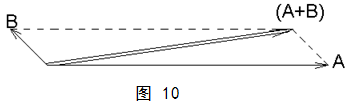
按照天赋人权,有权者的个人意志与无权者的个人意志大小一样。但无权者的人数多得多,因此权力意志B(所有有权者的个人意志之向量和)即使与无权者的个人意志之向量和 A 不一致,社会意志也如图 10 的(A+B),方向与大小都靠近 A。
According to the concept of inherent human rights, the magnitude of the individual will of those with power is the same as that of those without power. However, the number of individuals without power is much greater. Therefore, even if the vector sum of the individual wills of those with power (denoted as B) is not aligned with the vector sum of the individual wills of those without power (denoted as A), the societal will, represented by the vector sum (A+B), tends to be closer to A in both direction and magnitude, as illustrated in Figure 10.
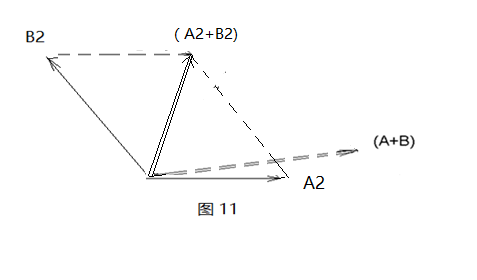
然而由于权力掌握沟通,所作的决定具有强制力,无权者出于对生存和安全的考量,不得不在与权力意志的决定相关的方面,扭曲自身意志,服从权力意志,从而使权力意志从B扩大为图11的B2,无权者的意志则从A缩小到了A2。A2与B2的向量和为(A2+B2)——相当于权力意志与无权者意志博弈后的社会实际走向。
However, because power controls communication, the decisions made have a coercive force. The powerless, out of consideration for survival and safety, have to distort their own will and obey the will of power in aspects related to the decisions of the will of power. This expands the will of power from B to B2 in Figure 11, while the will of those without power shrinks from A to A2. The vector sum of A2 and B2 is (A2+B2), represents the actual societal direction after the game between the will of power and the the powerless.
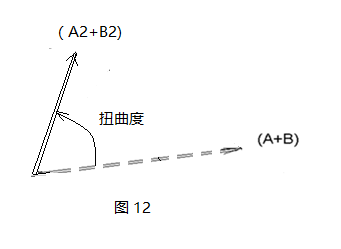
(A2+B2)便是权力意志对社会意志(A+B)的扭曲,二者形成的角度可视为社会意志的扭曲度(图 12)。
(A2+B2) is the distortion of the will to power to the societal will (A+B), and the angle formed by the two can be regarded as the distortion degree of the societal will (Fig. 12).
在权民分离的二元社会,只有当权力意志的目标与社会意志的目标恰好吻合,社会意志才能在服从权力意志的决定中实现自身目标,得到满意的判断。然而权力意志与社会意志的脱离既是必然,社会意志便会经常被扭曲,因而也经常不满意——这是二元社会的基本状态。
In a dualistic society where power and the people are separated, societal will can only achieve its objectives and obtain a satisfactory judgment when the goals of the will of power precisely align with those of societal will, and societal will complies with the decisions of the will of power. However, the detachment between the will of power and societal will is inevitable, leading to frequent distortions of societal will and consequently frequent dissatisfaction—this is the fundamental state of a dualistic society.