【本章提要:是否能让社会意志无需通过压力和强力,即可与权力意志无阻碍地沟通,从而使得社会意志无滞后地随时实现?】
Chapter synopsis: Is it possible to let societal will communicate with the will of power without any obstruction, without the need of pressure and force, thus allowing societal will to be realized without lag?
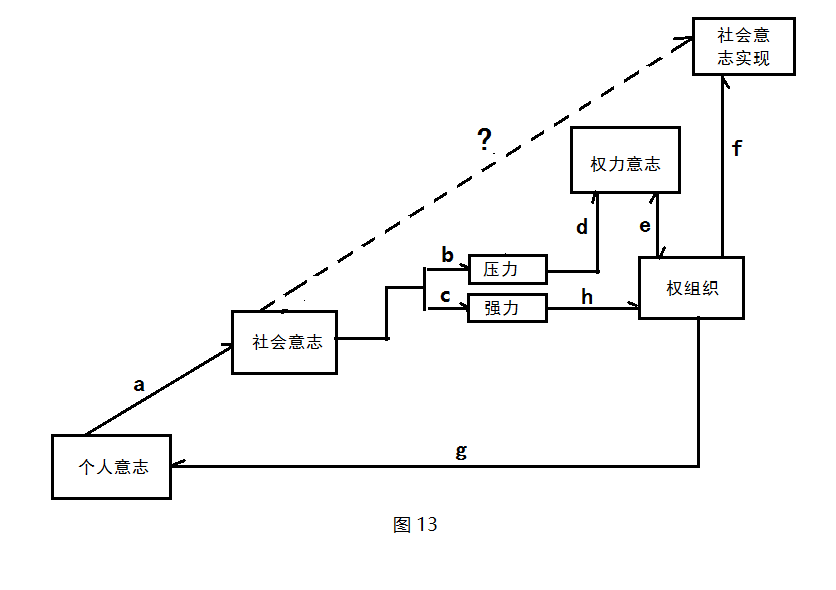
纵观历史,人类社会的核心问题是解决权力意志对社会意志的扭曲,可大致归纳为图 13:
Throughout history, the central issue in human society has been addressing the distortion of societal will by the will of power, which can be broadly summarized as illustrated in Figure 13.
当“权力意志”脱离“社会意志”,会通过“权组织”(e)扭曲“个人意志”(g),聚合为“社会意志”的扭曲(a)。多数情况下,“社会意志”的反扭力以“压力”方式表达(b),作用于“权力意志”(d),如果“权力意志”能相应调整和改革,便可通过“权组织”的权力实施(e),一方面使“社会意志实现”(f),一方面缓解“个人意志”的扭曲(g)。如果“权力意志”不能通过自我调整和改革释放“压力”,“社会意志”的反扭力就会形成或选择支持“强力”(c),推翻原有的“权组织”,以新的“权组织”取而代之(h),形成新的权力意志(e),新的“权力意志”再通过“权组织”(e)使“社会意志实现”(f),缓解“个人意志”的扭曲(g),进入下一轮循环。
When "will of power" detaches from "societal will", it distorts "individual will" through the "power organization" (e) and aggregates into the distortion of "societal will" (a). In most cases, the anti-distortion force of "societal will" is expressed as "pressure" (b) and acts on the "will of power" (d). If the "will of power" can adjust and reform accordingly, it can implement the power of the "power organization" (e). On the one hand, this achieves the realization of "societal will" (f), and on the other hand, it alleviates the distortion of "individual will" (g). If the "will of power" cannot release the "pressure" through self-adjustment and reform, the anti-distortion force of "societal will" may take the form of or choose to support "force" (c). This leads to the overthrow of the existing "power organization," replaced by a new "power organization" (h), forming a new will of power (e). The new "will of power" then utilizes the "power organization" (e) to achieve the realization of "societal will" (f) and alleviate the distortion of "individual will" (g), entering into the next cycle.
在二元社会,“社会意志”通过“权力意志”得到实现。但是“社会意志”与“权力意志”之间沟通困难,需用“压力”促使“权力意志”体现“社会意志”,或通过“压力”促使脱离了“社会意志”的“权力意志”回归。而“压力”形成和传递存在滞后,即使是对“压力”开放法定管道的代议制,也存在滞后并造成诸多不利。尤其对全球问题,漫漫长链的滞后可能导致严重后果。而专制体制没有传递“压力”的制度管道,仅凭当权者的自我感知,滞后更甚。如果专制权力不但颟顸迟钝,还要镇压,拒绝自我调整。那时“社会意志”便只有通过支持“强力”更换权力,不但滞后,且造成社会震荡和人民苦难。
In a dualistic society, "societal will" is realized through the "will of power." However, communication between "societal will" and the "will of power" is difficult, requiring "pressure" to compel the "will of power" to embody "societal will" or to induce the return of the "will of power" that has detached from "societal will." The formation and transmission of "pressure" are subject to lags, even in a representative democracy that provides legal channels for the expression of "pressure", causing various disadvantages. Particularly in the case of global issues, the prolonged chain of lags may lead to severe consequences. In a totalitarian system that lacks institutional channels for the transmission of "pressure," the lags are even more pronounced. If the authoritarian power is not only sluggish but also repressive, resistant to self-adjustment, then "societal will" can only seek a power renewal through the support of "strong force", resulting not only in lags but also causing societal upheaval and human suffering.
社会发展是否只能如此?图中带“?”的虚线代表提出的问题——能否找到一种方法,可以让“社会意志”无需通过“压力”和“强力”,无滞后地随时实现?
Can societal development only proceed in this manner? The dashed lines marked with "?" in the diagram represent the posed question: Is it possible to find a method that allows "societal will" to be realized at any time without the need for "pressure" and "force," free from lags?