Chapter synopsis: The method of vector summation of individual will is to elect “sum carrier” at any time within the empirical range. The “sum carrier” then continuously calculate larger vector partial sums in recursive hierarchical layers, and finally derive the societal will.
If societal will is correct in itself, societal development is to achieve societal will. First and foremost, concrete "summation operations" must be performed to obtain the true societal will. Concepts that cannot undergo concrete "summation operations" are inevitably susceptible to being seized and exploited by power. For example, utilitarianism regards social happiness as the sum of individual happiness, pursuing the "greatest happiness for the greatest number." Since individual happiness cannot be universally measured and subjected to "summation operations," it ends up being manipulated by power in the name of pursuing the greatest overall social happiness or leaning towards authoritarianism. For instance, claiming that depriving the rich can increase the happiness of the majority of the poor and thus increase the overall social happiness may ultimately result in comprehensive deprivation of society. Alternatively, it may veer towards materialism by simplifying happiness into economic figures, equating it with objectively measurable interests, ultimately deviating from societal justice.
In fact, regardless of any philosophical doctrine, the ultimate trace can lead to individual will—the contract is reached by the mutual agreement of individual wills, and happiness needs to be perceived and recognized by the will of individuals. So, instead of using concepts like contracts and the total quantity of happiness, why not directly trace it back to individual will and the societal will as the sum of individual wills? If a specific method for summing individual wills can be found, the issues faced by contract theory and utilitarianism can be readily resolved.
How to perform vector summation operations on the individual wills of all members of society to obtain societal will? There is no "other" capable of handling the enormous and rapidly changing information from the complex and diverse individual wills of millions or billions of people—no matter how powerful the government or advanced the computer. According to the formula provided earlier (2n-1-1), even in a group as small as 1000 people, the theoretically possible maximum number of relationships would be 5.35754304 × 10^300. That's a 301-digit integer, a concept beyond any number on Earth. Even if every person in the world could count as fast as the fastest supercomputer today (the "Sunway TaihuLight" developed by China in 2016), which can count 93×10^15 numbers per second and counts without stopping for 4.6 billion years (the current age of the Earth), all of humanity together could only count to a 37-digit integer. This is just replacing the possible relationships of one thousand people with counting, not the actual relationships.
The only entity capable of undertaking the vector summation of individual wills is the all individual wills participating in the summation. The logic of this statement itself can prove this conclusion—because what individual wills have to bear is precisely what they have done, and if individual wills cannot bear it, they would not want to do it.
The "operation" of individual wills mutually summing themselves is the process of self-organization through direct communication, negotiation, and consensus building. Since the scale of self-organization is limited by the extent of direct communication, the following discussion first explores how the vector summation of individual wills can be achieved within small-scale self-organizations. Later, we'll consider whether it is possible to expand the scale of self-organization to achieve a larger scope of summation.
Everyone will have a different will on different issues; Different people have different wills on the same issue. This complexity makes the vector summation of individual wills appear intricate. However, as long as the following four points can be achieved, vector summation will naturally be completed.
The sufficiency of communication is inversely proportional to the size of the communication scope. I refer to the range that can be sufficiently communicated directly as the "empirical range". The empirical range does not only refer to a community where people interact regularly but, in modern society, more commonly refers to work units, residential units, or "projects" (interest groups, advocacy organizations, cooperative businesses, or collaborations involving a few individuals, all can be considered "projects"). Regardless of the communication method, whether face-to-face or online, it falls under direct communication. In fact, any unit of any organization can broadly be seen as a "project". Participants in a "project" may not have knowledge of each other's various aspects like members of a communal living group, but as long as they directly communicate within the "project", have empirical interactions, and understand each other's aspects related to the "project", it is enough for them to carry out the vector summation of personal will on aspects related to the "project".
The empirical range of different “projects” has different scale limits. As long as there is sufficient direct communication about the content of the “project”, it falls within the empirical range. The reason why the individual wills within the empirical range can achieve vector summation is interrelated based on the following points:
Sufficient direct communication does not imply unanimity but the ability to understand each other. Remaining in disagreement means being unable to convince each other, while negotiation allows all parties to reach a compromise.
向量求和即是所有成员在充分沟通基础上反复协商达成共识的过程。
Vector summation is the process of all members repeatedly negotiating and reaching consensus based on sufficient communication.
The empirical range creates information symmetry among all members of the group, enabling an understanding of the conditions of other members and the overall situation. Individuals are aware of their optimal position on the "competition-cooperation" curve, understand the reactions and bottom lines of others, know when to concede and to what extent, plan the steps and how to implement them... until reaching a precise balance. Only then does this dynamic negotiation "bargaining" come to an end.
虽然对 b) 存在各种质疑,但不可否认多数人具有基于利害考量的理性。如果没有这一点,人类社会将没有合作,不存在秩序,奖赏和惩戒体系都会无效。事实显然并非如此。即使的确有人看上去不符合 b) 描述的理性,从功利角度衡量似乎“不智”,其仍是在追求个人意志的满足(哪怕只为赌气或炫耀),符合人的基本性质。
While there are various doubts about the existence of b), it cannot be denied that the majority of people have a rationality based on considerations of interests. Without this, human society would lack cooperation, order, and reward and punishment systems would be ineffective. The facts are clearly not so. Even if there are individuals who may appear to deviate from the rationality described by b), assessing them from a utilitarian perspective may seem "imprudent," but they are still pursuing the satisfaction of individual will (even if it's just to show off or be rebellious), aligning with the fundamental nature of humans.
最终达成的共识即是个人意志的向量和,也是该经验范围的“共同体意志”。
The ultimately reached consensus is both the vector sum of individual wills and the "communal will" of that empirical range.
条件二 形成默契Condition 2: Forming a tacit understanding
In the process of sufficient communication, language undoubtedly plays a crucial role, but it does not always accurately convey thoughts. Many individuals struggle not only to articulate their complete individual will but also to express specific will on particular issues. There is often a sense of difficulty in articulating thoughts, or they may be distorted when translated into language. Daily language tends to generalize, deviate from the main topic, or even lack sincerity. Relying solely on language for the vector summation of individual wills, even if achievable in the end, comes with a high cost of negotiation, and the consensus reached may lag behind the development of the situation as it is expressed in language.
Therefore, relying solely on language for the vector summation of individual will is not enough; context is also necessary. Every word and sentence in language is alive, containing implicit backgrounds, intricacies, differences, hints, attitudes, and more that can be understood but not explicitly conveyed. The characteristics of the vector of individual will exist more in the context. Without context, a significant portion of the vector summation of individual will would be lost. The crucial aspect of the empirical range in sufficient direct communication is having context, allowing the language within the empirical range not to be isolated and abstract but to have a "history" and "pictorial" quality, enabling holistic communication.
Grasping context primarily relies on tacit understanding. "Tacit understanding" generally refers to an intuitive comprehension without the need for explicit language and is often used to describe an optimal state of cooperation, although competition can also involve tacit understanding. When person A can genuinely sense person B's bottom line and make reasonable demands without going too far, and person B silently responds with restraint, it is a high-level tacit understanding. In reality, both cooperative and competitive tacit understandings are prevalent. Language negotiations can only be intermittent, while tacit understanding can be ongoing; language negotiations are time-consuming and resource-intensive, while tacit understanding requires almost no cost. For the vector summation of individual will to be applied in daily life, it needs the presence of instant and cost-free tacit understanding.
Tacit understanding and the formulation of written regulations, contracts, as well as upfront statements like "let's be clear from the start" or "close kin, clear accounts" are not contradictory. Tacit understanding is just one method of everyday communication and operation, complementing the clarity of written words. Recursive self-organization certainly involves discussions, negotiations in language, formulation of expressions, establishment of rules, contract agreements, and the creation of meticulously crafted legal documents. For a top-down communication structure—scalar summation, it tends to be relatively straightforward, as unified written language can be enforced. However, in a bottom-up structure where everyone participates in vector summation, it introduces numerous variables to the negotiation and decision-making process, exponentially increasing complexity. Without relying on tacit understanding, it may encounter operational obstacles that are challenging to overcome.
A one-on-one tacit understanding is easily achieved through natural interaction. Group-level tacit understanding is troublesome. For instance, if there is a disagreement between A and B, and C tacitly understands A, then they may not have a tacitly understand with B, and vice versa.
In theory, group-level tacit understanding can be achieved through repeated games and integration. Through continuous communication, speculation, testing, and competition among individuals, along with repeated interactions, each person can compare, synthesize, and adjust their perspectives. Eventually, they will recognize the common ground for tacit understanding that unifies everyone and position themselves accordingly. When all members of the group achieve this, the entire group's tacit understanding is realized.
It can be imagined that this method is complicated and cumbersome, as the number of people in the group increases slightly, the combinatorial relationships required for tacit understanding will grow dramatically (as mentioned earlier, 2n-1-1). A simplified approach is to establish a common hub where each member interacts with the common hub, transforming a one-to-many relationship into a one-to-one relationship. When all members integrate with the common hub, it becomes the vector sum of the personal will of all members. Therefore, the common hub can be called the "sum carrier" or "consensus carrier."
The proposal can serve as the "consensus carrier" in the form of written language. Each member evaluates and adjusts the proposal, then expresses their opinions on the proposal from draft to finalization. The process from draft to final version is the process of vector summation of individual wills, and the final version represents the calculated vector sum. However, as mentioned earlier, there are many limitations to the form of written language, and the cost is too high. It is not feasible to propose and repeatedly revise numerous decisions in daily situations.
Since tacit understanding is an effective way of vector summation, a better "sum carrier" should inherently possess the ability to establish tacit understanding. It's easy to understand that this carrier can only be a person. Since each member within the empirical range has the ability to establish tacit understanding, selecting one person who can intuitively establish tacit understanding with each member of the group, integrate their perspectives, and replace the actual negotiation process with proactive decision-making, can faithfully and completely reflect the vector sum. This approach minimizes operational costs and time consumption.
以人充当“和载体”的逻辑与优越在于:
The logic and superiority of using individual as "sum carriers" lies in:
The "sum carrier" within the empirical range can accurately anticipate the stance and attitudes of each member, understand their specific demands and desires, imagine the negotiations, interactions, and compromises at each step, as well as their respective bottom lines. Therefore, the "sum carrier" can almost precisely calculate the vector sum with tacit understanding.
Due to the sufficient communication within the empirical range, the "sum carrier" is under the supervision of all members. Any deviation from the sum carrier will be promptly requested for correction until it aligns with the vector sum.
经验范围使群体成员对“和载体”的偏离能及早发现、制约和修正,因此不会因滞后造成实际的恶果;
The empirical range enables group members to detect, constrain, and correct deviations from the "sum carrier" early on, preventing actual consequences due to lags.
With the "sum carrier," only a small number of significant decisions require actual negotiation among group members, while daily affairs are governed by the "sum carrier" through tacit understanding, eliminating negotiation costs and avoiding delays.
The question then boils down to who should assume the role of the "sum carrier"? How to ensure that the "sum carrier" remains loyal to the communal will? And how can deviations be immediately corrected when they occur? It is not difficult to think that only through elections can these be achieved.
这种选举须有两个限定:一是必须在经验范围内选举,二是可以随时选举。
This type of election must have two constraints: firstly, it must be within the empirical range, and secondly, election can be held at any time.
Elections are also a summation of individual wills. Unlike elections that merely express the scalar of "for" or "against," empirical range elections are vector, allowing for direct and sufficient communication. They enable each member to fully articulate their wills—whether conveyed explicitly or subtly implied. Each member expresses their degree of support, opposition, partial agreement, partial disagreement, and the reasons behind their will. It's not just a process of completing the election; rather, it's a vector summation of the collective will of the community. This involves not only verbal communication but also a sense of mutual tacit understanding. Each member may have differing opinions, and the individual elected through negotiation and compromise ultimately represents the will of the community, becoming the "sum carrier" of the community's will at the moment of election.
However, since everyone seeks the satisfaction of their individual will, how can we ensure that the elected representatives do not prioritize their own will but consistently act as faithful "sum carriers"? Naturally, one cannot expect elected representatives to willingly give up personal pursuits. Even if they manage to do so temporarily, it is unlikely to be sustainable. The fundamental constraint lies in the fact that as soon as an elected representative deviates from the communal will, they can be immediately removed from office, and a new person can take their place.
Therefore, it is required that elections for the "sum carrier" can be conducted at any time, rather than having fixed terms. This represents a significant change in the electoral process. Large-scale elections involving the masses are resource-intensive and can only be held periodically. In contrast, empirical range elections incur no costs, take no time, require no administration, do not involve campaigning, and lack the cumbersome procedures of voter registration, voting processes, and ballot counting. They can be initiated by any member at any time.
Once elections can be held at any time, it leads to an important and intriguing outcome—every step taken by the elected representative in fulfilling their duties is akin to facing a potential re-election. While actual elections may not occur frequently, the possibility of them happening at any moment prompts a constant mental simulation in the elected representative's mind. To avoid the risk of being removed through an impromptu election, elected representatives must continuously align with the collective will of the community, promptly correcting any minor deviations. This ensures that they consistently function as an accurate "sum carrier".
Therefore, the possibility of elections at any time doesn't necessarily mean that elections will happen frequently. Rather, the potential for impromptu elections encourages elected representatives to consistently align with the collective will, making continuous corrections to avoid deviations. Paradoxically, this may render the need for actual re-elections unnecessary, as the constant adherence to the community's will reduces the likelihood of significant deviations that would trigger such elections.
The "implicit but not expressed" nature of impromptu elections brings about another effect. In this case, the community only needs to perform the vector summation for the "sum carrier", and this automatically achieves the vector summation for other community affairs without the need for a direct vector summation for those specific matters. The mechanism behind this is that the vector summation of individual wills within the community for each matter is transferred from reality to the mind of the elected representative. Due to the constraints of impromptu elections, the tacit understanding, corrections, and integration of the elected representative will consistently align with the collective will of the community (i.e., the vector sum of the individual wills of all members). It perfectly coincides with the actual vector summation result, eliminating the need for a practical vector summation. Without this mechanism, even within the empirical range, constant vector summation of individual wills would be practically impossible and not a daily operation.
The four conditions mentioned above can naturally emerge in reality, with tacit understandings prevalent within empirical ranges. Even without being termed "sum carrier", leaders that naturally form in small groups often assume this role, akin to an impromptu election emerging from people's hearts. This is the ongoing self-organization observed in reality. As long as there is an empirical range with equal relationships, self-organization will naturally occur. However, the problem arises when any self-organizing entity with vitality will inevitably expand in scale, surpassing the limits of direct communication. At that point, structures for indirect communication need to be established. This leads back to a communication hub, where the hub position becomes proprietary, and self-organization transforms into a "power organization + been organized" structure. The vector summation transforms into a starting point for scalar summation. Yet, in the argument presented in this text, this cycle is not in vain. It highlights the crucial aspect of transcending this loop—there must be a way to consistently maintain direct communication within empirical ranges while allowing the scale of self-organization to expand continuously. Only in this way can the vector summation of individual wills be broadened, ultimately achieving the vector summation of societal will.
到了这一步,自然而然的方式已经解决不了,需要有所发明,有所设计。
At this stage, the solutions cannot rely on natural processes alone; innovation and intentional design are required.
The villagers' group formed by n households constitutes an empirical range, where the village head is elected as the "sum carrier," achieving the vector summation of the wills of n households through a self-organizing approach. Now, for the next administrative level, the entire village, how can the vector summation of individual wills of whole village be achieved?
Suppose an administrative village has 1000 residents, surpassing the range of sufficient direct communication. Regardless of whether it is through tacit understanding or language, and whether it involves negotiation or elections, the vector summation cannot be achieved for such a large number of people. Elected representatives are also unable to intuitively sum up the individual wills of a thousand villagers through tacit understanding. When there is a deviation between their personal will and the collective will of the community, the villagers cannot promptly detect it, and impromptu elections are not feasible. Moreover, regular elections for a community of 1000 people require facilitators, and those in power who occupy the position of facilitator tend to communicate in ways favorable to themselves while limiting unfavorable communication. This often leads to them being re-elected time and time again—this is the current reality of "village autonomy" in China.
Beyond the empirical range, it becomes impossible to achieve the vector summation of individual wills. However, is it possible to take the vectors obtained from each of the n villagers' groups, perform a vector summation on each group, and then sum those group vector summations to obtain the vector summation of all individual wills within the administrative village? According to the principles of vector summation, by grouping vectors, calculating the vector summation for each group, and then summing those group vector summations, the result will be identical to directly summing all individual vectors.
The collective will of the group carried by the villager group leader as the "sum carrier" is precisely such a vector sum. Therefore, the result of the vector sum of the collective will carried by each group leader should be the vector sum of the all individual wills within the entire village—essentially, the collective will of the administrative village.
If n villager group leaders gather together without surpassing the range of sufficient direct communication, then all the arguments presented earlier apply. As long as these n villager group leaders form another self-organizing entity within the empirical range and proceed to elect a "sum carrier," it becomes possible to achieve the vector summation of the wills of the n villager group leaders.
The issue lies in whether the wills brought into the summation by the n villager group leaders are their individual will or the collective will of the village group they represent. It is only by ensuring that the vector summation among the villager group leaders is based on the collective will of their respective village groups that we can obtain the vector summation of the individual wills of all villagers in the administrative village. This requires that the villager group leaders, while serving as the "sum carrier" within their village groups, also maintain their role as the "sum carrier" of the village group when participating in the vector summation among themselves. This is crucial.
This is guaranteed by a bottom-up "layered" structure. The layers are cross-cutting and must exist in a hierarchical relationship. In the layered structure, any node in the middle layer belongs simultaneously to both the upper and lower layers. Villager group leaders belong to the village group that elected them and, at the same time, belong to the upper-layer structure—the community of villager group leaders. Within the layer of the village group, the villager group leader is the elected representative, the "sum carrier"; in the upper-layer structure, the villager group leader is an ordinary member participating in the election of the "sum carrier." These two layers are inseparable.
In the layered structure, members of the village group can constantly constrain the group leader they elected (through impromptu elections). In the upper-layer structure, the group leader can only function as the "sum carrier" of the village group when participating in the summation of the administrative village. Otherwise, the members of the village group can replace the group leader through impromptu elections.
As long as it can be ensured that the villager group leader consistently participate in the vector summation of the administrative village as the "sum carrier," the upper-level "sum carrier" elected by the villager group leaders—the director of the administrative village—will simultaneously serve as the "sum carrier" for the individual wills of all villagers in the administrative village.
Thus, the limitations of the empirical range on the vector summation of individual wills are overcome, enabling summation on a larger scale. The village group to the administrative village represents just two levels of the layered structure. By continuing to expand with more levels, the structure and principles remain the same; only the village group leader needs to be replaced with the director of the administrative village, the township head, the county head, or the city mayor. Each role has a dual identity—serving as both the "sum carrier" for the lower level and a participant in the vector summation for the upper level; acting as both the elected representative for the lower level and the one conducting elections for the upper level; functioning as both the director of the lower-level committee and a member of the upper-level committee. By extending this layered structure from bottom to top, the scale of vector summation of individual wills can continually expand without departing from the empirical range.
For the realms of invention and design, both the empirical range and self-organization are naturally occurring phenomena with a long history, so their existence is not surprising. What can be considered innovative is the construction of an recursive structure using the layered approach for the empirical range and self-organization. This allows for an infinite expansion of scale while consistently maintaining a state that is neither a power organization nor an organized entity—recursive self-organization.
9.4. 分层不是障碍The layered structure is not a hindrance
With impromptu elections, theoretically, one can replace elected representatives in the upper-level structure who deviate from the collective will at any time. However, is there a possibility that elected representatives may exploit the isolation between layers to deviate without being noticed by the layer that elected them? The following logic can eliminate such a scenario:
Given that layers are within the empirical range, members of each layer have a comprehensive understanding of the elected representatives. This understanding extends beyond their capabilities to include their character—whether they are trustworthy or deceptive, consistent in their actions, or prone to double-dealing. This ensures, in advance, the moral character of the elected representatives.
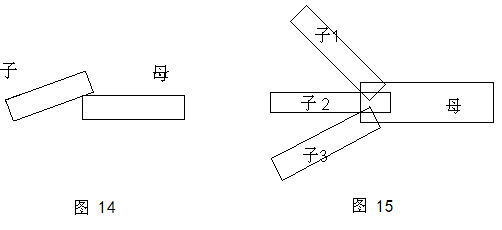
Even with layers in between, members of the lower-level layers will not be completely unaware of the actions of the elected representative in the upper-level layer. After all, there is overlap between the upper and lower-level layers, and important matters are understood. Using the concept of a "mother-son structure," the substructure (lower-level layer block) will have a certain empirical extension to the superstructure (upper-level layer block). In Figure 14, the part where "son" presses against "mother" represents this extension. Figure 15 is a top-down view of Figure 14, showing that beneath each mother structure, there are several substructures (several village households in a village group, several village groups in an administrative village, etc.). Each substructure contributes to the extension of the mother structure. This allows the actions of the elected representative in the upper-level layer to be supervised by multiple lower-level layers.
Any decision or action within the mother structure either directly imposes on the substructure or will eventually influence the substructure. Therefore, even if there is a temporary lack of awareness that elected representatives at the upper-level layer are deviating from the collective will of the community, it will be discovered sooner or later due to the practical impact caused by such deviations.
当选者在上级层块的行为会处于选举竞争者的密切监督下,也是制约。
The actions of elected representatives at upper-level blocks will be under close supervision by electoral competitors, serving as a constraint.
The above pertains to situations with one intervening layer. If there are multiple layers in between, can we still ensure that the "sum carrier" does not deviate from the will of the community? Or, even if there is deviation, can it be detected and replaced at any time?
Firstly, regardless of how many layers ascend, members of the corresponding blocks still fall within the same empirical range. Even if the leaders of the five continents form the top-level layer of a world federation, with residences thousands of kilometers apart and lacking the constant interaction seen in village communities, their communication technologies can bridge the gap. Conducting meetings through holographic imaging systems is nearly equivalent to sitting in the same room, and electric currents traverse thousands of kilometers much faster than a person walking from one end of a village to the other, making it more convenient than meeting fellow villagers. Undoubtedly, they won't engage in casual conversation about personal matters; their discussions revolve around global affairs, and there's no need to know whether someone is faithful to their spouse or skilled at fishing. However, if the faithfulness to a spouse ever becomes relevant to global affairs, it can be promptly investigated with the intelligence capabilities of each continent's leaders.
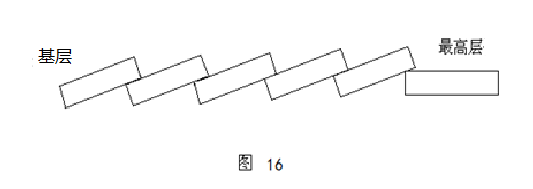
Next, let's consider the constraints of empirical extension. Generally, empirical extension from lower to upper layer blocks is typically applicable to adjacent mother-son structures and is challenging to extend across higher levels. However, since the elected representatives of each block are constrained by the empirical extension from the lower-level layers, as long as the grassroots can extend upward by one layer, it will extend to the highest level through a cascading relationship. Figure 16, resembling falling dominoes, illustrates that although the "highest level" is not directly pressed by the "grassroots," any action at the "highest level" can chain react and transmit to the "grassroots." In this series, all layer blocks are pressed down by the "grassroots," symbolizing that the recursively self-organizing will of the "grassroots" is to be reflected and obeyed layer by layer.
Imagining the view from above in Figure 16, the earlier discussion of "each mother structure having several substructures beneath it" would demonstrate a layered expansion. The highest level is pressed down by several "sub-high levels," each "sub-high level" is pressed by several "sub-sub-high levels," and so on. Each layer pressing down the layer beneath it represents a situation where more are constraining fewer. The substructures of the grassroots, being the most numerous, equate to the "highest level" being constrained by numerous elements at the grassroots level.
One of the main criticisms of the layered structure is the potential distortion in information transmission. Some argue, "Electing the central government through ten elections means that public opinion is diluted nine times... As long as public opinion is distorted or betrayed in one indirect election, even if all other indirect elections strictly respect the wishes of the electors, the resulting government will go against public opinion". If it were just a matter of layer-to-layer transmission, such issues could indeed arise. However, the block structure is not about layer-to-layer transmission but rather layer-by-layer aggregation. Societal will does not pass from the "grassroots" to the "highest level"; instead, it aggregates from the "grassroots" to the "highest level". Since it's not a transmission process, there is no issue of transmission distortion or dilution. The elevation in block structures is an expansion of aggregation. With each elevation, more individual wills contribute to the summation of vectors. The smaller vector sums continually aggregate into larger vector sums until the final expression of societal will.
Even from a transmission perspective, we can provide a counterexample. In a centralized power system with an equal number of hierarchical levels, the emperor appoints and dismisses only the ministers below him. Through a top-down, step-by-step appointment ladder, the will of the ruler can be imposed on the people. Using the same logic, why couldn't the will of the people be extended to the highest level by electing their upper-level layer in a recursive self-organization manner and employing a sequence akin to hierarchical elections (equivalent to power appointments)? The only difference between the two scenarios is the reversal of the direction of appointments. In fact, because top-down power involves few governing many, an emperor overseeing numerous bureaucrats cannot achieve information symmetry. On the other hand, bottom-up power involves many governing few, and each elected representative is constantly supervised by various sources. From this perspective, if a despotic emperor could extend their will to the grassroots, a recursively self-organizing populace should be even more capable of transmitting their will to the upper levels. Of course, the former has a guaranteed structure, so the latter also needs to establish a corresponding structure.