Chapter synopsis: The eight fundamental rules establish an automatic operation and self-regulation mechanism, capable of giving rise to a recursive self-organization society.
To achieve the vector summation of societal will, it requires a recursive self-organization structure that spans the entire society. In reality, the only organization that covers the entire society is the state authority. This article considers the state authority as a "public power organization," advocating for the comprehensive implementation of recursive self-organization by the "public power organization" to obtain societal will and address the issue of power will deviating from societal will.
In addition to the "public power organization", there are groups that collaborate for functions and objectives related to life, production, belief, career, etc., such as families, cooperatives, employee-owned enterprises, political parties, associations, churches, academic organizations, etc., which can be termed "collective power organizations", Collective power organizations do not require but can voluntarily implement recursive self-organization.
私有企业或机构为“私权组织”,不实行递进自组织。
Private enterprises or institutions are considered "private power organizations", and they do not implement recursive self-organization.
不实行递进自组织的众权组织和私权组织须遵守所属及上级公权组织层块的法律与决策。
Collective power organizations and private power organizations that do not implement recursive self-organization must adhere to the laws and decisions of the public power organization layer blocks to which they belong and the higher-level layer blocks.
Implementing such a system certainly requires careful and comprehensive institutional design, but delving into details at this moment is premature. The primary focus is to establish the mechanism. The mechanism doesn't need to be as exhaustive as an institution; by implementing the following eight fundamental rules, it will generate an internal driving force for automatic operation. Subsequently, corresponding order details will "naturally emerge", and the system will automatically adjust and self-improve based on feedback.
递进自组织基本规则Fundamental rules of Recursive Self-Organization
Rule 1 Recursive self-organization is composed of layer blocks that are recursive from bottom to top. The size of each layer is no less than four individuals and no greater than the extent to which all members of layer block can communicate directly and sufficiently.
规则二 基层层块以自由组合形成。
Rule 2 The blocks of the base layer are formed in free combinations.
Rule 3 Each layer block uses a two-thirds majority vote for elections and decision-making, and a simple majority vote for vetoing. The voting weight of each member is determined by the total number of members in all the layer blocks subordinate to them. The voting weight of an elected representative is the average of the voting weights of their electors.
Rule 4 The elected representative of a layer block becomes the elector for the upper-level layer block. There are no term limits for elected representatives, and elections can be held at any time. An incumbent elected representative may not belong to any lower layer block, may not hold elected positions in other layer blocks, and is also ineligible to participate in the elections of the current layer block.
规则五 当选者担任本层块行政首长,同时是本层块和上级层块的立法(决策)参与者。
Rule 5 The elected representative serves as the administrative leader of the current layer block while concurrently participating as a legislative (decision-making) participant in both the current block and the upper-level layer block.
规则六 行政人员由本层块行政首长或其受托人任命。行政人员不可成为所在递进自组织中任何层块的当选者。
Rule 6 Administrative personnel are appointed by the administrative leader of the current layer block or their delegate. Administrative personnel are not eligible to become elected representatives in any layer of the recursive self-organization.
规则七 各层块与其下属所有层块构成自治体,拥有不与上级决策和法律违反的一切权力。
Rule 7 Each block, along with all its subordinate blocks, forms an self-governing entity, possessing all powers not conflicting with decisions and laws from their superiors.
Rule 8 The layer block of the public power organization can, at any time, elect a judicial officer for the current block with a two-thirds majority vote, who may not hold concurrent positions. The judicial officer executes legislation for the current block and higher-level blocks, with jurisdiction over the current block and subordinate blocks. No interference other than elections shall be made in the appointment of the judicial officer.
Recursive self-organization is composed of layer blocks that are recursive from bottom to top. The size of each layer is no less than four individuals and no greater than the extent to which all members of layer block can communicate directly and sufficiently.
a) 限制层块规模是递进自组织的关键之一,是否对此有自觉意识和操作,结果完全不同。前面说过有活力的自组织会自然扩大,不自觉限制,一俟超出经验范围就无法充分沟通,需要靠人主持,进而生成权力,分为二元,自组织即变成“权组织+被组织”。因此必须自觉地限制规模扩大,始终保证层块内部能够实现充分的直接沟通,才可避免以往的怪圈——自组织发展导致扩大规模,扩大规模后便不再是自组织。
a) Restricting the size of the layer block within empirical range is one of the crucial aspects of recursive self-organization, and whether there is awareness and operation in this regard makes a significant difference. As mentioned earlier, a dynamic self-organization will naturally expand without conscious limitations. Once it surpasses the empirical range, sufficient communication becomes challenging, requiring facilitator and leading to the emergence of power, resulting in a dualistic structure where self-organization transforms into "power organization + been organized". Therefore, it is imperative to consciously limit the scale expansion, ensuring that there is always sufficient direct communication within the layer block. This conscious limitation is crucial to avoid the paradox where the development of self-organization leads to scale expansion, and once the scale expands, it is no longer truly self-organization.
b) 根据项目不同,层块规模的限度也不同。判断是否达到限度只需掌握一点——如果离开主持人即无法运转,就是超出了规模限度,层块即应通过再分组,调整到无需主持也能自行运转的规模。
b) Depending on the project, the limit of the block size may vary. The key criterion for determining whether the limit is reached is simple: if the layer block cannot operate without a moderator, it has exceeded the size limit. In such a case, the block should be reorganized, adjusting to a size that can operate independently without the need for oversight.
c) 层块的再分组,要保持新的层块规模不小于四人。因为层块进行重新选举时,原先当选的成员不能参与,基层层块至少还需要有三个其他成员才能进行三分之二决的选举,因此最小规模需要为四人。高层层块虽以票权而非层块成员数计票,但从多元性考虑,也需要保证一定成员数。
c) The regrouping of layer blocks must ensure that the new block size is no less than four individuals. This is because, during the re-election of blocks, the previously elected members cannot participate. For grassroots blocks to conduct a two-thirds majority vote election, there must be at least three other members, making the minimum size required four individuals. Although higher-level blocks count votes based on voting rights rather than the number of block members, a certain number of members should still be maintained for diversity considerations.
d) Relying on a facilitator and utilizing a facilitator are distinct concepts. The former implies that without a facilitator, the operation cannot proceed, while the latter is about reducing operational costs—operations can still proceed without a facilitator, and any member can take on the role of a facilitator. For instance, the "sum carrier" required for vector summation of individual wills can be viewed as a facilitator, but in the context of electing a "sum carrier" within the empirical range, vector summation does not depend on the facilitator—an election initiator can be any member. This ensures the possibility of elections at any time and constrains the "sum carrier" from deviating from the sum of vectors. However, beyond the empirical range, elections require a facilitator, giving the facilitator the potential to manipulate elections, and their wielded power may inadvertently diverge from the collective will of the community.
规则二Rule 2
基层层块以自由组合形成。
The blocks of the base layer are formed in free combinations.
a) 自由组合的含义,一是加入哪个层块不是强制划分而由当事人选择;二是需要被选择的层块同意才能加入;三是可以随时退出所在层块。
a) The meaning of free combination, first, the choice of joining a specific layer block is not mandatory and is left to the discretion of the individual; Second, consent from the layer block being chosen to join is required; The third is that one can exit the layer block at any time.
b) 基层层块是递进自组织的主体,是要进行求和的个人意志向量之所在。保证基层层块向量求和的真实,基层以上的向量求和才有真实的基础。基层以上的层块只是求和结构,是逐层聚合的向量分和,功用是凝聚和体现基层的向量和。
b) The grassroots layer block is the core of recursive self-organization, where the vector of individual will to be summed. To ensure the authenticity of the summation of vectors at the grassroots layer, the summation of vectors above the grassroots layer must have a genuine foundation. Layers above the grassroots layer are only summation structures, involving the incremental aggregation of vector components. Their function is to consolidate and reflect the vectors and essence of the grassroots layer.
c) 递进自组织的前提在于基层层块必须是真正的自组织,因而不能有任何强制,必须自由组合。
c) The premise of recursive self-organization is that the grassroots layer blocks must be truly self-organizing, so that there is no coercion and they can be freely combined.
d) Freedom of association allows people who identify with each other to come together. The ability to leave freely helps to avoid irreconcilable differences or the formation of unresolved deadlocks. It also prevents elected representatives from being torn apart on both ends by electoral participants who refuse to compromise.
e) The freedom of association allows minority groups to form their own layer blocks, preventing them from being assimilated and overwhelmed by the majority. This is beneficial for preserving the distinct characteristics of minority groups. The will of the minority is summed up in higher-level layer block through their own "sum carriers".
f) Currently, public power organization are organized based on geographical divisions. The population within the smallest administrative units, such as residents' committees in administrative villages or urban areas, also needs to be further subdivided into multiple layers to facilitate sufficiently direct communication. Therefore, there is no need to dismantle the existing geographical divisions of public power organization. Instead, the focus should be on freely combining during further subdivision into layers. This approach aligns well with the current state of affairs and facilitates a smooth transition.
g) 如果确有需要突破地域区划的自由组合,在实行了递进自组织后,由相关区划的公权组织进行协商决定。
g) If there is a need to break through the free association of geographical divisions, after the implementation of recursive self-organization, the public power organization of the relevant division shall negotiate and decide.
Each layer block uses a two-thirds majority vote for elections and decision-making, and a simple majority vote for vetoing. The voting weight of each member is determined by the total number of members in all the layer blocks subordinate to them. The voting weight of an elected representative is the average of the voting weights of their electors.
a) 采取三分之二决,是在一致性的价值理念和现实操作性之间的折中。一方面要求绝对多数,以避免二分之一的简单多数造成共同体近于势均力敌的分裂,一方面仍保留一定的少数服从多数,避免僵局无法化解。
a) Adopting a two-thirds majority decision represents a compromise between the value of consensus and practical operability. On one hand, it demands an absolute majority to avoid the potential division caused by a simple majority, where the community might become nearly evenly split. On the other hand, it still maintains a degree of minority acceptance of the majority to prevent deadlock and ensure resolutions can be reached.
b) 三分之二决固然不如二分之一决容易达成,但宁可不厌其烦反复协商。操作便捷只是其次。比起二分之一决,三分之二决更能促使共同体认真对待反对意见,有利培育整体共识。
b) While a two-thirds decision may not be as easily attainable as a simple majority decision, it is preferable to endure the inconvenience of repeated negotiations. Operational convenience takes a back seat in importance. Compared to a simple majority decision, a two-thirds majority is more effective in prompting the community to genuinely consider opposing views, thereby fostering a more robust overall consensus.
c) 递进自组织需要正式表决的情况不多。日常决策是由当选者以默契方式追随共同体意志进行,只有要事才需层块讨论,争执不下时才用计票表决;对当选者的重新选举也要计票表决。这些表决都事关全局,即使不能取得全体一致,至少需要三分之二支持。
c) In the context of recursive self-organization, formal voting is infrequent. Daily decisions are made through an tacit understanding to the collective will by elected representative. Layer block discussions are reserved for crucial matters, with a vote tally used only in cases of unresolved disputes. Re-election of elected representatives also requires a vote tally. These votes are crucial in nature, and even if unanimous agreement cannot be reached, at least a two-thirds majority support is deemed necessary.
d) No need to specify which matters require a vote. Aside from elections and issues designated for communal agreement, any matter can be subject to a vote if someone proposes it and obtains the required seconding support as per the established criteria.
e) Due to the freedom of association, grassroots layers typically avoid deadlock (as they can reorganize if needed). Members of higher-level layers act as "sum carriers," working not on personal whims but engaging in rational negotiations and seeking compromises for the vectors they carry (the will of the elected layers). If an issue is beneficial to the overall community, mutually beneficial solutions can usually be found. If no compromise can be reached, it means that it may be necessary to abandon the issue or temporarily set it aside.
f) If more than half of the members of a layer veto a decision, the matter must be terminated. This serves as a constraint on the daily decisions or appointments made by elected representatives. It also allows for corrections to be made during the implementation of decisions if they deviate from the intended course.
g) Voting rights are calculated based on the number of subordinate members to ensure a fair distribution of rights among layers of different sizes within the recursive self-organizing structure. Each elected representative in the recursive self-organizing structure represents not only their elected layer but also all the subordinate layers beneath it. For example, the voting power of a township mayor in the county committee is not determined by the number of village mayors who elected them but by the total number of voters in the township they represent.
h) Upon reaching a sufficient proportion of supporting votes, the corresponding layer must organize its subordinate members for a public referendum. If the public referendum results in a simple majority vote, the veto becomes effective.
i) The elected representative, apart from abstaining from reelection within their own layer block, is required to participate in all other layer decisions. This ensures their involvement in legislative decisions at higher layers, allowing them to fully express the intentions of their own layer and avoid conflicts between layers. The reason for their election indicates their relative excellence within the layer. As administrators overseeing layer affairs, they possess a global perspective. Furthermore, their position detached from subordinate layers, coupled with their neutral status, implies that elected representatives should carry a corresponding voting power in layer decisions. Since elected representatives do not have subordinate layers (as stated in Rule Four: "Cannot concurrently hold elected status in other layers"), their personal vote may not have the intended impact in decisions. Therefore, their voting power is determined by the average voting power of their electors within their own layer. This approach enables them to effectively participate in layer decisions, serving an arbitration and deadlock-breaking role when needed.
The elected representative of a layer block becomes the elector for the upper-level layer block. There are no term limits for elected representatives, and elections can be held at any time. An incumbent elected representative may not belong to any lower layer block, may not hold elected positions in other layer blocks, and is also ineligible to participate in the elections of the current layer block.
a) 由当选者作为上一级层块的选举者,即“逐层递选”。
a) Where the elected representatives serve as electors for the layer above them, it is known as "recursive elections".
b) 选举可随时举行,当选者无任期限制,可长期在位,也可被随时选举罢免。
(b) Elections may be held at any time, and those elected representative may remain in office for a long time or may be recalled at any time by election.
c) 为了保证当选者地位中立,履责公平,当选者不得属于下属任何层块,因此当选者原本所属层块若在其当选的层块覆盖之下,当选者须与之脱离。
c) To ensure the neutrality of elected representatives and fair execution of their responsibilities, elected representatives must not belong to any subordinate layer. Therefore, if the layer to which the elected representative originally belonged falls under the jurisdiction of the layer they were elected to, the elected representative must disassociate from the original layer.
d) Elected representatives are prohibited from holding elected positions in multiple layers, aiming to prevent conflicts of interest and maintain fairness. If an representative is elected in different layers, they can only accept one elected position, relinquishing others. Consequently, elected individuals within their elected layer do not have subordinate layers.
e) The provision that elected representatives in office do not participate in elections within their own layer is because the election is precisely about deciding whether to replace the incumbent. In this case, the elected representative simply needs to wait and accept the outcome.
f) The rules do not stipulate that elected representatives must come from the layer conducting the election; anyone can be elected as the elected representative within the layer. This is because the electors are in the best position to determine who is the most suitable and feasible candidate.
规则五Rule 5
当选者担任本层块行政首长,同时是本层块和上级层块的立法(决策)参与者。
The elected person serves as the executive head of the block and is also a legislative (decision-making) participant in the block and the higher level.
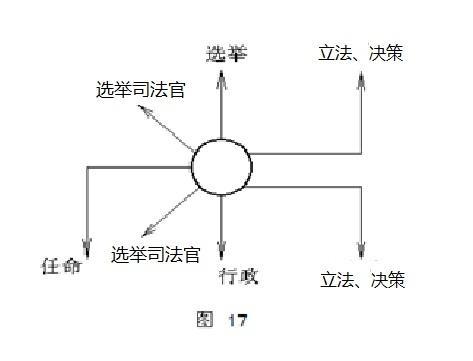
a) 除去基层选举者和最高当选者,递进自组织其他层次的每个当选者在当选层块具有图17所示的各项权力:
a) With the exception of the grassroots electors and the highest elected representative, each elected representative at every level in the recursive self-organization possesses the various powers illustrated in Figure 17 within their elected layer block.
b) 并非每个层块都会拥有如图17那些正式的权力(至少到乡镇以上才需要),村民小组长可能只会“任命”临时记账员,选举邻里调解员而非司法官,谈不上“立法”而是制定规则和进行决策,但都可以涵盖在图17中。
b) Not every layer will necessarily have the formal powers illustrated in Figure 17 (at least not until the township level and above). For instance, a village group leader might only 'appoint' a temporary accountant, elect a community mediator rather than a magistrate, and may not engage in 'legislation' but rather in rule-making and decision-making. However, all these functions can be encompassed within the framework covered in Figure 17.
c) 当选者是本层块的行政首长,主持日常事务。
c) The elected representative serves as the administrative head of the layer, overseeing daily affairs.
d) The elected representative participates in both the legislation and major decision-making processes within their own layer, as well as in the legislation and major decisions of the higher layer. This dual participation allows them to sufficiently convey the will of the subordinate layers to the higher layer.
e) The elected representative does not possess judicial authority but holds the power to elect judicial officials (judges and prosecutors). Spanning two layers, they can participate in the election of judicial officials for both the layer below and the layer above.
f) Representative democracy utilize checks and balances to prevent the abuse of power and corruption. However, just as allowing a person's brain, heart, and hands to act independently and check each other involves inherent complexities, even the most ingenious designs can impact functionality. In contrast, recursive self-organization avoids the need for "checks and balances" to prevent the abuse of power and corruption. It consolidates the power of each layer into a unified entity, aligning more closely with the nature of communication.
g) Each layer in recursive self-organization operates as an autonomous entity, akin to another form of decentralization. While representative democracy involve the separation of powers, recursive self-organization embodies as many divisions of power as there are layers, providing a more comprehensive system of checks and balances.
规则六Rule 6
行政人员由本层块行政首长或其受托人任命。行政人员不可成为所在递进自组织中任何层块的当选人。
Administrative personnel are appointed by the administrative leader of the current layer block or their delegate. Administrative personnel are not eligible to become elected representatives in any layer of the recursive self-organization.
a) 图 17 中的“任命”, 是对辅佐“和载体”( 行政首长)履行职责的行政团队而言。行政团队本质上是实现行政首长意志的工具,权力出自行政首长的委让。工具必须服从,不服从即重新任命。
a) In Figure 17, "appointment" pertains to the administrative team assisting the "sum carrier" (administrative head). The administrative team fundamentally serves as a tool to execute the responsibilities of the administrative head, with authority delegated by the administrative head. The tool must obey; disobedience results in reappointment.
b) “受托人”是指得到行政首长任命或授权者。规模较大的行政团队,行政首长无法任命所有职位,可由受托人逐层向下任命,如元首任命部长,部长任命其下属司长,司长任命下属处长……
b) "Trustee" means a person appointed or authorized by the executive head. For a larger administrative team, the head of the executive cannot appoint all positions, but can be appointed by the trustee down the levels, such as the head of state appointing the minister, the minister appointing his subordinate director, the director appointing the subordinate director...
c) 任命非行政首长独断专行。一是其在随时选举制约下,需主动征求其选举者对重要任命的意见;二是选举者能用二分之一票权否决当选者的任命(规则三)。
c) Such appointments are not arbitrary decisions made solely by the administrative head. Firstly, under the constraint of the ongoing election system, they must actively seek the opinions of their electors on crucial appointments. Secondly, electors have the power to veto the appointments of the elected individual with a simple majority vote (Rule 3).
d) Restricting the ability of executives to be elected to their recursive self-organization is intended to avoid conflicts of interest. This restriction is valid for all layers within the same recursive self-organization system. For example, a Minister of State may not be elected as mayor of a township at the same time, but he or she may not be elected to an organization other than the public power organization.
规则七Rule 7
各层块与其下属所有层块构成自治体,拥有不与上级决策和法律违反的一切权力。
Each block, along with all its subordinate blocks, forms an self-governing entity, possessing all powers not conflicting with decisions and laws from their superiors.
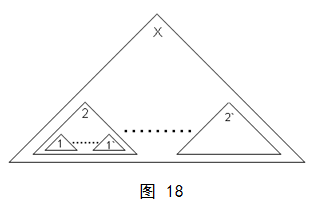
a) 每个层块皆为自我管理的委员会。所说的“各层块与其下属所有层块构成自治体”,如图 18 示意:
a) Each layer block is a self-governing committee. The phrase "each layer block and all its subordinate layers constitute an autonomous entities" is illustrated in Figure 18:
In the diagram, the large triangle encompasses smaller triangles, representing the nested relationships of autonomous entities. To simplify, only three layers are depicted, and each triangle includes only two of its subordinate triangles. Recursive self-organization is a structure where entities are nested layer by layer, ultimately forming a large triangle that encompasses all layers. Each triangle represents an autonomous entity. For example, 1 and 1' are the first-level blocks at the grassroots. '...' represents other same-level blocks that are not drawn. Assuming 1...1' represents village groups and 2...2' represents administrative villages. Initially, each village group is an autonomous entity, managing internal affairs collectively decided by its members and the elected village group leader—such as how to collaborate, formulate rules, and implement rewards and penalties. Simultaneously, the administrative village is a larger autonomous entity that includes village groups. Internal affairs—collaboration among village groups, coordination of relationships, establishment of rules, distribution of interests, etc.—are decided and managed by the leaders of each village group and the elected head of the village committee. The entities 2...2' collectively form the autonomous entity X at the township level, encompassing various administrative villages and the two-layer autonomous entities of village groups within each village. X can be at any hierarchical level, and so on. The nested autonomous entities expand layer by layer in this manner.
b) 这种自治从基层层块开始,自下而上的所有层块皆为自治体。但不管相隔多少层,只要被包括在同一个三角内,自治便被限定于“不与上级决策和法律违反”。这里的“上级”指自治体被嵌套于其中的所有三角。
b) This autonomy starts at the grassroots level, and all the layers from the bottom up are self-government. But no matter how many layers are separated, as long as they are included in the same triangle, autonomy is limited to "not violating decisions and laws with superiors". The "superior" here refers to all the triangles in which the autonomous government is nested.
c) 服从与自治不构成矛盾,没有服从是有自而无治。但这与自上而下的层层统治有何区别?在传统概念中,上级与下级相互为“他者”关系,管束甚至压制,与自治不相容。在递进自组织中,上级产生于下级的向量求和,每个下级层块的意志都参与向量求和,最终结果虽不会和任何下级层块的意志完全一致,却是所有下级层块的共同意志,人人有份。在这个意义上,服从上级法律和决策正是服从自己,是自身意志在更高层次的扩展与升华。
c) Obedience and self-government are not contradictory, and without obedience there is no self-governance. But how does this differ from top-down layered rule? In the traditional concept, superiors and subordinates are in a relationship of "otherness", which is incompatible with autonomy. In recursive self-organization, the superior generates the vector summation of the subordinate, and the will of each subordinate layer participates in the vector summation, although the final result will not be completely consistent with the will of any subordinate layer, but it is the collective will of all subordinate layers, and everyone has a share. In this sense, obedience to the laws and decisions of superiors is to obey oneself, and it is the expansion and sublimation of one's own will at a higher level.
d) Since the recursive self-organization legislative power is from bottom-up, and at the same time requires the subordinate laws to be subordinate to the higher laws, the coexistence of these two relations will lead to the fact that the subordinates must make as few laws as possible from the superiors, so as not to limit their own autonomy and freedom. Unless legislation is necessary for the interests of the subordinate is ceded to the superior, the subordinate will not authorize the higher legislature. Just as autocracy is reluctant to hand over power, recursive self-organization is reluctant to hand over power and remains in charge as much as possible. This is done layer by layer, resulting in the autonomy of the subordinates being kept to the maximum.
e) In the past, autonomy was the separation of a piece of the ruling structure, giving it more independence and the right to self-determination, and it was still rule internally, and autonomy was only "self-rule", which was the exclusive autonomy of the elite. And true autonomy should be for the whole people, that is, starting from each individual member of society, all levels and all levels are autonomous, and the will of the individual, the collective, and the will of the society is embodied - only recursive self-organization can achieve this kind of national self-governing.
The layer block of the public power organization can, at any time, elect a judicial officer for the current block with a two-thirds majority vote, who may not hold concurrent positions. The judicial officer executes legislation for the current block and higher-level blocks, with jurisdiction over the current block and subordinate blocks. No interference other than elections shall be made in the appointment of the judicial officer.
a) 司法官主要指法官和检察官。
a) Judicial officers are primarily judges and prosecutors.
b) 司法官以三分之二多数当选,因此不需要听从行政首长;司法官由本层块选举,因此也不需要迎合基层民众。
b) Judicial officers are elected with a two-thirds majority, so they do not need to comply with the administrative head. Since judicial officers are elected within their own layer, they also do not need to cater to the grassroots population.
c) 除了对司法官的选举,任何人和机构都不得干涉司法官履职,保证司法独立。
c) Apart from the election of judicial officers, no individual or institution is allowed to interfere with the duties of judicial officers, ensuring judicial independence.
d) 更换司法官要达到三分之二多数,意味哪怕面对的反对者超过二分之一,司法官仍可坚持其主张。
d) Replacing judicial officers requires a two-thirds majority, which means that even if facing opposition from more than half, the judicial officer can still uphold their position.
e) Judicial officers adhere to a two-thirds majority within the layer, representing the collective will of the community and providing relative stability. In the recursive self-organizing structure, upper-level legislation takes precedence over lower-level legislation, restricting casual modifications at lower levels and further ensuring judicial stability. Therefore, there is no need to resort to lifetime appointments for judges to maintain judicial stability.
f) 随时选举司法官的可能性,能让司法官的履职更加符合共同体意志或社会意志,避免僵化和教条。
f) The possibility of electing judicial officers at any time allows their duties to better align with the will of the community or societal consensus, avoiding rigidity and dogmatism.
g) 司法官不得兼任其他职务,避免利益牵扯,保持中立。
g) Judicial officers may not hold concurrent positions to avoid conflicts of interest and maintain neutrality.
h) 上级司法官的权限高于其层块下属的各级司法官,可对下级的司法进行重新裁决。
h) The authority of higher-level judicial officers supersedes that of the various levels of judicial officers subordinate to them, allowing them to review and overturn the judicial decisions of the lower levels.
i) 涉及层块之间的法律纠纷和案件,交由上级司法官裁决。
i) Legal disputes and cases involving different layers are adjudicated by higher-level judicial officers.
j) 专职司法官和司法机构在一定级别以上才需设置,下级层块可设置无机构或非专职的司法官。
j) Full-time judicial officers and judicial institutions are only required to be established at specific levels, while lower-level blocks may have non-professional judicial officers or no institutions.
The implementation of recursive self-organization in public power organizations is an unprecedented revolution, yet it won't result in a "earth-shattering" transformation. In essence, it will be somewhat similar to contemporary liberal democratic societies — with human rights, rule of law, a free economy, freedom of speech and the press, association and party formation, as well as freedom of religion. The right to protest and engage in social movements will still exist, and both public and private organizations will have ample autonomy. The direct experience for ordinary citizens will mainly involve changes in the election of public authorities — in representative democracies, there might be a perceived psychological regression (due to the absence of direct elections for high-level positions), but the actual situation will not worsen, and long-term development is likely to improve. In authoritarian societies, citizens may perceive it as progress, and the actual situation is likely to improve as well.
下面对实施上述规则将导致的社会变化做一些展望,并非是定论,只是帮助想象和理解递进自组织社会。
The following provides some prospects for the social changes that would result from implementing the above rules. It is not a definitive conclusion but rather aims to assist in envisioning and understanding a society with recursive self-organization.
The primary question is whether there is a government. From the definition of government—a political system established in a certain region, responsible for enacting and enforcing laws, and composed of relevant institutions—in the context of a recursive self-organizing society, there is indeed a government. However, its government is composed of the entire populace, or one could say that the recursive self-organization itself, encompassing all members of society, serves as the government. In this sense, there is a certain alignment with the decentralized management and mass participation principles of anarchism.
The political system of recursive self-organization follows a "recursive election system + recursive committee system." Each layer functions as an autonomous committee composed of all its members, deciding on the major political directions for the layer and conducting elections. The elected individual becomes the administrative head of the layer, implementing the major political directions established by the committee. Simultaneously, as the elected individual acts as the "sum carrier," they become a member of the higher-level committee (layer) and, along with other members, collectively decides on the major political directions of the higher-level layer, elects the administrative head of the higher-level layer, and so on. This progression continues upward, covering each layer until it encompasses the entire society.
The term "committee" has been misused in the past. A genuine committee must first ensure that each member can sufficiently communicate and express themselves, with all members having equal rights to speak and make decisions, avoiding control by a facilitator. Therefore, the size of the committee can only be within the range where sufficient direct communication is feasible. When the public organizations of society form a recursive committee system from the bottom-up, with government being participatory across the entire populace, each committee director will not act based on their personal will but will sum up the vector in the higher-level committee based on the collective will they carry. This involves considering the maximum benefit for their community while also compromising with other committee directors (representing their respective communities).
A committee, unlike large-scale voting facing isolated issues in a single vote, engages in long-term cooperation addressing a series of problems. Committee decisions often achieve consensus by fully incorporating various perspectives. Because the issues to be addressed vary each time, a committee does not form a fixed majority and minority. All parties can anticipate that concessions made in one instance will be reciprocated in the next, forming a long-term transactional mechanism. Majority rule, where the minority yields to the majority, is occasionally employed to break a deadlock, but if it becomes routine, it signifies the committee's ineffectiveness.
The reason representative democracy requires campaigns is that, within large-scale communities, electors have no other means to learn about candidates, and campaigning serves as the communication method between candidates and electors. Within the empirical range, electors can know the candidates and communicate with them fully at any time, rendering campaigning unnecessary. In representative democracy, winning an election requires mobilizing voters, utilizing media for publicity, planning public relations, and the resulting fundraising, talent recruitment, research, etc., are beyond an individual's capacity and must rely on political parties. In the empirical range, mutual understanding between electors and candidates is feasible, making elections within layers convenient. Therefore, while recursive self-organizing societies do not prohibit party formation, political parties are no longer linked to wielding power.
Each elected "sum carrier" does not mechanically carry the already determined vector and only passively represents or conveys it. Instead, the election of a "sum carrier" is for the purpose of utilizing their "tacit understanding" to actively handle the majority of daily decisions, with other members participating primarily in major political directions. This inevitably requires the "sum carrier" to possess independence, the wisdom to accurately grasp the collective will, and the ability to actively make decisions and lead its implementation. It also demands that, upon entering a higher-level layer, the "sum carrier" is not passively executing orders but actively engaging in negotiations, transactions, and compromises with other "sum carriers." The autonomous space granted to it is no smaller than the "representative" in a representative democracy. However, this is not a bestowed power but rather an obligation that it must fulfill.
参与Participation
a) 低成本参与:对于全民参与社会管理的质疑,往往集中于人们是否有这种意愿。远非所有人都热衷于公共事务,哪怕与自己有着非常直接的关系,许多人也漠不关心,因此才需要政客代议,甚至连选举政客都懒得参与。其实,获得承认、进行分享、追求理想等公益心人人皆有,只是很大程度取决于需付出的成本。如果参与成本低于分享愿望,便会改变冷漠。递进自组织的基层民主本身成本就不高,所有成员的共同参与使成本进一步分摊。且多数日常事务并不需要全体成员进行实际协商,而是由“和载体”在头脑中模拟,更使参与成本降低。
a) Low-cost Participation: Skepticism about widespread participation in social management often centers around whether people have the willingness to engage. Not everyone is enthusiastic about public affairs, even if it directly relates to them; many people remain indifferent. Hence, politicians are needed for representation, and some may even refrain from participating in electing politicians. In reality, everyone has altruistic tendencies such as seeking recognition, sharing, and pursuing ideals, but this largely depends on the associated costs. If the cost of participation is lower than the desire to share, it can change indifference. Grassroots democracy in recursive self-organization itself incurs relatively low costs, with the collective involvement of all members further spreading the costs. Additionally, most daily affairs do not require actual negotiation by all members; instead, the "sum carrier" simulates them in their mind, reducing the cost of participation even more.
Another reason people did not participate in public affairs in the past is that they could free-ride in large groups. However, within the scope of recursive self-organization, free-riding is not easily concealed, resulting in a loss of respect within familiar groups, making it no longer the optimal choice.
The question of whether to actively participate in public affairs only needs to be addressed at the grassroots level of recursive self-organization; all other levels consist of "sum carriers," and this issue is fundamentally not allowed to exist. The basic requirement for "sum carriers" to be elected is their active participation in public affairs, and they are constantly supervised by the voters within the empirical range.
b) 开放参与:众权组织自行决定组织方式,若认为没有必要和公权组织发生联系,可以只做独立的社会团体;但是其自身若实行递进自组织,便可以被纳入公权组织。所谓的纳入,即是该众权组织推选的“和载体”被相应的公权组织层块接纳为成员,参加公权组织的决策,进行该层块的选举。其参与表决的票权,是该众权组织的成员数。
b) Open participation: The collective power organizations determines its own way of organizing. If it deems unnecessary to establish a connection with public power organization, it can choose to operate as an independent societal group. However, if it implements recursive self-organization, it can be integrated into public power organization. The integration involves the "sum carrier" elected by the collective power organizations being accepted as a member by the corresponding public power organization layer, participating in the decision-making of the public power organization, and engaging in the elections of that layer. The voting rights in the decision-making process are based on the number of members in the collective power organizations.
This will attract some collective power organizations to implement recursive self-organization in order to qualify for integration into public power organization, thereby influencing public power and benefiting their own development and goals. In a representative democracy, collective power organizations can only influence public power by exerting pressure from the outside, and their effectiveness depends on whether public authorities accept it. In a recursive self-organizing society, collective power organizations can directly participate in public decision-making by integrating into public authorities and play an active role.
The private organization is the personal domain of the owner, and does not practice recursive self-organization. Employees of private organizations may establish their own collective power organizations (such as trade unions or supervisory bodies) and, if they are recursively self-organized, may also be included in public power organizations. For public power organizations, the rights of the boss of the private organization are the same as those of the employees, because the larger the number of employees, the greater the overall influence of the boss, and therefore the decision-making of the public organization will be tilted in favor of the employees. At the same time, recursive self-organization can avoid populism, suppress the evil of private organizations, and retain their socially beneficial aspects.
c) 多方位参与:传统社会的工作地和居住地在一起,现代社会多数人的工作地和居住地则是分开的,若依然限制公民只能在单一地域参与显然不对,应是既可参与居住地的公权组织,也可同时参与工作地的公权组织,亦可从所参与的众权组织纳入公权组织,通过不同管道将公民在不同领域的个人意志立体地体现到公权组织的各种决策中。
c) Multi-dimensional participation: In traditional societies, the workplace and residence were often in the same location. In modern society, most people's workplaces and residences are separate. Restricting citizens to participate only in a single region is evidently inappropriate. Citizens should have the option to participate in both the public power organization of their place of residence and their workplace. Additionally, they can bring their personal opinions from various domains into public power organizations through participation in collective power organizations, thereby contributing to decisions made by public power organization through different channels.
In reality, we often see situations where active individuals have an advantage. Will recursive self-organization lead to actual inequality between the active and passive participants? In crowds where direct communication is not sufficient, external expression plays a major role, allowing active individuals to stand out. However, everyone has opinions and reactions, and being active or passive is just a difference in external expression. In a range where direct communication is sufficient, external expression is not decisive. Passive participants can convey their sentiments through other means (facial expressions, body language, actions, etc.) and be accurately perceived by other members (through mutual understanding), so the advantage difference between active and passive participants may not be significant.
Nor will the influence be unequal due to the number of projects people participate in. Each project addresses only relevant matters, and the election is for the "carrier" of the project, not involving other matters outside the project. The active participant's involvement in multiple projects is equivalent to expressing individual will on different issues. Whether expressing intentions through participating in a union's recursive self-organization or environmental protection's recursive self-organization, even if both are integrated into public organizations, it does not equate to one person having two votes in quantity; the vector sum is still "1," just with more facets and depth. Passive participants engage in fewer projects because they prioritize certain aspects, and as long as their influence is equal to others in those areas, it suffices for them.
d) Macro participation: If the public only focuses on electing the president and legislators, it may sound significant, but the actual participation is very low—just a few minutes of voting every few years. In the grassroots of recursive self-organization, ordinary people are constantly involved in the operation of public power, extending upward to the highest layer block of public power like drops of water converging into a river.
However, modern technology allows grassroots members to have a global perspective, and various opinions on macro issues seem to require an equivalent platform like electing a president or legislator; relying solely on grassroots participation in recursive self-organization may not be sufficient. This is a limitation of recursive self-organization compared to representative democracy, but it is a necessary limitation and a fundamental difference between recursive self-organization and representative democracy.
Of course, ordinary citizens have the right to focus on and participate in affairs beyond the layers. Although their participation in recursive self-organization can be conveyed through "sum carrier", it goes through several indirect channels, making it difficult for people to intuitively believe that their opinions have been effectively expressed. Moreover, human nature tends to exercise rights directly rather than through indirect intermediaries. To address this, firstly, other channels of expression, such as freedom of speech, association, and protests, can be utilized to criticize and make demands on affairs at any level. Secondly, through linkage and mobilization, as long as the support of half of the members within a corresponding scope is obtained, according to Rule 3 of recursive self-organization, decisions at the highest level within that scope, including election results, can be vetoed—equivalent to recalling the elected person at the highest level within that scope. This direct recall, compared to the general elections in representative systems, does not have a higher threshold and can be conducted at any time.
e) Elite participation: "sum carrier" are, of course, political elites. The difference is that the political elite is separated from the masses in a dualistic structure, with the elite mainly pursuing personal interests; The recursive self-organization political elite is elected layer by layer, and can only serve as a "sum carrier", and any deviation from the will of the community will be immediately constrained.
Elections at any time become a prerequisite for effective checks, and the position of "sum carrier" is pursued, and recall is what the elected representative try to avoid, so that the constraints can be established. There is no problem with the top position, and it will become a competition target for many political aspirants; There will be no shortage of people in the position of county and township head, which is not only in the middle stage of climbing the ladder layer by layer, but also a good career. The key is whether the grassroots positions can attract enough candidates and be subject to elections at any time after they are elected. Grassroots elected people similar to villagers' groups and owners' groups face trivial matters, but there is no glory and interests. As long as the constraints of recursive self-organization elections at any time are ineffective at the grassroots level, it is equivalent to losing the source and foundation, resulting in the ineffectiveness of the whole.
吸引基层当选者,主要不能靠物质激励。假设每家出一人,代表基本一致的家庭利益和诉求参与基层自由组合的层块,平均每个层块十家(三、四十人),涵盖中国人口就得有三、四千万个这种基层层块。若用金钱激励这一层当选者,少则不起作用(甚至是反作用),多则难以负担。事实上,这层当选者需要的条件不高,多数人都能承担,不会缺了谁就不行。当选者的主要动力应是公益心。自由组合多为亲朋好友或共识同道,能当选说明受到大家推戴和信任,已是激励,论金钱反而失去这个意义,反会削弱人的动力(美国心理学家 Edward Deci 以实验证实诸如报酬等外在动机对内在动机具有“驱逐效应”)。何况需要基层当选者做的事不多,顺手即可完成,一般无需耽误个人主业。其所做的服务与层块成员关系紧密,会被看到并感激,也会按人情往来予以回报。这些因素的综合,是这层“和载体”的责任心基础,而遭到罢免在亲友同道中丢的颜面,则能起到约束其追随层块意志的作用。
Attracting grassroots elected representatives cannot rely primarily on material incentives. Assuming each household contributes one representative, representing the basic consistent interests and demands of families participating in the freely formed blocks at the grassroots level, with an average of ten households per block (thirty to forty people), there would be tens of millions of such grassroots blocks covering the Chinese population. If monetary incentives are used for these elected representatives, it may have little effect, or even backfire, if the amounts are small, and it would be difficult to afford if the amounts are large. In fact, the conditions required for these elected representatives are not high, and most people can afford them; there is no indispensable need for any specific individual. The main motivation for these elected representatives should be a sense of public service.
Freely formed blocks often consist of relatives, friends, or like-minded individuals, and being elected indicates the collective endorsement and trust of the group, serving as motivation in itself. Offering monetary rewards may diminish intrinsic motivation, as demonstrated by the "crowding-out effect" observed in studies, such as those conducted by the American psychologist Edward Deci on external motivators like rewards. Moreover, the tasks required of grassroots elected representatives are usually minimal and can be easily accomplished without significantly interfering with personal occupations. The services they provide are closely tied to the relationships with block members, and their efforts are visible and appreciated, often reciprocated based on personal relationships. The combination of these factors forms the foundation of the "sum carrier" sense of responsibility, and the potential loss of face within their circle of friends and associates in the event of a recall can act as a constraint on following the will of the block.
The position of grassroots "sum carrier" is not as appealing, which actually helps prevent the kind of competition seen in animal groups vying for leadership, making it easier for candidates and elected representatives to maintain rationality. If one is not particularly concerned about being elected, there is no incentive to compromise principles for votes. Instead, candidates are more likely to consider the overall picture and long-term goals, sticking to their own convictions and trying to persuade other members of the block. This guides the formation of grassroots will and aligns more with the overall interests of the block. In this way, elected representatives are more likely to act in a manner that benefits the block as a whole. Additionally, electors are less likely to impose extreme demands and pressure on the elected representatives, providing a buffer against populism right from the source.
As long as the grassroots "sum carrier" are genuine, there is an assurance for the implementation of recursive self-organization. The higher-level positions are merely the process of continuously summing up into a larger vector. The higher the level of the "sum carrier", the greater the workload. How to motivate them, what benefits to provide, how much to give, and how to provide them—recursive self-organization's mechanism will spontaneously and organically adjust to address these various aspects.
In addition, recursive self-organization is equivalent to providing an equal and open path for every member of society to ascend from the grassroots to the highest level. As long as an individual has the desire, the only determining factors are their work capacity and diligence. If a person's overall qualities consistently surpass those of other members at the same level, they can continuously be elected to higher levels on the ladder of recursive selection, without any other obstacles, until they reach a balance point between their qualities and the position— even if that balance point is the head of state. This "all roads lead to Rome" approach can create incentives similar to the imperial examination system, allowing those who start from the grassroots and have aspirations to climb through loyal service at each level, enabling society to fully utilize people's talents.
The key to ensuring recursive self-organization lies in the recursive election from bottom up and elections at any time within empirical range, and this is the main difference from representative elections. If the emperor could only appoint or dismiss ministers every few years, it would be considered inconceivable. The reason why the emperor could exercise power thoroughly largely lies in the fact that he could appoint or dismiss officials at any time. Why should the power originating from the people only be subject to periodic appointments (elections)? And why is it considered reasonable?
Representative elections are of massive scale, requiring significant efforts each time—campaigning, voter registration, setting up polling stations, and nationwide voting. The costs are high, both in terms of resources and manpower. Moreover, these processes need to be overseen by specialized institutions, making periodic elections a necessity. That's not because it's reasonable, it's a last resort.
Enumerating the rationale behind periodic elections, it is often argued that fixed terms provide elected officials with a buffer space, granting autonomy for representatives to negotiate and compromise. This autonomy is seen as essential for maintaining rational decision-making and considering long-term interests, shielding against the influence of populist, short-sighted demands. However, the mechanism of recursive self-organization is already better equipped to address such issues. Instead of relying on periodic elections, it requires spontaneous and cost-effective elections at any time to ensure that the will of those in power remains aligned with the collective will of the community (society) and that societal decisions are reflected promptly.
As mentioned earlier, the implicit nature of "anytime elections" results in elected officials mentally conducting a "simulated election" before making decisions or fulfilling responsibilities. They ensure majority approval in their minds before implementation, rendering the need for an actual election unnecessary. However, there is a concern that the interconnected nature of the recursive structure might lead to changes in upper-level elected officials when lower-level elected individuals are replaced. Indeed, a newly elected township leader may call for the re-election of the county leader, but they cannot meet the requirement of a two-thirds majority for the replacement of the county leader. This replacement would only occur if the original demand for the re-election of the county leader was only one vote short of a two-thirds majority, or if a majority of townships in that county simultaneously elected new leaders. The former scenario suggests that the county leader should indeed be replaced, and the latter scenario has a low probability of occurring, so there is no need for concern.
However, if the newly elected township leader adjusts the vector they carry, the inability to replace the county leader will not result in a complete inability to reflect the adjustments. The new township leader's various participation at the county level will strive to reflect their new adjustments, ensuring that the adjustments are appropriately reflected in the vector sum of the county-level block. The county leader who remains unchanged will also consider the adjustments needed by the new township leader when making decisions. There may be many similar questions and details, all of which can be addressed within the mechanisms of the recursive self-organization.
Recursive self-organization seems to be a simple approach, but can it achieve social change like the integration of power and people? If you look at the simple difference between campaigning and non-election, and create two completely different societies, you can believe that the effect of the method is striking. The two elements of recursive self-organization—recursive elect with in empirical range and election at any time—are both sufficient as methods to be on the same magnitude as campaigns, so that societal change can be expected to carry the same weight, if not twice as much.
Here, "legislation" is used in a broad sense, referring to national laws, but it can also refer to the rules of a factory or the village agreements of a township, including various regulations. Therefore, any layer in the recursive self-organization can have this kind of "legislation." The difference lies in the fact that legislation at higher levels is precisely documented and suitable for judicial rulings, while lower-level layer blocks, with fewer people and easier communication, do not require formalities and can even be based on verbal agreements.
The highest level block of the public power organization—such as the National Committee composed of the elected heads of the thirty-four provinces, municipalities (direct-controlled municipalities), and regions (autonomous regions) in China, along with the elected national head—adopting this method for national legislation raises obvious questions: Are these thirty-five individuals representative enough? Do they possess sufficient legislative capability? Do they have enough time to dedicate to legislative research? And if they focus all their energy on legislation, how can they fulfill their responsibilities as administrative heads?
Firstly, in the recursive self-organizing structure, these thirty-five individuals are constrained by the electors in their respective provinces, municipalities, or regions. Legislation is not based on their personal preferences but requires the approval of their respective electors. Assuming each province, municipality, or region has thirty lower-level mayors, this implies that over a thousand people are involved in national legislation.
Those lower-level mayors also need to seek the opinions of their respective electors on important legislation. ... As this process goes layer by layer, it eventually encompasses all members of society. It doesn't mean that every member of society will actually participate in national legislation, but the structure and mechanisms of recursive self-organization do provide this possibility.
There is no need to worry about the capacity and energy of legislators. Firstly, the bottom-up autonomy of recursive self-organization ensures that higher-level laws are minimized, and the legislative workload does not concentrate upward as much as it does now. Secondly, the higher the level of the block, the more resources are available, and at the provincial and municipal levels, there are specialized legal departments responsible for proposing and researching bills. The participation of provincial and municipal leaders in legislation at the national level will not require a significant personal investment of effort; the main research is carried out by subordinate departments, and this holds true for legislation at all levels.
For example, when the relevant functional department drafts a new bill on automobile emission standards for review by the national committee, provincial and municipal leaders will not personally study the components of car exhaust. Instead, their subordinate legal departments will assess the perspectives from various aspects such as the province's economy and environment, propose modifications, and report the opinions to the leader and the committee of their province—consisting of mayors from various cities and counties within the province. The mayors will also instruct their subordinate legal departments to evaluate the economic and environmental aspects, deciding the stance of the city or county mayor during the discussion of the bill in the provincial committee. In general, provincial and municipal leaders will vote in accordance with the majority opinions of mayors from various cities and counties. If two-thirds of the provincial and municipal leaders agree, the proposal can become law. It can be seen that the reason why legislators at all levels can handle the legislative burden is because, on the one hand, functional departments share the load, and on the other hand, legislators only need to express their stance based on the resolutions of the elected layer block. This type of legislation can be described as a bottom-up "recursive legislation."
行政administration
a) 递进自组织既是进行个人意志向量求和的结构,也是使向量和得以实现的结构;既是自下而上的选举、立法和决策系统,又是自上而下的行政、执行系统。
a) Recursive self-organization is both a structure for summing vectors of individual wills and a structure for enabling vector sums; It is not only a bottom-up electoral, legislative and decision-making system, but also a top-down administrative and executive system.
b) 行政事务由行政首长指挥行政部门完成。凡是符合上级层块立法的行政,下级层块和成员需服从。
(b)Administrative affairs are directed by the administrative head, overseeing administrative departments to carry them out. Any administrative actions that align with the legislation of higher-layer blocks must be adhered to by lower-layer blocks and their members.
c) 对本层块的不服从者,行政首长可采取行政措施使之服从或加以制裁。下级层块的不服从者由下级层块处置。
c) For those who disobey this block, the administrative head can take administrative measures to make them comply or impose sanctions. Disobedience within lower-layer blocks is handled by those respective lower-layer blocks.
d) According to the needs of management functions, the higher-layer administrative departments can be extended downwards and set up the necessary dispatched agencies at the lower layers to complete the necessary functions. Because the self-organizing entity always avoids intervention as much as possible, this administrative extension will be terminated at the earliest possible end.
e) The executive leader operates under the constant supervision and constraints of the members of the current block but possesses a considerable degree of autonomy. Everyday affairs do not necessitate discussion and voting by block members; instead, they are autonomously decided by the executive leader. This autonomy, fundamentally, stems from the tacit understanding of the executive leader as the "sum carrier" of collective will for the community.
f) Dissatisfaction with the executive, either through a two-thirds majority of the members of the block to change the legislation implemented by the executive, or by a two-thirds majority veto the executive decision (rule 3), or by a re-election to replace the executive head.
g) There is no need to worry about the lack of policy coherence due to frequent elections. On the one hand, as explained earlier, unscheduled elections do not occur frequently. On the other hand, policies originate from the electors rather than the elected individuals. Changing elected individuals occurs when they fail to faithfully implement the policies set by the electors, and such replacements can only lead to greater policy coherence and stability.
(h) There is no need to worry that the administrative head, by having control over the administrative apparatus, will dominate other members within the layer, as each member is the administrative head of their respective subordinate layer and has their own administrative structure.
The professional nature of the judiciary requires design by experts. Therefore, the specific methods of the judiciary can be planned after the implementation of recursive self-organization within public power organizations. With the self-generating mechanism initiated by the implementation of rule 8 of the recursive self-organization, the feedback-adjustment loop will supplement the details needed to form and improve the judicial system.
The judicial practices and legal theories of the recursive self-organizing society differ significantly from those of today. The legal system is simplified as much as possible, and there is a shift from the situation where "the worse the state, the denser the legal network" occurs. Most disputes are resolved through self-arbitration and mediation at the lower levels, eliminating the need for involvement in the judicial process.
For example, the committee at the local level conducts a "preliminary review" of cases occurring within its jurisdiction (cross-level cases are reviewed by the committee at the higher level), makes a ruling, and if both parties accept it, the matter can be resolved locally. Otherwise, the dissatisfied party can continue to appeal, entering the formal judicial process. This preliminary review does not require adherence to legal statutes and concrete evidence. Instead, it relies on judgment factors similar to those in traditional societies, such as family elders, village gentry, or community leaders—factors like conscience, intuition, compassion, personal experience, and wisdom. This approach aims to escape the intricacies of the law, balance the law's relentlessness, and reduce legal costs. While not necessarily highly professional, similar to the principles of a jury, it involves deriving intuitive judgments in direct consideration of the arguments presented by the parties. This process results in decisions that align with reason and conscience, offering a potentially more concise resolution to problems than the legal system, with fewer potential complications.
Justice is unrelenting, recognizing only legal statutes and disregarding motives; breaking the law equates to guilt. The judicial process is time-consuming and expensive, making it unbearable for those seeking legal recourse. Once within the legal system, these issues are unavoidable, as any leniency in the law would undermine its foundation. Preliminary reviews, however, introduce a buffer between individuals and the law, allowing for the consideration of motives and outcomes together. People should not be condemned as legal offenders due to unintentional or accidental mistakes, and disputes need not necessarily result in a win-lose scenario. Concerns about potential miscarriages of justice are mitigated by the fact that, on one hand, the committee members are always constrained by the electorate, and on the other hand, the results of the preliminary review are not mandatory. Those who do not accept the decision can continue the legal process, ensuring both the preservation of legal rigor and the allowance of space for reasonable considerations.
The independence of the judiciary should neither be too extensive nor too limited. Without independence, it is inevitable that legal processes will be influenced by societal emotions and administrative needs, rendering the law ineffective. On the other hand, complete independence may lead to dogmatism and become an obstacle to development. When a two-thirds majority of the corresponding local committee opposes a judicial official, it can be considered that their independence has exceeded a reasonable limit and should be adjusted. Judicial officials can be elected at any time, and this does not contradict the requirement for judicial stability. As discussed earlier in the context of elections, the possibility of elections at any time is a latent feature, causing elected officials to mentally simulate elections before assuming their responsibilities each time, aiming to secure the approval of the majority. Consequently, actual unscheduled elections may occur less frequently than regularly scheduled ones.
As a public authority, the results of unscheduled elections in the recursive self-organizing system must undergo legal confirmation and public disclosure. This ensures that the elected individuals are accepted by the higher-level committee, preventing impersonation or conflicting claims. This responsibility falls under the duties of the higher-level prosecutor. The prosecutor is also responsible for determining the inclusion of various organizational powers into the public authority organization, verifying the number of members, deciding their voting rights, and granting them permissions. These verifications are quite complex for manual operation but are straightforward for computer and network technologies. Another responsibility of prosecutors at different levels is to review legislation at lower levels. If any conflicts with higher-level legislation are identified, modifications must be requested, or legal action may be taken to challenge the court's ruling.
The police should be under the jurisdiction of the administrative head. Apart from their law enforcement function, the police are also involved in a significant amount of social and administrative services. To prevent situations where the administrative head's command is ineffective, the head of the police force should be appointed by the administrative head of the corresponding local committee. There is no need to worry about the police becoming a personal tool for the administrative head for several reasons: First, the administrative head is constrained by the possibility of unscheduled elections at the local committee level, preventing the abuse of power. Second, the local committee has the power to veto appointments and can revoke the appointment of the police chief with a two-thirds majority vote at any time. Third, the law enforcement activities of the police are subject to checks and balances from the prosecutorial and judicial systems.
Recursive self-organization cannot rely solely on individuals conscientiously following the rules; it must take into account the potential issues inherent in human nature. Establishing sufficient constraints is essential, allowing lower levels to have the ability to constrain higher levels, and vice versa. The former ensures freedom, while the latter ensures order; both are indispensable.
在递进自组织规则中,相应的制约分散于不同条文,不一定能得到凸显,因此不惮重复,这里继续细谈。
In the recursive self-organization rules, the corresponding constraints are scattered in different provisions and may not be highlighted, so they are not afraid to be repeated, and we will continue to discuss them in detail here.
In recursive self-organization, the fundamental ability for lower levels to constrain higher levels lies in the option of unscheduled elections. However, there are situations that may not warrant a full re-election, such as having objections to a specific decision made by the elected official without the intention of replacing them. In such cases, a vote within the local committee can be employed. If more than half of the voting rights oppose the decision, it is deemed null and void without necessitating a full re-election.
This veto mechanism can be extended downward, allowing members of subordinate levels to participate in such voting. For instance, if a decision made by a county-level committee, composed of township mayors, is challenged by elected officials at the village level and the county-level committee remains unresponsive, the village-level elected officials can connect and conduct a vote. If more than half of the vetoing votes from all village-level elected officials in the county are obtained, the decision of the county-level committee is likewise annulled. This process can continue to cascade downward until it reaches a point where all eligible voters cast their votes on a one-person-one-vote basis — in other words, a referendum.
The constraining power of recursive elections at each level may raise concerns before being fully tested in practice. There might be worries that the existence of intermediate levels could hinder ordinary voters from expressing their concerns on macro-level issues and expressing dissatisfaction with higher levels without a channel to exert influence. Hence, there is a need to retain mechanisms to address these concerns by breaking through these hierarchical layers. The above-mentioned methods are precisely tools that ordinary citizens, including political parties, NGOs, and opposition politicians, can utilize. Regardless of the level or scope, as long as they can mobilize half of the voting rights within the corresponding scope, they can annul decisions or official appointments made by the highest-level committee within that scope. Many means of direct intervention, prevalent in today's representative politics, can still be effective in this context.
The horizontal division of governmental power into legislative, executive, and judicial branches, allowing for their independent separation of powers, is considered a cornerstone for safeguarding freedom in Western political thought. However, the separation of powers is not the sole mechanism for checks and balances. In recursive self-organization, public authority is allocated to each level and block, granting them autonomy. These autonomous entities are then synthesized into larger autonomous entities. In this process of combined authority, a system of checks and balances, which I refer to as "combined authority checks and balances", can also emerge. Starting from individuals and progressing through the synthesis of larger autonomous entities from the bottom up in recursive self-organization, decisions and legislation are continually made through negotiation. The "sum carrier" is generated through unscheduled elections, serving as both the process of consolidating autonomous powers and a mechanism for mutual checks and balances. The higher the recursive level of the block, and the more subordinate autonomous entities, the stronger the checks and balances in the formed combined authority.
If the purpose of decentralization is to break the monopoly of public authority and prevent arbitrary abuse by the same bureaucratic institution, autonomy is a more effective means than decentralization. Each autonomous entity represents a form of decentralization, exceeding the three branches' decentralization. Simultaneously, within each autonomous entity, the unity of public authority can be maintained, avoiding the vetocracy resulting from decentralization and benefiting public services.
People might be concerned whether the autonomy of each level and block in recursive self-organization can ensure unified management. Will there be a tendency towards parochialism, refusal to compromise, and disregard for the overall situation? In reality, such concerns exist in representative systems as well, and experience has shown that they can be addressed. In comparison, recursive self-organization should be able to address these issues more effectively. On the one hand, it possesses a nature of refining reason layer by layer (see the next chapter). On the other hand, as long as members or entities seek cooperation, they will not act unilaterally; otherwise, cooperation will not be forthcoming.
While recursive self-organization includes judicial and coercive elements, boycotts serve as the primary means of constraining non-cooperation or violation of agreements. Suppose a "sum carrier" refuses to comply with higher-level laws and decisions and receives support from its electing block. In that case, other blocks can unite to boycott it. Since higher-level laws and decisions are made from the bottom up, the block in question is rejecting not the higher level but other blocks. This is where the legitimacy of other blocks' joint boycott lies. The mechanisms of recursive self-organization make it easy to implement joint boycotts. Any block facing a joint boycott will experience more significant difficulties than the temporary discomfort caused by accepting higher-level laws and decisions. If it persists in resistance, it can eventually be expelled from the community.
The expelled individual (or one who voluntarily exits) has the option to join a community that accepts them or form a new community with like-minded individuals. Recursive self-organization provides corresponding institutional arrangements for such situations. However, it doesn't rule out the possibility that certain individuals may be unable to cooperate, consistently acting impulsively or even planning criminal activities. Additionally, there may be situations where expulsion is not an appropriate solution, such as when a country will not expel a region along with a community that refuses to cooperate within it. Similar to how any democratic country has means to address such scenarios, a recursive self-organizing society will have institutions to prevent crime, and forces like the military and police to serve as the ultimate means of safeguarding law and order. These mechanisms will be subject to constraints against undue use of force, similar to any democratic nation.
This is one of the main concerns regarding the feasibility of recursive self-organization. Requiring a two-thirds majority for elections and decision-making demands a high level of consensus; otherwise, it can lead to a deadlock where individuals cannot be elected or decisions cannot be made. The Democratic Party in the United States once implemented a two-thirds majority requirement for nominating presidential candidates during their party conventions. At its peak, it took 103 rounds of voting to reach a decision, eventually necessitating a shift to a simple majority nomination. The deadlock in recursive self-organization is not limited to a single link. For instance, if a township consists of ten villages and four of them are deadlocked in elections for village chiefs, resulting in vacancies, and the remaining six villages cannot achieve a two-thirds majority for electing the township chief, the administrative management of the township comes to a standstill. This deadlock can propagate upwards and, if widespread, could potentially paralyze the entire power structure of the recursive self-organizing system. If fixed terms were adopted, successfully navigating a deadlock at least ensures stability for a few years. In the case of unscheduled elections in recursive self-organization, deadlock and paralysis could occur at any time. The "resolute minority" could wield veto power by achieving a one-third threshold, causing a chain reaction of paralysis, preventing the appointment of individuals they oppose or blocking unfavorable measures during the ongoing deliberative process on numerous issues.
This concern is certainly reasonable. However, the "resolute minority" is not expected to become a common occurrence in recursive self-organization. Since the grassroots blocks are freely formed, those consistently in opposition and unwilling to compromise are unlikely to join such formations but instead opt for groups that align with their views. While diverse opinions may arise within freely formed groups, the fundamental state is one of consensus and cooperation. All parties involved will possess a spirit of compromise (or else the formation would dissolve). Even if a minority remains dissatisfied with the final outcome, being part of a long-term cooperative community, they understand that concessions may be compensated when they become the majority in the future. Members recognize that adhering to the rule of majority rule benefits everyone in the community.
The same reasoning applies to higher-level blocks as well. Members of these blocks, being elected representatives from lower-level blocks, are less likely to bring personal sentiments into the decision-making process. They tend to be more rational, discerning, and adept at negotiations, including compromise. Moreover, the size of the blocks is limited to a range that allows for direct and effective communication. In contrast to the challenging communication dynamics in large-scale assemblies like the Democratic National Convention in the United States, achieving consensus in these smaller, more communicative blocks is considerably easier.
Higher-level blocks within the public power organization generally cannot form freely, meaning townships cannot withdraw from one county to join another. Consider a scenario where the majority of townships decide to build a landfill at a specific location, but elected officials from surrounding townships vehemently disagree due to impassioned demands from local residents, forming a situation akin to a "resolute minority." In this case, the landfill may not be constructed. However, this may not necessarily be a bad outcome. Imagine if, with more than one-third opposition, a decision were forcibly passed with a two-thirds vote. Would this be preferable? Even if the one-third strong opposition is temporarily suppressed, the underlying conflict persists. Enforcing a two-thirds decision would continually create and accumulate such conflicts, reaching an unsustainable level. The fundamental concept behind a two-thirds decision is that if consensus is not reached to a significant extent, it is better to engage in further deliberation, modify the proposal, seek additional compromise, rather than suppressing conflicts for the sake of efficiency. Democratic decision-making has never been more efficient than autocratic decision-making; however, its superiority lies in its democratic principles. Delaying a good proposal is inconsequential, and good things are not afraid of being delayed. Even in urgent matters, the world will continue to turn, and if it is genuinely a situation that cannot be delayed, everyone will be harmed. Trust that within the scope of sufficient communication, rationality can find a suitable decision that surpasses a two-thirds consensus.
If within a community, an irreconcilable opposition emerges, persisting in a deadlock with solidified factions — for example, supporting and opposing same-sex marriage or different ethnic groups — it indicates that the community should consider splitting, allowing each group to go their separate ways. recursive self-organization provides mechanisms to facilitate such separations when necessary.
Some differences in viewpoints arise when large populations confront macroscopic issues, often stemming from the sum of biases and limitations. Additionally, since individuals expressing their opinions on macroscopic issues don't bear direct responsibility, they may not think seriously and may be prone to following the prevailing tide based on feelings. However, when experiences come into play, the dynamics can be different. For instance, someone who strongly opposes same-sex marriage in a general sense may become more tolerant when faced with a same-sex marriage involving someone they know, at least not being as extreme. recursive self-organization aggregates this tolerance within the scope of personal experiences to foster overall greater tolerance while isolating, outside the decision-making process, the intolerance that accumulates through sheer numerical aggregation.
Through negotiation, a solution to any deadlock can always be found, and it is this confidence that underlies the pursuit of democracy. Of course, corresponding institutional arrangements are necessary. For example, when elections fail to produce a two-thirds majority, a deadlock resolution can be achieved by having the electors prioritize and rank the candidates. The rankings from all electors are compiled, and the top few candidates are then ranked again by the electors. This process is repeated until a two-thirds majority is reached. If no candidate consistently achieves a two-thirds majority, the candidate with the highest overall votes can act as a proxy. The proxy has limited authority and cannot make unilateral decisions in day-to-day matters; instead, the other members of the same block must participate in decision-making. If the proxy performs well, they will soon gain the trust of two-thirds of the block, or as new talents emerge during the collective administrative process, gradually earn the trust necessary to surpass a two-thirds majority.
Another measure that can be adopted is to reduce the voting weight of proxy representatives by half in the decision-making process of the higher-level block due to their lack of direct representation. This is disadvantageous for the overall interests of the block, serving as an incentive for breaking the deadlock and quickly electing a formally elected representative with a two-thirds majority.
The measures mentioned above are only examples to illustrate that institutional arrangements can be envisaged to avoid impasse and paralysis. The specifics don't need to be pursued too much now, and when the mechanism of recursive self-organization is put into operation, the best way will gradually be formed.
As for concerns about political polarization—where some individuals oppose merely for the sake of opposition, treating political turmoil and conflict as a source of meaning and enjoyment in life—that is an anomaly born of dualistic societies, where individuals go to extreme lengths to acquire private power. Whether it's the palace intrigue in authoritarian societies, class struggles, party competitions in representative democracy, or elite-driven nationalism and patriotism, the foundation of all these scenarios is built on the essence of struggle. Politicians who thrive on stirring up trouble and engaging in political mischief grow in the soil of such environments. In a recursive self-organizing society, the kind of political maneuvering seen in a "house of cards" will become obsolete. When there is no longer private power to pursue, career politicians will lose their motivation. At that point, avenues for expressing dissatisfaction will exist, historical grievances will fade with time, and the seemingly inherent political ugliness of dualistic societies will gradually disappear.
Anthropologically, settled societies often consist of patrilineal clans led by several grandfathers who are cousins, each leading several core families. The size of the clan typically aligns closely with Dunbar's number. The parents of multiple such patrilineal clans can form cooperative alliances, expanding the scale to several hundred individuals. When conflicts arise among members exceeding Dunbar's number, the parents of the conflicting parties may resolve the issue or submit it to a parent council for judgment. recursively adding these hierarchical levels, each staying within Dunbar's number, results in multi-layered kinship organizations that can reach sizes of several thousand or even tens of thousands of people.
The earliest recorded example of a bottom-up recursive structure appears in the "Code of Genghis Khan," documented 800 years ago in its 23rd section: "The army is organized in a decimal system... Ten men elect a unit leader, ten unit leaders elect a hundred-unit leader, and a hundred-unit leader elects a thousand-unit leader." Genghis Khan did not practice democracy in the true sense; he implemented this bottom-up, hierarchical election system only within his military. Nevertheless, the effectiveness of his army, which was unparalleled, demonstrates the utility of such a structure.
Throughout history, attempts at direct participatory democracy have generally employed a hierarchical recursive structure. Hannah Arendt cites examples such as the revolutionary associations during the French Revolution, the Paris Commune of 1871, the Russian Soviets of 1905 and 1917, and the councils of the 1956 Hungarian Revolution. These instances share similarities with the principles of recursive self-organization: they spontaneously formed (self-organizing) rather than being created by politicians; they established order through negotiation; they consisted of small organizations engaging in face-to-face communication; and they featured lower-level committees electing representatives to participate in higher-level committees, creating a pyramid-like structure of recursive elections. Arendt acknowledges that not all of these characteristics were fully realized, often remaining in a nascent stage or confined to the realm of ideas. However, this did not prevent Arendt from envisioning a prospect where small committees, progressing hierarchically, could replace the nation-state, ultimately leading to the formation of a global federation.
The question to be answered is: why did the historical recursive organizational structures not become a universal form of democracy, but were instead used by authoritarian powers (such as the Soviet system and the Chinese people's congress system)? How is recursive self-organization different from those recursive structures?
The key lies in the rule of "the size of the block should not exceed the limit at which all members of the layer block can communicate sufficiently" (Rule 1 of Recursive Self-Organization). During the development of an organization, an increase in the number of people is often seen as encouraging, seemingly indicating that more is better. However, if the size of the block exceeds the limit at which all members can communicate sufficiently, problems such as the emergence of leaders, centralized power structures, and dualistic systems, as discussed earlier, are likely to occur.
The grassroots layer block is the starting point of recursive self-organization, and its ability to maintain self-organizational characteristics determines whether recursive self-organization can truly take shape. However, in the past, there has been insufficient emphasis on the grassroots, with attention often focused on the higher levels. Similar to how inaccurate raw data can compromise the accuracy of subsequent calculations, if the size of the grassroots block is not consciously limited to a empirical range where all members can communicate sufficiently, the constraints on elected representatives become ineffective. Their participation in higher-level blocks will then be based on personal will rather than adhering to the collective will of the community, leading to a rupture between power and the people. Subsequent progressions will deviate from self-organization, becoming activities of power organization, and the people will still lack real influence. This trajectory has been observed from the French Revolution to the Russian Revolution.
In fact, whether in civil society or in the online space, the first level of self-organization continually emerges spontaneously, but it has consistently failed to break through to the second level. The reason for this lies in the lack of conscious size limitation and the failure to timely undergo fission to form hierarchical structures. Once the size exceeds the capacity for sufficient direct communication, it falls under the control of a moderator, becoming their personal domain and evolving into a dualistic structure of power organization and the organized.
From Marx to Lenin, the emphasis on the new political power's ability to replace public officials through elections or to recall Soviet representatives at any time is rendered ineffective due to the issue of scale. When members can no longer communicate effectively, spontaneous coordination for re-elections or recall decisions becomes impossible. With control in the hands of moderators, the notion of "recalling at any time," even if gloriously written into the Soviet constitution, remains meaningless. Only by ensuring that all members can communicate fully without the need for moderators can the concept of "at any time" become a reality.
Understanding these points makes it clear why the Chinese system of the National People's Congress (NPC) may appear similar in form to recursive self-organization but is fundamentally different in essence. The system mandates the direct election of NPC deputies at the township and county levels, placing the layers at a scale where communication becomes impossible. Townships typically have tens of thousands of residents, while counties have populations ranging from several hundred thousand to over a million. This scale severs communication between the people and the exercise of power. The subsequent recursive elections—where city and provincial-level NPC deputies are elected by county-level NPC deputies, national NPC deputies are elected by provincial-level NPC deputies, and the NPC Standing Committee is elected by the National People's Congress—are also used by the authorities to cut off direct communication. The number of NPC deputies in various provinces and municipalities ranges from four to five hundred to eight or nine hundred, with the National People's Congress having nearly three thousand members (2943 in 2016). The annual brief gatherings of representatives, the five-yearly elections, and the prohibition on forming alliances contribute to making the NPC a rubber stamp and a puppet for decisions. The authoritarian regime employs elections to create the illusion of legitimacy, primarily by leveraging scale. China's NPC system is a typical example of how the recursive organizational structure advocated by Arendt is turned on its head.
破解不在抛弃递进组织结构,而是要抓住其本来应有之义——把每一层块都限制在可以充分直接沟通的规模。
The solution is not to abandon the recursive organizational structure, but to grasp the meaning it is meant to be—to limit each layer block to a scale that can be sufficiently and directly communicated.