【本章提要:用递进自组织的方法实现递进自组织本身,形成人类社会按照社会意志驶向未来的自动车。】
Chapter synopsis: Using the method of recursive self-organizing to achieve recursive self-organization itself, forming an automatic car for human society to drive towards the future according to societal will.
对递进自组织的质疑,其中主要一点在于如何才能实现?甚至被认为不可能实现。这是两个需要区分开的问题,一个问题是现有权力与秩序不会接受递进自组织;另一个问题是递进自组织本身的机制使其无法实现。的确,要让现实社会的公权力转型为递进自组织,似乎不可思议。权力自身不会这样做,无权者则无力这样做——除非亿万民众能充分沟通,搞明白并接受递进自组织的理念,再自下而上地实现变革。这种情况首先陷入的悖论是,说服和动员亿万民众本身就需要巨大的组织力,如何产生?且不说现实权力不允许,即使能产生,那种组织力是否会在取代旧权力的过程中发生异化,重演权民分离的二元状态?
The skepticism towards recursive self-organization involves two main concerns: the acceptance by existing power and order, and the feasibility of the mechanism itself. Indeed, it seems implausible to transform the current societal authority into recursive self-organization. The existing power structures are unlikely to willingly undergo such a transformation, and those without power lack the means to instigate it—unless billions of people can communicate effectively, understand, and embrace the principles of recursive self-organization, driving change from the bottom up. The initial paradox in this scenario is that convincing and mobilizing billions of people requires significant organizational power. How can this be achieved? Not only do current power structures pose a challenge, but even if such organizational power were to emerge, would it undergo a transformation during the process of replacing the old authority, potentially leading to a reiteration of the dualistic state of power and citizen separation?
这种类似先有鸡还是先有蛋的问题是无解的,因此不能指望。递进自组织的实现虽是自下而上,却不非得同时开始,可以“以点带面”。革命先驱者从来是少数,只要能在局部搞出递进自组织样板,激活机制,良性运转,在社会陷入危机、民众普遍寻求出路时,便能产生巨大吸引,引发涟漪式复制。递进自组织无需外部输入,任何单元都具备完整要素,可以自我实现,并进行相互联合。这种超强的可复制性决定了哪怕只有很少的成功样板,病毒传播式的指数扩散也能最终形成爆发之势。
The dilemma akin to the "chicken or egg" question is unsolvable, and therefore, reliance on it is futile. While the implementation of recursive self-organization is from the bottom up, it doesn't necessarily have to commence simultaneously everywhere; it can start "from point to area". Revolutionaries have always been a minority, and as long as they can establish a model of recursive self-organization at the local level, activate its mechanisms, and operate positively, it can generate immense attraction during societal crises when people are seeking solutions. This attraction, in turn, triggers a ripple effect. recursive self-organization doesn't require external input; each unit possesses complete elements, can self-implement, and interconnect. This extraordinary replicability means that even with a few successful models, a viral, exponential spread can eventually lead to a breakthrough.
当然,样板由谁来完成,亦即“上帝第一脚”如何踢,现在还是悬念。基层自发的自组织做不到。历史已经反复证实基层自组织发展到一定规模就会演变为他组织,唯有让自组织形成递进结构,才是解决变异的关键。其实,只要在基层自组织之上再形成一级符合本文所述的递进层块,后面的层层递进就会在相同机制驱动下自动实现。如果确信转型是可行的,具体如何开始,如何实现,便可以交给历史发展自行解决。等到社会有这种需要,相信上帝一定会在最佳时机踢出所需的第一脚。
Certainly, who will complete the model, that is, how the "first kick of God" will be taken, remains a mystery. Spontaneous grassroots self-organization cannot achieve this. History has repeatedly shown that grassroots self-organization, when developing to a certain scale, tends to evolve into another form of organization. The key to addressing this variability is to let self-organization form a recursive structure. In fact, as long as a level of recursive blocks, as described in this text, is formed above grassroots self-organization, the subsequent progressions will automatically occur under the same driving mechanism. If the transformation is deemed feasible, the specifics of how to begin and achieve it can be left to historical development to resolve. When society has such a need, I believe that God will kick the necessary first step at the optimal time.
当今社会前所未有的一体化,形成盘根错节的纠结。以往那种打倒、推翻、另起炉灶式的革命不仅困难,还可能将洗澡水连孩子一块泼掉。现代专制国家的镇压无所不及,导致无法事先培育替代力量,一旦出现权力真空,来不及整合社会,就可能引发连锁失序,不要说转型不能成功,连社会的基本生存都会受威胁。
The unprecedented integration in today's society has resulted in a complex and intertwined situation. Traditional methods of revolution, such as overthrowing and starting anew, are not only challenging but may also risk losing everything, including the benefits gained. The suppression by modern authoritarian states is extensive, making it difficult to cultivate alternative forces in advance. If a power vacuum occurs without the proper integration of society, it could trigger a chain of disorder. In such a scenario, not only is a successful transition unlikely, but the basic survival of society could also be threatened.
尽管革命派总是对此断然否定,并攻击这种担忧的用心,但即使只有“万一”的可能,也须小心对待。小心不是不做,成大事以小心。即使小心最终被证明多余,顶多是徒劳,损失有限,而不小心的结果却可能会跌下深渊。
Despite the revolutionary factions consistently rejecting and criticizing such concerns, it is crucial to handle them cautiously. Caution does not imply inaction; great achievements are made with caution. Even if caution is ultimately proven unnecessary and perhaps futile, the losses incurred are limited. On the contrary, the consequences of being careless could lead to a disastrous outcome.
例如专制政权建立的社会管理机器,费时多年,花费巨大,触角伸及每个社会细胞,网络覆盖整个国家,其专业团队、行政技巧和配合关系绝非轻易可以取代。小心的方式是不能轻言打碎这个机器,反该将其当作值得珍惜利用的资源。从革命角度看,这似乎矛盾,让那机器继续运转难道还是革命?问题在于,当专制权力已经把社会管理的功能与自身合为一体,打倒其便会同时丧失社会管理的功能,恰恰是专制权力竭力营造的“人质关系”。有“乱离人不如太平犬”心态的民众会宁愿放弃民主,也不愿面对无政府带来的难料后果。解决这个问题,取决于能不能把社会管理功能与一党专制的权力剥离。对已然互为表里血肉相连的二者,剥离并不容易,没有可以一刀两断的方式,需要极其小心。
For instance, the societal management apparatus established by authoritarian regimes takes years to build, incurring massive costs, extending its tentacles into every social cell, with a network covering the entire country. Its professional teams, administrative skills, and cooperative relationships are not easily replaceable. The cautious approach dictates refraining from hastily dismantling this apparatus; instead, it should be considered a valuable and usable resource. From a revolutionary perspective, this may seem contradictory—allowing the machinery to continue operating might appear counter to the revolutionary cause. The challenge lies in the fact that when authoritarian power has integrated the function of societal management with itself, toppling it would simultaneously result in the loss of societal management functions—a situation deliberately crafted as a "hostage relationship" by the authoritarian power. Some people with a "better a peaceful dog than a chaotic man" mentality would rather give up democracy than face the unpredictable consequences of anarchy. Resolving this issue depends on whether it's possible to separate the societal management function from the authoritarian power. For these closely intertwined elements, achieving this separation is not easy. There is no straightforward method, and extreme caution is required.
代议制转型是“盖房式”的——须先整体搭建完整的框架(宪政),才能在其上添砖加瓦,完成其他部分。在专制制度下,代议制元素难以自行获得发展空间,依赖当政者赐予的“政治改革”——往往只是开放个别元素(多元化、新闻开放、基层选举等),却不会允许出现整体框架(那等于取代专制权力)。那些元素萌芽后缺少框架约制,便会在竞争中得寸进尺,不断扩张,总是迅速突破当局容忍的界限,导致所谓的“开明政改”半途而废,否则会使专制大堤溃于蚁穴。可以说,代议制是不可能与专制并存的,因此也不会为专制所容。除非专制权力中出了自我转型的“圣人”,否则代议制的实现只能通过革命一蹴而就。那时, 被推翻的专制权力若是与社会管理功能一体,便导致权力真空,带来玉石俱焚的危险。
The transformation of the representative democracy is like building a house—it requires first constructing a complete framework (constitutional governance) before adding bricks and tiles to complete other parts. Under authoritarian regimes, elements of the representative democracy struggle to gain independent development space and depend on the ruler's grant of "political reforms". These reforms often only open up particular elements (such as diversification, media openness, grassroots elections, etc.) but do not allow the emergence of a comprehensive framework (which would equate to replacing authoritarian power). When these elements sprout without a constraining framework, they tend to expand in competition, continually pushing boundaries, and quickly surpassing the limits tolerated by the authorities. This can lead to the so-called "enlightened political reforms" being abandoned halfway, as it would otherwise cause the authoritarian dam to collapse from ant nests. It can be said that representative democracy cannot coexist with authoritarianism and are not tolerated by authoritarian regimes. Unless there is a self-transforming "sage" within authoritarian power, the realization of a representative democracy can only occur through a revolutionary transformation. At that time, if the overthrown authoritarian power is integral to the function of societal management, it can lead to a power vacuum, posing the danger of mutual destruction.
递进自组织却不同,其每个层块自身内部都具备完整要素,不需要外部框架支撑,即可在内部实现转型。形象地形容,这种转型如同“滚雪球”,从最初的雪核开始,框架与要素皆俱全。递进自组织的扩展只是相同层块的组合,如同滚雪球附着的都是一样的雪,相互黏结是对各层块的向量和进行再求和。或者用另一种比喻,完成转型的层块,就如原本无闸的大坝上每块石头自我形成调节自如的闸门,因此不需要炸开大坝让洪水泥沙一泻千里,而是在无需拆除大坝的状况下让洪水缓慢消退。
In contrast, recursive self-organization is different; each layer possesses complete elements internally and doesn't require external frameworks for support. It can undergo transformation internally without the need for external scaffolding. Describing it metaphorically, this kind of transformation is like a "snowball effect," starting from the initial snow nucleus with both the framework and elements in place. The expansion of recursive self-organization is merely the combination of similar layers, much like a snowball accumulating layers of the same snow, bonding together through the vector sums of each layer. Alternatively, using another metaphor, the layers that have completed the transformation are like stones on a dam without gates that have naturally formed adjustable gates. Therefore, there's no need to demolish the dam and let the floodwaters and sediment rush downstream; instead, the floodwaters can slowly recede without dismantling the dam.
一般会认为,递进自组织的层块划分工程浩大,难以实行,且认为层次必定太多,导致管理机构庞大。其实不会,因为层块早已存在—— 现实的权力科层与单元便是由直属上级和下级构成的层块。从运作有效性出发,权力科层同样会要求层块保持在可充分直接沟通的限度。因此公权转型为递进自组织,只需利用国家权力原本的层块,无需重新划分,只是把权力的源头转到基层,把上级任免变成下级选举,以“和载体”取代官,即可把自上而下的权力实施变成自下而上的向量求和。这样的转型不需要另起炉灶,从而可以大大减轻震荡,降低成本。且原本越是组织严密的全能型专制权力,其结构对递进自组织越适用。
It is generally believed that the division of layers in recursive self-organization is a massive undertaking and difficult to implement. Some may think that the hierarchy would be too extensive, leading to a large and cumbersome management structure. In reality, this is not the case because the layers already exist—the existing hierarchical structure of power and units is composed of direct superiors and subordinates. From the perspective of operational efficiency, hierarchical structures also demand that layers be maintained within a range conducive to direct communication. Therefore, the transformation of public power into recursive self-organization only requires leveraging the existing hierarchical structure of state power. There is no need for a redivision; instead, the transformation involves shifting the source of power to the grassroots, turning appointments by superiors into elections by subordinates, and replacing officials with "sum carriers." This approach can transform the implementation of power from top-down to bottom-up vector summation. Such a transformation doesn't require starting from scratch, significantly reducing disruptions and costs. Moreover, the more tightly organized and all-encompassing a dictatorial power structure is, the more suitable its structure is for recursive self-organization.
因为递进自组织的要素在每个层块内皆齐全,无需外部提供,因此转型可以从任何局部开始。先以自由组合的方式形成基层层块,把被组织变成自组织,基层层块的“和载体”再按原体制的行政单元进行组合,形成上一级层块。如此自下而上地在原体制中逐层转型,可以概括为“用递进自组织的方法实现递进自组织本身”。这句绕口令般的话指的是,当一个公权组织层块的下属多数单元实行了递进自组织,该层块就可以(且必然)实行递进自组织。例如一个县的多数乡镇实行了递进自组织,选出的乡镇长自然会组成管理该县的委员会,选举县长。递进自组织即向上扩展一级。当一个市的多数县都实行递进自组织,当选县长就会组成管理该市的委员会,进行决策并选举市长。如此递进,最终由当选的省市区首长组成国家管理委员会,选举国家领导人,社会转型便告完成。
Because the elements of recursive self-organization are complete within each layer, requiring no external provision, the transformation can start from any local level. By initially forming grassroots layers of free association and transforming the organized into self-organized entities, the "sum carriers" of these grassroots layers can then be combined according to the administrative units of the original system, forming higher-level layers. This bottom-up transformation within the original system, which can be summarized as "using the recursive self-organization method to implement recursive self-organization itself", means that when a subordinate majority of units within a public authority layer implement recursive self-organization, that layer can (and inevitably will) implement recursive self-organization. For example, when the majority of townships in a county implement recursive self-organization, the elected township leaders will naturally form a committee to manage the county and elect the county leader. recursive self-organization thus expands upwards by one level. When the majority of counties in a city implement recursive self-organization, the elected county leaders will form a committee to manage the city, make decisions, and elect the city leader. Progressing in this manner, the elected leaders of provinces, cities, and districts will eventually form the National Management Committee, electing the national leader, completing the societal transformation.
以往民间只能施加压力,政权不让步即不会有实质进展。递进自组织的转型无需等待政权让步,可以主动置换政权。权力的实质在于服从,只要人们换了服从对象,权力就发生转移。递进自组织的每个层块都能充分直接沟通,可以协同行动。当多数成员共同拒绝服从旧权力,只服从本层块的共同体意志,选举自己的 “和载体”充当行政首长,便等于用新权力置换了旧权力。
In the past, civil society could only exert pressure, and there would be no substantial progress if the authorities did not concede. The transformation of recursive self-organization does not require waiting for the authorities to concede; it can actively replace the authorities. The essence of power lies in obedience, and as long as people shift their obedience to a new object, power undergoes a transfer. Each layer of recursive self-organization can communicate sufficiently and directly, enabling coordinated action. When the majority of members collectively refuse to obey the old authority, only adhering to the collective will of their layer, and elect their "sum carrier" as the administrative leader, it is equivalent to replacing the old power with a new one.
在这种方式中,决定变化的不再是权力一方,而是无权一方。只需逐层递进地选出“和载体”,就相当于一步一步把权力“夺”到手中,却不需要使用强力去“推翻”,只是将旧权力晾在一边不理睬而已。随着置换的逐层提升,最终完成整体转型。
In this approach, the determining factor for change is no longer the side with power but the side without power. Simply by recursively selecting the "sum carrier" at each level, it is equivalent to gradually taking hold of power without the need for forceful "overthrowing." Instead, the old authority is left aside and ignored. With the step-by-step advancement of replacement, the overall transformation is eventually completed.
旧权力的行政人员和专家团队这时需要选择继续效忠专制权力,还是转而服务于公权递进自组织。摇摆将会在趋势明朗后停止,官僚历练权场,有足够智力看出什么才是未来。公权递进自组织会自下而上地层层将他们与专制权力剥离,并在使用过程中对其筛选、重组和改造,最终成为适用于各级公权递进自组织的职能部门。
At this point, the administrative personnel and expert teams of the old authority need to decide whether to continue serving the authoritarian power or to switch and work for the recursive self-organization of public authority. The wavering will cease once the trend becomes clear, as bureaucrats experienced in power dynamics possess enough intelligence to discern what the future holds. The recursive self-organization of public authority will gradually detach them from the authoritarian power from the bottom up, and during the utilization process, they will be filtered, reorganized, and transformed to ultimately become functional departments applicable to various levels of recursive self-organization of public authority.
专制政权无疑会反制,采取切断资源输入,阻塞对外沟通管道等措施。但是在资源大部分市场化的时代,尤其当政权给基层的财政拨款难以为继时,对具有自给自足性质的乡村社会,这类措施起不到决定作用。有效威慑只能是抓人。以往当局总要“抓黑手”,是因为抓了核心人物,其他参与者便会“树倒猢狲散”。而递进自组织不是由核心操纵,当选者是被动的。专制镇压从来只对少数有效,面对多数就陷入“法难治众” ——即使抓了当选者,选举者们可以再选新人,除非连选举者也一块抓;然而选举者又是由其下更多选举者所选,层层抓下去,难道能把全体民众关进监狱?那是任何政权也做不到的。从这个角度,暴力便失去了效力。这是递进自组织能够以非暴力对抗镇压的根本力量所在。
The authoritarian regime will undoubtedly counteract by taking measures such as cutting off resource inputs and blocking external communication channels. However, in an era where most resources are market-oriented, especially when funding from the regime to the grassroots becomes unsustainable, such measures have little decisive impact on self-sufficient rural communities. Effective deterrence can only be achieved through arrests. In the past, authorities always aimed to "catch the mastermind" because apprehending key figures would disperse other participants. However, recursive self-organization is not manipulated by a core figure, and the elected individuals are passive. Authoritarian repression has always been effective against a minority; when facing the majority, it falls into the dilemma of "legal difficulty in governing the masses"—even if elected individuals are arrested, voters can elect new representatives, unless the voters themselves are also arrested. However, voters are selected by those below them, and continuing this chain of arrests cannot imprison the entire population. No regime can achieve that. From this perspective, violence loses its effectiveness. This is the fundamental strength of recursive self-organization to resist repression through non-violent means.
当然,初始还是需要勇气的。专制权力一定会抓人,哪怕只是出于制造恐惧的目的。那时就要践行不合作运动的“填满监狱”,抓了再选,一直选下去。“当选”毕竟构不成罪名,风险可承受,入狱反会成为荣誉,如果“填满监狱”能前仆后继地坚持,最终挺不住的一定是政权。
Certainly, courage is needed at the outset. The authoritarian regime will surely make arrests, even if only to instill fear. This is where the non-cooperation movement comes into play, with the strategy of "filling the prisons". If someone is arrested, the movement continues to elect new representatives, and this process persists. Being "elected" does not constitute a criminal charge, and the risk is manageable; going to jail may even become a badge of honor. If the movement can consistently and relentlessly "fill the prisons," the regime will eventually succumb under the pressure.
另一方面,递进自组织具有的“理性逐层提炼”和“隔层保护”之性质,可以缓和对旧权力的冲击。如果当局给予默认,已形成的递进自组织便会与之合作,只在内部自治,对外仍然服从当局,使旧权力系统不会因为局部实行了递进自组织而断裂。当政权陷入内外交困、控制力衰弱时,比起用镇压激化冲突,导致失控,默认递进自组织至少还能维持运转,有利社会稳定,便可能成为地方政权的选项。
On the other hand, the nature of "rational layer-by-layer refinement" and "compartment protection" inherent in recursive self-organization can mitigate the impact on the existing power structure. If the authorities tacitly accept it, the established recursive self-organization will cooperate with them, governing autonomously internally while still outwardly complying with the authorities. This prevents the old power system from fracturing due to the local implementation of recursive self-organization. When the regime faces internal and external challenges and weakened control, choosing to default to recursive self-organization, instead of escalating repression and risking conflict, can at least maintain operational stability and contribute to societal stability, making it a potential option for regional authorities.
递进自组织与旧权力系统保持合作,却不是不再发展,仍会继续“用递进自组织自身的方法实现递进自组织本身”,自下而上地生长。其对旧权力的置换将是先慢后快的过程,下面层次体量大,层块多,置换需时长,扩展到较高层次后会加速,最终呈现破竹之势,直至完成政权的整体置换。这种递进置换既有不可阻挡的内驱力,又可理性控制节奏,给解决历史问题留出充分时间,将震荡与冲击降到最低,保持转型始终平顺。
Recursive self-organization, while maintaining cooperation with the existing power system, does not cease its development. It will continue to "implement recursive self-organization using the methods of recursive self-organization itself", growing from the bottom up. The replacement of the old power by recursive self-organization will be a gradual process, starting slow and accelerating later. The lower levels have a larger volume and more blocks, requiring a longer time for replacement. However, as it expands to higher levels, the process will speed up, eventually demonstrating an unstoppable momentum until the complete replacement of the political power. This recursive replacement not only possesses an unstoppable internal driving force but also allows for rational control of the pace. It provides ample time to address historical issues, minimizing disturbances and shocks, ensuring a smooth transition throughout.
如前所述,代议制转型须先改变社会整体结构——分拆权力、新建多层代议机构、形成多个政党、进行各级选举……能做到这些的前提要么是当权者让步,要么是革命成功。只要开始转型,往往就无法控制节奏,社会震荡几乎无法避免。如果社会原本积累了矛盾和仇恨,出现的权力真空会使之从压抑状态爆发,导致转型扭曲,甚至走向反面。
As mentioned earlier, the transition to a representative democracy requires a fundamental change in the overall structure of society—breaking down centralized power, establishing multi-tiered representative institutions, forming multiple political parties, and conducting elections at various levels. The prerequisites for achieving these changes are either concessions from those in power or the success of a revolution. Once the transition begins, it often becomes challenging to control the pace, and societal upheaval becomes nearly unavoidable. If a society has accumulated contradictions and resentment, the emergence of a power vacuum can trigger an eruption from its suppressed state, leading to distorted transitions or even a turn towards adverse outcomes.
代议制的良好运转还需民众有服从法律、遵守规则、包容异议的道德,有对社会事务进行理性思考的知识,以及对公共事务的公益心和参与热情,这些都需长期培育。一些实行了代议民主的转型社会并未得到期待效果,几乎都与此有关。
The successful operation of a representative system also requires the populace to have the morality of obeying laws, adhering to rules, embracing dissenting opinions, knowledge for rational consideration of social affairs, and a sense of public welfare and enthusiasm for participation. All of these qualities need to be cultivated over the long term. Some transitional societies that have implemented representative democracy have not achieved the expected results, and this is almost always related to these factors.
民众一旦对最高权力进行过普选,便会不满足于递进自组织的基层选举,因此从转型顺序上,递进自组织应该在先,既降低转型难度,得到好的民主质量,还能留出选择余地——如果多数人最终仍愿选择代议制,递进自组织先作为平顺过渡的中间环节,填补权力真空、消化社会矛盾、培育民众民主能力,然后再由递进自组织自上而下地主持代议制转型,也不失为一条好途径。
Once the general population has participated in the direct election of the highest authority, they may not be satisfied with grassroots elections within the recursive self-organization. Therefore, in terms of the sequence of transition, recursive self-organization should come first. This not only reduces the difficulty of transition and ensures a high quality of democracy but also leaves room for choice. If the majority still prefers representative democracy in the end, recursive self-organization can serve as an intermediate step for a smooth transition, filling the power vacuum, resolving social conflicts, and nurturing democratic capabilities among the people. Subsequently, the transition to representative democracy can be facilitated from the top down by recursive self-organization, making it a viable approach.
代议制在欧美有几百年从初级到高级的过程,法律逐步确立,选举逐步扩大,政党多年轮替……如同种籽长成大树,经历风雨,扎下根系,与文化土壤结合,获得生命力和抵御破坏的能力。然而那种循序渐进今天已不能重复,民主理念如此天经地义,转型只能被要求一步到位;欧美也把自身达到的民主程度当作要求其他国家的标准。而若缺少渐进过程,照搬现成的代议制,看似速成壮观,却难免不出问题,甚至徒剩外衣。
The representative democracy in Europe and America has undergone a process of several hundred years, progressing from its early stages to advanced stages. Laws were gradually established, elections expanded step by step, and political parties experienced regular turnovers over many years. It is like a seed growing into a big tree, experiencing storms, establishing roots, integrating with the cultural soil, and gaining vitality and the ability to resist destruction. However, such a gradual progression cannot be replicated today. The concept of democracy is so universally accepted that transitions are demanded to happen in one go. Europe and America consider the level of democracy they have achieved as the standard for other countries. If the gradual process is lacking, blindly adopting a ready-made representative system may seem impressive but is prone to problems, and it may end up being nothing more than a façade.
对此,把问题归结于民众素质,力图让民众“学会民主”的启蒙是南辕北辙。与其总是徒劳和碰壁,不如把削足适履的思路颠倒过来—— 问题不在民众,而是民主方式。不需要提高民众素质去适应不变的民主方式,而是改变民主方式适应民众素质。如果民主方式必须要民众做出改变才能实行,那就不是合适的方式。“江山易改本性难移”用于形容一个人,如何指望先得改变千千万万的人后才能实行民主?那要么成为专制抗拒民主的理由,要么会在转型后落得淮橘为枳。
In this regard, attributing the problem to the quality of the people and attempting to enlighten the public to "learn democracy" is counterproductive. Instead of consistently facing obstacles and making futile efforts, it is better to reverse the strategy— the issue is not with the people but with the democratic approach. There is no need to elevate the quality of the people to adapt to an unchanging democratic approach; rather, the democratic approach should be changed to accommodate the quality of the people. If the democratic approach requires people to change before it can be implemented, then it is not a suitable approach. Using the saying "old habits die hard" to describe an individual, how can one expect to change the nature of millions of people before democracy can be implemented? That would either become a reason for authoritarian resistance to democracy or result in disappointment after the transition.
对传统精神结构已经解体,与代议制相适的精神结构又未形成,转型压力已迫在眉睫的社会,要找到的是一种既可实现民主理念,又无须依赖社会既有精神结构支持的民主方法——递进自组织正是这样的方法。
For a society where the traditional spiritual structure has already disintegrated, and a suitable spiritual structure for representative democracy has not yet formed, facing imminent transformation pressure, what is needed is a method that can realize democratic ideals without relying on the existing spiritual structure of society—recursive self-organization is precisely such a method.
无论道德解体、文化衰落、教育低下,社会的精神结构毁坏到何种程度,人的基本性质都不会改变。而只要人有“不断追求自身更好的生活”或“不断追求个人意志的满足”的性质,对递进自组织就够了,不再需要别的。这可以被认为是“自私”,递进自组织正是基于这种“自私”建立个人意志向量求和的结构。从这个角度,递进自组织不像其他制度那样依赖文化与道德,只要人自利并有理性,就能在实施递进自组织的过程中建立道德。经验范围使每个人都能认识到自己的“更好”和“满足”,知道怎样“追求”才能得到,无需具备超经验的道德与知识。人人追求自己更好所得到的妥协结果是对每个人都好,“私”就变成道德。这种由制度结构形成的道德比依赖文化的道德容易把握,却无需培育文化道德那样漫长的时间。
Regardless of the extent of moral decay, cultural decline, or low education, and the spiritual structure of society is destroyed, the basic nature of human beings will not change. As long as people have the nature of "constantly pursuing a better life for themselves" or "continuously seeking the satisfaction of individual will," that's enough for recursive self-organization; nothing else is needed. This can be considered "selfish," and recursive self-organization is based on this "selfish" nature to establish the structure of summing individual will vectors. From this perspective, recursive self-organization, unlike other systems, does not rely on culture and morality. As long as people act in their self-interest and are rational, they can establish morality in the process of implementing recursive self-organization. The empirical range allows everyone to recognize their own "better" and "satisfaction," knowing how to "pursue" to achieve them, without the need for super-empirical morals and knowledge. The compromise results obtained by everyone pursuing their own better are good for everyone, turning "self" into morality. This morality formed by the structural design of the system is easier to grasp than morality dependent on culture, without the need for the lengthy cultivation of cultural morals.
当然历史不可割断,积累的恩怨、派性、民族矛盾都会在转型中产生作用。递进自组织会在自下而上的渐进置换过程逐步释放和吸收。同时递进自组织的平等节制将不再制造新的压迫。逐层提炼的理性则会约束冲突。没有新仇,旧恨终会消融。
Of course, history cannot be severed, and accumulated grievances, factionalism, and ethnic conflicts will play a role in the transformation. recursive self-organization will gradually release and absorb these factors in the gradual replacement process from bottom to top. At the same time, the egalitarian restraint of recursive self-organization will no longer generate new oppressions. The rationality distilled at each level will constrain conflicts. Without new animosities, old grievances will eventually dissipate.
将公权力转型为递进自组织,最方便的当然是权力自上而下推动。吊诡却在于,若有权力推动,不会是民主权力,只会是专制权力。因为如前所述,已经实行过高层普选的民众会将限于基层的选举视为倒退,因此由民众普选产生的代议制权力便不可能推动递进自组织。反而专制权力推动递进自组织是会受到民众欢迎的。当然,对专制权力的这种期望会被视为与虎谋皮。的确那与一般的逻辑相违。但历史上的专制权力确实出现过超越者。其超越不一定非得出自良知,更多的是现实危机倒逼,或是历史声名考量,主要是个人利益的计算……无论如何,专制制度中位置越高的当权者,拥有的超越能力越强,相应可得到的补偿也越多。
Transforming public power into recursive self-organization is most conveniently driven from the top down. The irony lies in the fact that if there is power driving this transformation, it won't be democratic power; it will be authoritarian power. As mentioned earlier, the public, having experienced high-level universal suffrage, would see elections limited to the grassroots as a regression. Therefore, the representative power generated by the universal suffrage of the people cannot drive recursive self-organization. On the contrary, authoritarian power driving recursive self-organization would be welcomed by the public. Of course, expecting such a move from authoritarian power is often seen as making a pact with the devil. Indeed, this contradicts common logic. However, there have been instances in history where authoritarian power transcended its own nature. This transcendence may not necessarily arise from a sense of conscience; it is more often driven by practical crises, historical considerations, or, primarily, calculations of personal interests. Regardless, the higher the position within the authoritarian system, the greater the ability to transcend it, along with the corresponding compensations that can be obtained.
以当前中国为例,推动递进自组织转型可能给当权者带来什么好处?首先,中国经济的高速发展期已过,以经济化解政治问题和社会问题的手段随之丧失,政治体制造成的矛盾浮出水面并将日趋紧张,政治改革不得不提上日程。然而历史的路径依赖决定了中共体制与代议制无法转换。代议制的旗帜是在其政治反对派、六四死难者手中,在欧美、台湾、达赖喇嘛一边。政治改革若走代议民主之路,中共只能是被清算的对象。递进自组织则不同,都是从零开始,没有其他正宗,不掺杂历史因素,也没有传统标准。一旦换了舞台,谁先上场谁占据中心,充当主角。因此以递进自组织进行政治改革,中共可以避免与原本的对立面直接竞争,闪开代议制体系,使对方失去打击自己的发力点。
Using current China as an example, what benefits might promoting the transformation to recursive self-organization bring to those in power? Firstly, China's era of rapid economic growth has passed, and the means of using economic development to address political and social issues have diminished. Contradictions arising from the political system are becoming increasingly tense, and political reform has to be put on the agenda. However, historical path dependence determines that the Chinese Communist Party (CCP) system cannot transition to representative democracy. The banner of representative democracy is held by its political opponents, those who suffered in the Tiananmen Square incident, and figures in Europe, the United States, Taiwan, and the Dalai Lama. If political reform follows the path of representative democracy, the CCP will only be subject to a reckoning. Recursive self-organization is different; it starts from scratch, has no other legitimate representatives, is free from historical factors, and lacks traditional standards. Once the stage is changed, whoever takes the lead becomes the center and the protagonist. Therefore, by implementing political reform through recursive self-organization, the CCP can avoid direct competition with its historical adversaries, sidestep the representative democratic system, and deprive opponents of a focal point for attacking them.
其次从操作上看,代议制转型从开始就需整体变化,不易控制节奏,递进自组织则是自下而上逐层渐变。只需高层当权者公布一个时间表,只要在不超过社会中坚一代的有生之年——哪怕是二十年甚至三十年——完成转型,社会都会有等待的耐心,按照时间表欢欣鼓舞迎来每个步骤的兑现。积重难返的社会矛盾将被这个过程逐步化解,最终水到渠成地实现整个社会公权力的递进自组织转型。
Secondly, from an operational perspective, the transformation to representative democracy requires an overall change from the beginning, making it difficult to control the pace. In contrast, recursive self-organization occurs from the bottom up in a gradual and layered manner. If the top-level authorities announce a timetable and commit to completing the transformation within the lifetime of a generation—even if it takes twenty or even thirty years—society will patiently await each step's fulfillment according to the schedule. The progressively unfolding process will gradually resolve deeply rooted societal conflicts, ultimately achieving the transformation of the entire societal public power through recursive self-organization.
这会让专制高层掌权时间更长。时间表具有的合法性使反对派无从反对,国际社会只能期许;时间表也是一份希望清单,而希望是最好的社会稳定剂;递进自组织的转型自下而上,越高层块的缓冲时间越多,直到最后才触及其权力。拟定时间表的当权者会被当作理所当然的主持人,到时间表完成才退位,并将为此名垂青史。
This will extend the duration of authoritarian rule at the highest levels. The legitimacy of the timetable leaves little room for opposition, and the international community can only hope. The timetable is also a list of hopes, and hope is the best stabilizer for society. The transformation of recursive self-organization occurs from the bottom up, with more buffering time for higher-level blocks until their power is touched only in the final stages. The authorities drafting the timetable will be regarded as the natural facilitators, stepping down only after its completion, leaving behind a historical legacy for their role in the process.
以往凡是政治改革都需通过权组织推动,构成权组织的官僚因为改革使其利益受损,或怠工抵制、制造混乱,或发动党内斗争搞垮改革的领袖。而递进自组织的转型无需通过权组织,只要高层给予合法性,民众便可自发地自下而上逐层置换,逐层架空官僚集团。无需造反和打倒,始终保持有政府状态和社会组织化,又能保证改革不断推进。而时间表给了官僚集团明确预期,凡是在换届退休前不会受影响的高层官僚,将在个人利益上失去反对变革的动力。
In the past, any political reform required the promotion of the power organization, and the bureaucrats constituting the power organization, due to the reform that undermined their interests, either engaged in sabotage, created chaos, or initiated internal party struggles to overthrow reformist leaders. In contrast, the transformation through recursive self-organization does not require the involvement of the power organization. As long as the top level provides legitimacy, the people can spontaneously replace layers from the bottom up, gradually sidelining bureaucratic groups at each level. There is no need for rebellion or overthrowing; the government and social organization can be maintained while ensuring continuous reform. The timetable provides clear expectations for bureaucratic groups. High-level bureaucrats who won't be affected before retirement or reshuffling will lose the incentive to oppose the changes for personal interests.
递进自组织比代议制有更丰富的理想资源,在人民主权、全民参政、向量求和、自治、联邦、族群问题等方面,可以独辟通途,占据制高点,形成独树一帜的意识形态。在形式上,也可让中共找到与其原本思想脉络的连接点,实现某种承先启后。
Recursive self-organization has richer ideal resources compared to representative democracy. It can offer unique perspectives on issues such as people's sovereignty, widespread participation, vector summation, autonomy, federation, and ethnic concerns, establishing a distinctive ideological framework and holding a strategic position. In terms of form, it can also enable the Chinese Communist Party (CCP) to find connection points with its original ideological context, achieving a form of continuity and innovation.
专制者自我改革的概率仅如凤毛麟角,无法寄予希望。而民众自下而上以递进自组织置换公权组织,需事先广泛传播理念,才能大范围同步开始。做不到这一点,在专制权力有能力镇压时难以突破;在专制权力衰落时,抢先崛起的占山为王者照样会拒绝递进自组织。
"The probability of self-reform by autocrats is extremely rare, and there is little hope to be placed in it. On the other hand, for the people to replace public power organizations from the bottom up through recursive self-organization, the ideas need to be widely disseminated in advance to start synchronously on a large scale. Without achieving this, it is difficult to break through when autocratic power has the ability to suppress; when autocratic power declines, those who rise first may still reject recursive self-organization."
走出这种困局,有必要考虑非政治途径。如无法变革公权组织时,能否在众权组织和民间项目做起——村民自治,合作消费,物业管理,维权活动,公益事业等。众权组织有相对自由的空间,可自行决定组织结构,成员对民主有天然要求,实施递进自组织既是实践的检验,也能树立样板。
To break out of this dilemma, it is necessary to consider non-political avenues. If it is not possible to reform public power organizations, can efforts be made in collective power organizations and grassroots projects—such as village autonomy, cooperative consumption, property management, rights protection activities, public welfare initiatives, and more? Collective power organizations have a relatively free space, can independently decide on organizational structures, and members naturally demand democracy. Implementing recursive self-organization is both a practical test and an opportunity to set an example.
当今 NGO(非政府组织)成为日渐重要的力量,而组织演变的规律对其同样有效。初创时志同道合的自组织,规模扩大到无法充分直接沟通时便须依靠主持人,形成权组织,演化为二元结构。那时或是主持人说了算——相当于专制,或是选举主持人——类似代议制。无论哪种,二元结构的特性都在,权力的毛病都有。现实中很多 NGO 就是这样沦为少数人谋生的饭碗和自我循环的小圈子。
In today's world, NGOs (non-governmental organizations) have become an increasingly important force, and the laws of organizational evolution are equally applicable to them. In the initial stages, like-minded self-organization grows to a scale where direct communication becomes insufficient, and it must rely on a leader, forming a power structure and evolving into a dualistic system. At this point, either the leader makes decisions—akin to autocracy—or the leader is elected—similar to a representative democracy. Regardless of the choice, the characteristics of a dualistic structure persist, and issues with power dynamics arise. In reality, many NGOs end up becoming a means of livelihood for a few individuals and self-perpetuating small circles.
NGO 没有对成员形成约束力的权力资源和经济资源,参加者稍不如意便可拂袖而去或不再作为。NGO 的资源主要是道德,参与者为的是实现价值认同和理想追求,因此会需要有自主感,不甘于沦为无权者。而组织又需保持共同目标和整体秩序,不能让成员随心所欲各行其是。递进自组织能协调二者。其自下而上的多中心可发挥每个参与者的主动性,满足自主感;递进的层块结构又能整合多中心,形成有序整体。无论规模怎样扩大,皆不出现有权无权的分离,因此给 NGO 带来前所未有的生命力。
NGOs lack coercive power resources and economic resources that bind their members. Participants can easily leave or cease to be active if things do not go well for them. The main resources of NGOs are moral in nature, and participants join to achieve value alignment and ideal pursuits. As a result, they need a sense of autonomy and are unwilling to be powerless. However, the organization also needs to maintain common goals and overall order, preventing members from doing as they please. Recursive self-organization can coordinate these aspects. Its bottom-up multi-center structure can harness the initiative of each participant, satisfying their sense of autonomy. The recursive layering structure can integrate multiple centers to form an organized whole. Regardless of the scale, there is no separation between those with power and those without, bringing unprecedented vitality to NGOs.
实行了递进自组织的 NGO 之间,亦可用递进自组织的方法进行联合。例如从事合作消费的相邻社区,由各自当选的业主委员会主任组成上一级层块,合作消费规模便扩大数倍。不断提升这种联合的层次,甚至不同城市的消费者都可实现联合。既然消费规模决定谈判能力,无论在价格上还是在质量上,消费者都会得到更多好处,且能将影响力从商业领域延伸到生产领域(工业)、原材料领域(农业),乃至政府政策的制定。
Among NGOs that have implemented recursive self-organization, a recursive self-organizing approach can also be used for collaboration. For example, neighboring communities engaged in cooperative consumption could have elected community leaders form the next higher-level block, expanding the scale of cooperative consumption several times. Continuously elevating the level of this collaboration, even consumers in different cities can achieve unity. Since the scale of consumption determines bargaining power, consumers will benefit more in terms of both price and quality. Moreover, they can extend their influence from the commercial sector to the production sector (industry), raw materials sector (agriculture), and even influence government policy formulation.
这种递进自组织虽不涉政治,理念和方法却能在推广过程中为民众所掌握。可复制性是递进自组织转型的最大优势,局部成功的样板可以通过不断复制的模式扩大——既可以是受样板吸引的自发复制,也可以是有组织的推广。一旦历史条件成熟,便可迅速复制于公权组织,用于政治转型。具备这样的基础,届时其他力量都无力成为递进自组织的对手。
Although this recursive self-organization does not involve politics, its concepts and methods can be grasped by the public during the promotion process. The replicability is the greatest advantage of the transformation through recursive self-organization, as the successful models in specific areas can be expanded through a continuous replication model—either through spontaneous replication inspired by the models or through organized promotion. Once the historical conditions are ripe, it can be rapidly replicated within public organizations for political transformation. With such a foundation, other forces will be powerless to oppose recursive self-organization at that time.
在缺乏沟通能力的时代,社会分离为二元是不可避免的宿命。步入信息时代,沟通能力前所未有地增强,新的沟通技术给递进自组织提供了强大支持。例如递进自组织的多种参与方式——公权组织,众权组织;每人可按居住地、工作地、不同项目等参加;选举时需要计算票权,进行认证,根据选举结果进行权限转移……成员因此可能有多种身份,仅身份管理就异常繁杂,还需跟踪变化、维护规则、进行监察等,如果都靠人管理,相当困难且易错,还难免人为干扰。然而拜资讯时代所赐的电脑网路,既能迅速、便捷、缜密地管理,又能杜绝私情舞弊。智慧型手机进一步提供了全民参与的技术基础,为递进自组织插上翅膀。可以预期社会组织的水平会因“递进自组织+移动网路”得到前所未有的飞跃。
In an era lacking communication capabilities, society separation into dualistic is an inevitable fate. With the advent of the information age, communication capabilities have been unprecedentedly enhanced, and new communication technologies provide robust support for recursive self-organization. For instance, various participation methods in recursive self-organization—public power organizations, collective power organizations; individuals participating based on residence, workplace, different projects, etc.; the need to calculate voting rights during elections, conduct authentication, transfer permissions based on election results, etc. Members may have multiple identities, and identity management alone is exceptionally complex. It requires tracking changes, maintaining rules, conducting supervision, etc. If all this is managed by humans, it is quite challenging, prone to errors, and susceptible to human interference. However, thanks to the information age and computer networks, which allow rapid, convenient, and precise management, as well as the prevention of personal biases and fraud. Smartphones further provide the technological foundation for universal participation, giving recursive self-organization wings. It can be anticipated that the horizontal development of societal organizations will experience an unprecedented leap due to "recursive self-organization + mobile networks."
以往民主最大的麻烦在于各执己见。意见不同本是民主应有之义,但人性的执着总是要压倒对方,由此争执不休、议而不决、决而不行,造成民主的瘫痪和分裂,导致人心厌倦。如果把民主规则固化于计算机程序,让机器执行规则,排除人为因素,一视同仁,不予扯皮,无法拖延,无空可钻,按表决结果自动授权和刚性执行,那时人们反而会放下执着,变得宽容,因为面对机器程序没有对峙的理由和对象,从而不是非得执着己见。
In the past, the biggest trouble with democracy lay in the divergence of opinions. Differing opinions are inherent in democracy, but the human tendency to insist on one's own views often overpowers others, leading to endless disputes, indecisive deliberations, decisions that are not implemented, causing the paralysis and division of democracy and resulting in people growing weary of it. If democratic rules are codified into computer programs, allowing machines to execute these rules, eliminating human factors, treating everyone impartially, avoiding contentious debates, preventing delays, and leaving no room for maneuvering, with automatic authorization and rigid enforcement based on voting results, people would actually let go of their insistence and become more tolerant. Facing a machine program, there would be no reason or target for confrontation, leading to a less stubborn stance.
从实现变革的角度,递进自组织的一个重要优点却构成障碍——历史上的制度变革总是由个别集团或阶级推动,因为变革可使其获得份额最大的利益。这种动力源于利益分配的不平均。递进自组织却是平均得益,不给任何人特权。对这种变革,强势集团会反对,弱势集团宁愿搭便车。在权力时代,无人得到权力的变革只能沦为纸上谈兵。
From the perspective of implementing change, an important advantage of recursive self-organization becomes an obstacle. Throughout history, institutional changes have typically been driven by specific groups or classes because such changes can bring them the maximum share of benefits. This drive stems from the uneven distribution of interests. However, recursive self-organization ensures an equal distribution of benefits, without granting any special privileges to individuals. Powerful groups tend to oppose such a change, while weaker groups may prefer to free-ride. In an era dominated by power, reforms that do not grant power to anyone tend to remain mere talk on paper.
不过,递进自组织的原理不仅可以用于人的组织,也适用于互联网时代的信息筛选与整合,以及智慧的集结与提炼。此种蕴含商机的市场应该能够开辟另一领域,以市场的得益弥补权力动力的缺失。一旦人们看得出递进自组织的原理有在互联网上再造谷歌、脸书那类成功的可能性,市场力量便会万马争先,不可阻挡。我用递进自组织原理设计并获得了美国专利(见 http://portal.uspto.gov/pair/PublicPair )的两项应用--self-organization COMMUNITY SYSTEM ( US 9,223,887 ) 和 ELECTRONIC INFORMATION FILTERING SYSTEM (US 9,171,094),便是对此的抛砖引玉。而从互联网上的递进自组织应用转换为实体的递进自组织,只有一步之遥。
However, the principles of recursive self-organization are not only applicable to human organizations but also suitable for information filtering and integration in the Internet era, as well as the gathering and refinement of intelligence. This market, which harbors business opportunities, should be able to open up another field, compensating for the lack of power dynamics with the benefits of the market. Once people recognize the potential of the principles of recursive self-organization to recreate successes like Google and Facebook on the Internet, market forces will rush in, unstoppable. I have designed and obtained two applications of the principles of recursive self-organization, granted US patents (see http://portal.uspto.gov/pair/PublicPair) for the self-organization COMMUNITY SYSTEM (US 9,223,887) and ELECTRONIC INFORMATION FILTERING SYSTEM (US 9,171,094), serving as a testament to this concept. The transition from recursive self-organization applications on the Internet to tangible implementations is just one step away.
另一方面,沟通时代还有另一种可能。有一种人类,虽不属于同一阶级或集团,却有相同的理想基因。他们个人意志追求的满足就是改变世界。以往他们如沙漠中的金砂被厚重寂寞相互隔离,但是当世界被互联网打通,便能找到彼此,并把互联网当作共同理想的生长之地。目前还不知道理想者的集结能否得到什么和实现什么,但是变革社会的动力已不再仅仅发端于利益,理想者的沟通将以相互沟通的理想改变世界。
On the other hand, the age of communication offers another possibility. There is a kind of human who, although not belonging to the same class or group, shares the same ideal genes. Their individual pursuit of satisfaction is to change the world. In the past, they were like grains of gold in the desert, isolated from each other by heaviness and loneliness. However, when the world is connected by the Internet, they can find each other and regard the Internet as the growing ground for their shared ideals. Currently, it is not known what the gathering of idealists can achieve or realize, but the driving force for social change is no longer solely rooted in interests. The communication among idealists will change the world through the ideal of mutual communication.
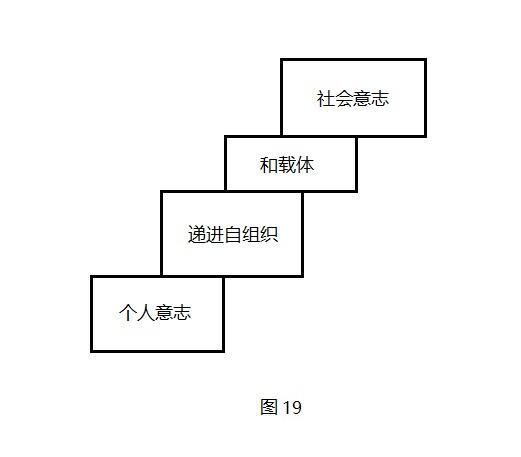
递进自组织将“权力意志”溶入“社会意志”,以“和载体”取代“权组织”,社会从此不再分离为二元,不再需要通过“压力”和“强力”才能调整或更换权力,第八章图 13 的模型将变成如下的图 19。
Recursive self-organization integrates "power will" into "societal will," replacing "power organizations" with "sum carriers". This eliminates the division of society into a dualistic society. There is no longer a need for adjustments or replacements of power through "pressure" and "force". The model, as shown in Figure 13 of Chapter 8, transforms into the following representation, as illustrated in Figure 19.
在图13中看到,“社会意志”与“社会意志实现”之间隔着诸多环节,“权力意志”是主要的障碍。而在图19中,已经没有“社会意志”与“社会意志实现”的区分。或者说,在“社会意志”与“社会意志实现”之间已经不再有任何障碍,只要“社会意志”形成,就意味必定实现。
In Figure 13, we can see that there are many links between "societal will" and "the realization of societal will," with "power will" being the main obstacle. However, in Figure 19, there is no longer a distinction between "societal will" and "the realization of societal will." One could say that there are no longer any obstacles between "societal will" and its realization. Once "societal will" is formed, it implies inevitable implementation.
图19所表达的,“个人意志”通过“递进自组织”产生“和载体”形成“社会意志”,四个元素可被视为是完整的一体,中间没有任何断裂,也不需要联系管道,每个部分的结合都是全方位的,因此图形不用通常那种分开的框与线。用了目前这种阶梯形式,也只是为了取与本文相合的“递进”意象,而非说明它们之间有什么分隔和错位。那将是最为简洁、灵敏、有效与和平的社会结构。
What Figure 19 conveys is that "individual will," through "recursive self-organization", generates the "sum carrier", forming the "societal will". The four elements can be considered a complete unity, with no fractures in between, and there is no need for connecting pipelines. The combination of each part is all-encompassing, so the diagram does not use the usual separate boxes and lines. The current stepped form is only used to convey the "recursive" imagery in line with this text, rather than indicating any separation or misalignment between them. This would be the most concise, agile, effective, and peaceful societal structure.
政治制度有如承载社会的车,社会意志是其应有的行驶路线。二元结构的政治之车虽在大方向上不能脱离社会意志,但是恰好的状态不多,总是左摇右摆,甚至落沟或撞崖。
The political system is like a vehicle carrying society, and the societal will is its intended route. The dualistic structure of the political vehicle, while not completely deviating from the societal will in the general direction, has limited ideal states. It often sways from left to right, and may even end up in a ditch or collide with a cliff.
专制政治之车的方向盘操于当权者之手,其他人被隔离在乘客区不能过问,只有在事故频仍,撞得头破血流后,忍无可忍的乘客打破隔离,才能换上新司机,随即又会被隔离,进入下轮循环。
The steering wheel of the authoritarian political vehicle is controlled by those in power, while others are isolated in the passenger compartment and cannot intervene. Only when accidents occur frequently and passengers are injured, do the passengers who can no longer tolerate the situation break the isolation to replace the driver. However, they are soon isolated again, entering the next cycle.
代议制让乘客定期推举司机,也能对司机评头论足,但是选上的司机不一定合适,或者坐上司机之位就变得任性,不到下次选举仍难更换。好在不用冒车毁人亡的风险暴动,虽然有滞后,可以等到推举新司机后再修正偏离。
The representative democracy allows passengers to regularly elect drivers and criticize their performance. However, the elected driver may not be suitable or may become arbitrary once in office, making it difficult to replace until the next election. Fortunately, there is no need to risk riots with the potential for destruction and casualties. Although there may be a delay, corrections can be made after electing a new driver.
根本的解决是换上一辆由社会意志直接控制的自动车。如科幻作品描写的意念驾驶,社会意志怎么想,车就怎么开。递进自组织的“和载体”相当于社会意志的“意念”,其对社会意志的体现便相当于对社会之车的驾驶。社会意志是社会之车的行驶路线,而社会之车又由社会意志控制,形成完美的自洽。
The fundamental solution is to replace the vehicle with a self-driving car directly controlled by the will of the society. Similar to the concept of thought-driven vehicles depicted in science fiction, the car operates based on how the societal will envisions it. The "sum carrier" in the recursive self-organization serves as the "thought" of societal will, reflecting its manifestation in guiding the societal vehicle. Societal will defines the course of the societal vehicle, creating a perfect and self-consistent system where the societal vehicle is controlled by the societal will.
本文除递进自组织之外未涉及诸如国家形式、经济制度、所有权、财富分配、社会福利、教育、军队等方面的构建,原因在于递进自组织不是一种目标,更不是乌托邦。乌托邦构建的是理想社会或终极状态,递进自组织只是一种方法,或者说是达到理想的手段。乌托邦是事先选定的目的地,递进自组织只是驶向未来的车。目的地是什么,不由车决定,也不会有终极目标。然而只要有了这辆自动车,社会所需的其他方面便会自然形成,且会随发展自然变化,社会始终平顺无阻地按照社会意志驶向未来。
The text does not delve into the construction of aspects such as the form of the state, economic systems, ownership, wealth distribution, societal welfare, education, military, etc., other than recursive self-organization. The reason is that recursive self-organization is not a goal, and certainly not a utopia. Utopia constructs an ideal society or ultimate state, while recursive self-organization is merely a method or a means to achieve the ideal. Utopia is a predetermined destination, whereas recursive self-organization is the vehicle heading towards the future. The destination is not determined by the vehicle and does not have a final goal. However, once this self-driving vehicle is in place, other aspects required by society will naturally form and evolve with development, allowing society to smoothly and unhinderedly move towards the future according to the societal will.
(完)(ENDS)